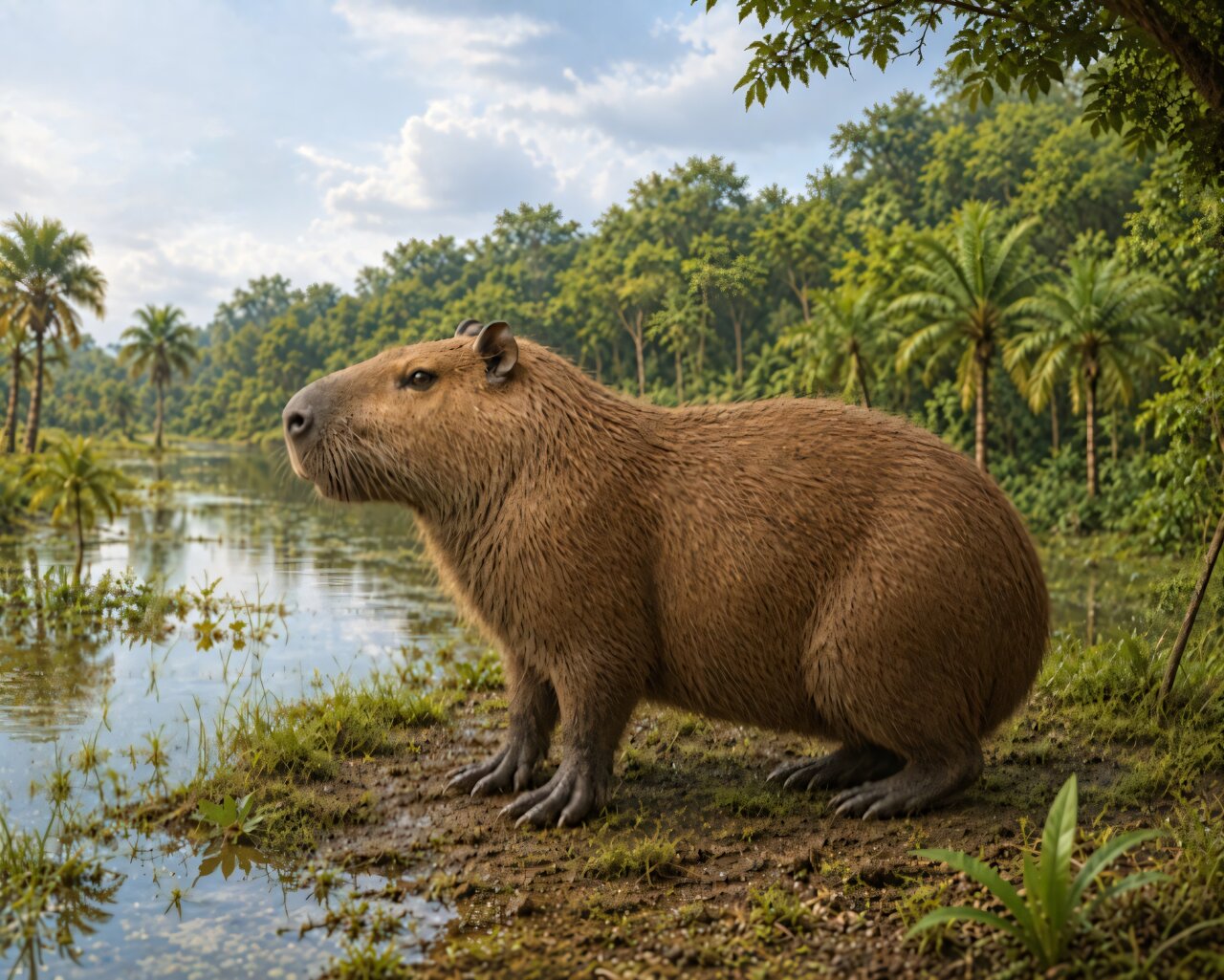
Fossil teeth discovered in a coal mine in southern Thailand belong to a previously unknown rodent that may have weighed around 30 kilograms (66 pounds)—roughly twice the size of other rodents known from the same period. The discovery suggests that the evolution of giant rodents began earlier and across a wider geographic area than scientists had previously recognized.
The animal, named Yakamys sirindhornae, lived about 34 million years ago. Its fossils were found at Bang Mark Pit in the Krabi lignite mine in southern Thailand, where researchers recovered a lower molar and a lower incisor.
Although only two teeth have been identified, their dimensions were enough to estimate the animal’s size and distinguish it as a new species. The findings also point to Southeast Asia as an important region in the early evolution of unusually large rodents, a history previously associated largely with South America.
An unusually large rodent for its time
Today, the capybara holds the title of the world’s largest living rodent. But large rodents have appeared at different points in evolutionary history, and the new Thai fossils suggest that some of those early developments occurred much farther back than previously recognized.
The research team estimated Yakamys‘ body mass using seven established methods based on the dimensions of its teeth. The estimates put the rodent at approximately 30 kilograms—about twice the size of other rodents known from the same period, including Hulgana.
That would have made Yakamys exceptionally large among its contemporaries. However, the estimate is not a precise measurement, particularly because researchers have only a small amount of fossil material to work with.
“This is only a ballpark figure, as there is substantial uncertainty associated with fossil body-mass estimation,” Millien said.
The limited remains also make it difficult to reconstruct how the animal lived, what it ate or how it evolved. Teeth can provide useful clues about an extinct animal’s identity and size, but without more of its skeleton, many details of its biology remain unknown.
Southeast Asia’s place in the evolution of giant rodents
Large-bodied rodents evolved repeatedly over time, with many of the best-known examples coming from South America. The Thai fossils suggest that Southeast Asia may also have been an important setting for the early evolution of rodent gigantism.
“Today, the largest living rodent is the capybara, but very large rodents are not restricted to recent ecosystems,” said Virginie Millien, study co-author and professor of biology at McGill University. “Giant rodents evolved repeatedly during the later history of the group, mostly in South America. This discovery suggests that Southeast Asia also played an important role in the early evolutionary history of large-bodied rodents.”
The discovery does not establish precisely when or why Yakamys evolved its large body size, nor does it reveal whether gigantism developed in the region through a particular evolutionary pathway. It does add evidence that large rodents were present in Southeast Asia tens of millions of years ago, expanding the known geographic record of their evolution.
The genus name Yakamys combines the Thai word “yak,” meaning giant, with the Greek “mys,” meaning mouse or rat. The species name sirindhornae honors Princess Maha Chakri Sirindhorn for her longstanding support of science and paleontological research in Thailand.
The fossils were uncovered through a collaborative project studying fossil mammals in Thailand’s Krabi Basin, involving McGill University, Thailand’s Department of Mineral Resources and French research institutions, including CNRS and Université de Poitiers.
Further fossil discoveries will be needed to establish how Yakamys lived, what drove its large size and how it fits into the evolutionary history of rodents in Southeast Asia.
The study was published in Scientific Reports.