Astronomers have witnessed an unusual stellar merger in which a star smaller than the Sun spiraled into the core of a much larger supergiant on the outskirts of the Andromeda galaxy. The resulting object, nicknamed Bao, was caught during its dramatic brightening in 2025, giving scientists an unusually detailed record of how two stars became one. Observations from NASA’s James Webb Space Telescope, taken just 47 days after the eruption peaked, helped confirm that the smaller star had been swallowed.
Stellar mergers are notoriously difficult to observe as they happen. Astronomers often have to reconstruct these events long after they occur, using the material left behind. Bao was different: Researchers noticed unusual changes in the system in 2023 and continued monitoring it until it erupted in October 2025.
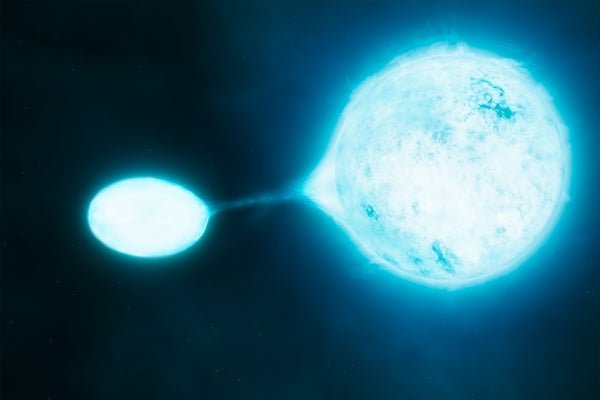
The event began with two stars orbiting one another. The larger star eventually engulfed its smaller companion, which spiraled inward through the giant’s outer layers before reaching its core.
The observations offer an unusually close look at a process called common envelope evolution, an important but poorly understood stage in the lives of some binary stars.
How one star swallowed its companion
Before the merger, the two stars had spent millennia orbiting each other. Their transformation into a single object, however, happened relatively quickly once the smaller star began interacting with the larger star’s outer surface.
The researchers believe the pair completed only seven orbits, spanning about seven years, between the beginning of this interaction and their merger. That is striking compared with other observed binary mergers involving two smaller stars, which occurred after thousands of orbits.
As the smaller companion approached the larger star, it began disturbing and stripping away the giant’s outer layers. Gas released during this process flowed into the surrounding space.
The interaction gradually intensified. As the smaller star moved through the giant’s expanding envelope, drag slowed its orbital motion and robbed it of energy. It consequently spiraled deeper into the larger star.
This stage is known as common envelope evolution because both stars become surrounded by a shared layer of gas.
“When a companion star begins to interact with the outer surface of the primary star, it produces a subtle effect—a slow brightening, which we clearly saw in Bao’s data,” said co-author Kishalay De, an assistant professor at Columbia University in New York. “As the companion continues its orbit, it keeps peeling off the primary star’s outer layers, and that gas flows away into the surrounding space.”
The process does not always end with a merger. In some binary systems, both stars survive after losing substantial amounts of mass, remaining together in much tighter orbits. Such systems can eventually produce neutron stars or black holes, trigger supernova explosions or generate gravitational waves, which are ripples in space-time.
In Bao’s case, however, the smaller star did not survive.
Webb helped reconstruct the collision
The researchers combined observations from several telescopes covering ultraviolet, visible and infrared wavelengths to follow the system’s changing behavior.
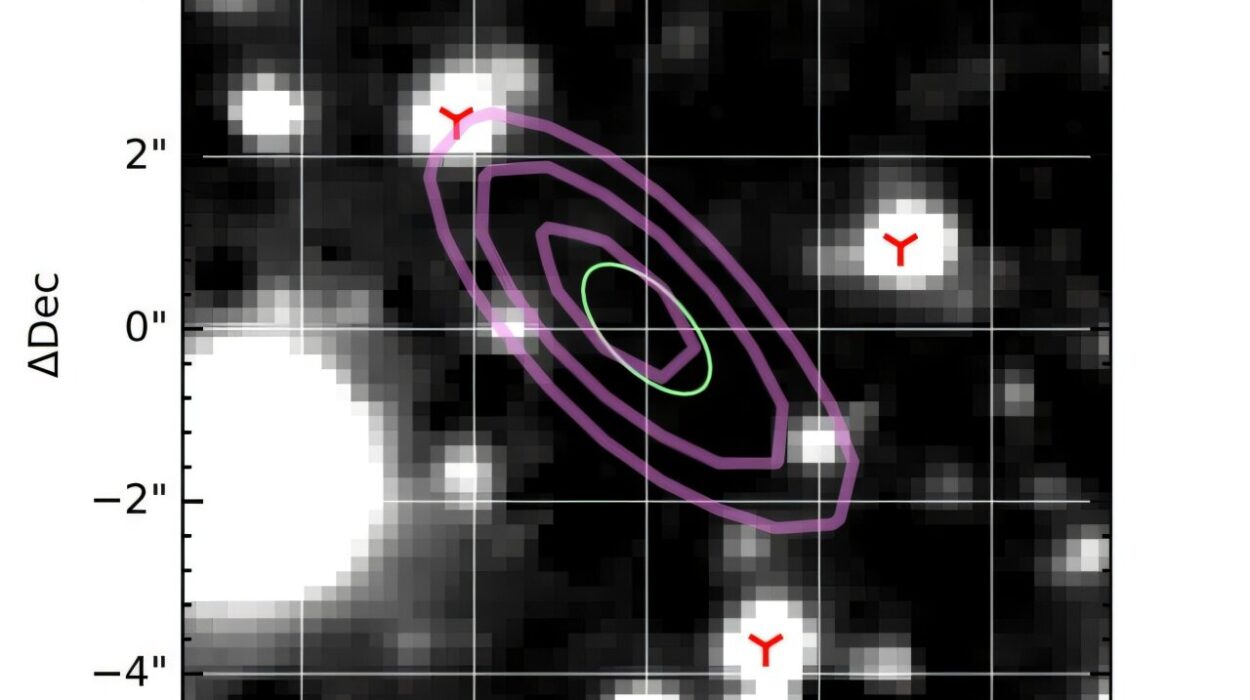
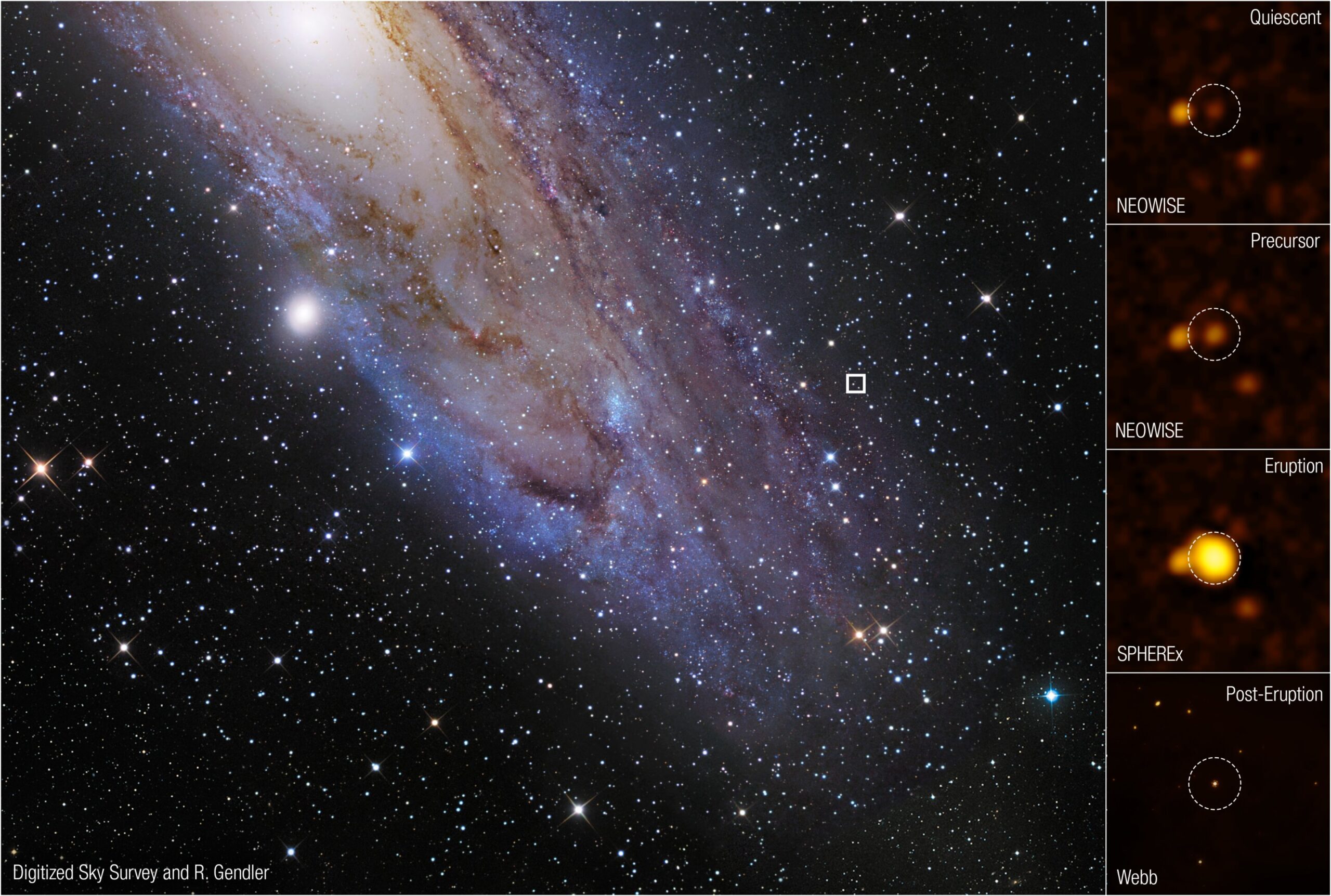
Bao first attracted their attention in February 2023, when data from NASA’s retired NEOWISE mission revealed an unusual variable star. Before 2018, the object had maintained a consistent luminosity, or total energy output.
By September 2024, observations from the Wide-field Infrared Transient Explorer showed that the system was brightening and releasing dust.
Further changes appeared in July 2025, when NASA’s SPHEREx mission detected a rapid fading in visible light alongside increasing infrared brightness. These changes suggested that something unusual was happening around the stars.
The eruption was detected on October 17, 2025, by the Zwicky Transient Facility, which recorded a rapid increase in brightness as the system heated up.
In November, researchers obtained additional observations from NASA’s Neil Gehrels Swift Observatory and the Gemini North telescope in Hawaii. Webb then observed the system on December 24, just 47 days after the eruption reached its peak.
That rapid follow-up was particularly valuable. Webb’s mid-infrared measurements allowed the team to examine dust released by the larger star over centuries and compare the observations with computer simulations of the merger.
“Stellar mergers are very, very difficult to observe in real time because they are hard to predict,” said Viraj Karambelkar, the first author of a new paper published in Nature and a NASA Hubble Fellow at Columbia University in New York. “However, we noticed something unusual was going on in 2023 and continued to monitor the system to see what it would do. Then, in 2025, it erupted.
“Webb observed Bao only 47 days after the stars’ eruption peaked, the earliest-ever follow-up of an event like this. The telescope’s data helped us characterize what the system looked like before, during and immediately after the merger, which is absolutely mind-blowing.”
The size difference between Big Bao and Little Bao
By comparing their observations with simulations, the researchers reconstructed the properties of the two stars before they merged.
The larger star, nicknamed Big Bao, was estimated to have been about seven times as massive as the Sun, with a radius 350 times larger and a brightness roughly 18,000 times greater.
“It was an absolute beast of a star, completely outshining its companion in the data,” said co-author Karel Temmink, a Ph.D. student at Radboud University in Nijmegen, Netherlands, who led the simulations.
The smaller companion, Little Bao, was estimated to have had about 0.7 times the Sun’s mass. It also had a slightly smaller radius and was fainter than the Sun.
These calculations provided the first mass estimate for the smaller star, which was no longer independently visible after the merger.
Initially, the researchers considered whether some of the energy released during the encounter might have allowed Little Bao to escape. Further analysis, however, indicated that the companion had been dragged all the way into Big Bao’s core.
“Their encounter was “almost like a bomb exploding inside a living star,” De said.
The resulting object is now known simply as Bao. Its eventual size and structure remain uncertain, and astronomers will need further observations to determine how it settles after the merger.
A new way to study stellar mergers
One of the most important aspects of Bao is that astronomers were able to follow the process while it was happening rather than reconstructing it from an ancient remnant.
By combining Webb’s infrared measurements with observations from other telescopes, the team could estimate how much material the larger star expelled and investigate how efficiently orbital energy was transferred during common envelope evolution.
Understanding this process matters because it helps explain how some binary systems develop into much more compact pairs. Depending on whether both stars survive, their eventual evolution can lead to objects and events including black holes, neutron stars, supernovae and gravitational waves.
The researchers’ approach could become increasingly useful as NASA’s Nancy Grace Roman Space Telescope begins conducting large-scale surveys. Its Galactic Bulge Time-Domain Survey is expected to identify many transient events, including short-lived changes in astronomical objects that can reveal otherwise difficult-to-observe processes.
“There’s going to be a large influx of similar discoveries just ahead,” Karambelkar said.
Bao provides an opportunity to test models of stellar mergers against observations collected during the event itself. Future discoveries could help astronomers determine whether the process seen in this system is typical of common envelope evolution or reflects a less common outcome.
The research was published in Nature.