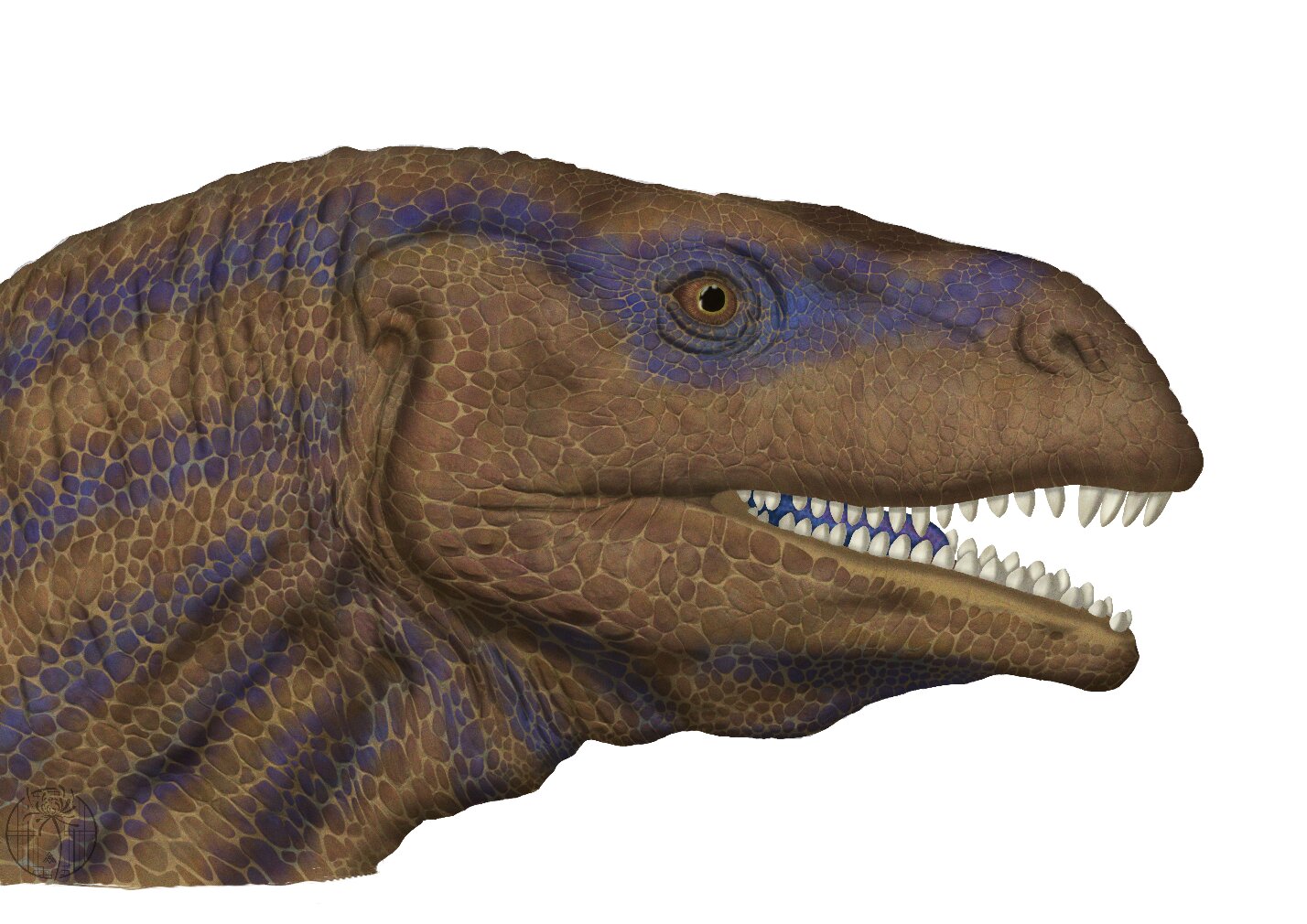
A dinosaur that lived more than 200 million years ago was already about 400 kilograms (880 pounds) despite being only a few years old. Named Nyana rooiwalensis, the newly identified species belonged to an early dinosaur group that eventually gave rise to some of the largest land animals ever to walk the Earth. Its fossilized skull and limb bones are now helping scientists investigate how these dinosaurs grew and diversified.
The fossils were discovered in South Africa and include a near-complete skull along with several other bones. Although the remains do not represent a complete skeleton, they preserve enough anatomical detail to identify the animal as a previously unknown species.
Nyana belonged to the sauropodomorphs, a group of early dinosaurs whose descendants eventually included familiar giants such as Brachiosaurus and Diplodocus. These later dinosaurs were known for their enormous bodies and long necks, but their early relatives looked quite different.
The new species lived during the Late Triassic, when sauropodomorphs were still evolving and diversifying. Fossil skulls from this early period are relatively uncommon, particularly in southern Africa, making the discovery valuable for understanding the group’s early history.
A skull that helps place an early dinosaur on the family tree
To work out where Nyana belonged among other dinosaurs, researchers led by Atashni Moopen of South Africa’s University of the Witwatersrand used powerful X-rays to examine its skull.
The scans allowed them to build a detailed three-dimensional model, which they compared with skull features from other sauropodomorphs. This helped the team determine the animal’s evolutionary relationships and distinguish it from previously known species.
The researchers also turned to the dinosaur’s limb bones for clues about its age. They examined thin slices of bone under a microscope, looking at internal growth patterns that can reveal how an animal developed.
Their analysis indicated that Nyana was still growing rapidly when it died. Despite its estimated weight of about 400 kilograms, the dinosaur had reached at least its third year of growth and was nowhere near its full adult size.
That makes its estimated future size particularly interesting. The team calculated its body mass by measuring the circumference of its thigh bone and comparing the result with growth curves developed from related dinosaurs.
The researchers believe the animal could have become much heavier as it matured. “Extrapolation of these growth curves suggests that adult Nyana may have reached multi-tonne body masses,” wrote the study authors in their paper.
This is an estimate of its potential adult size, not a measurement from a fully grown fossil. Nevertheless, it suggests that substantial body size and rapid growth were already features of some sauropodomorphs early in their evolutionary history.
What the fossils reveal about dinosaur evolution
The importance of Nyana extends beyond its own size. Its skull provides additional anatomical information about early sauropodomorphs, particularly a subgroup called massopodans.
Such details matter because scientists use differences in skeletal structures to reconstruct evolutionary relationships. Adding a previously unknown species to the fossil record can help refine those reconstructions and clarify how early dinosaur groups were related.
The discovery may also have implications for understanding where these dinosaurs lived and how they spread. The researchers point to a possible previously unrecognized biogeographical connection between southern Africa and North America.
That connection remains a suggestion for future investigation rather than a settled explanation of how the dinosaurs moved between regions. More fossil evidence and comparisons will be needed to establish the nature of the relationship.
The findings also support the idea that rapid growth strategies appeared early in sauropodomorph evolution. Nyana was already a large animal while still relatively young, suggesting that fast growth was not simply a feature that emerged later among the group’s enormous descendants.
A near-complete skull and a handful of bones cannot answer every question about this dinosaur. But they provide important evidence about its anatomy, development and place in dinosaur evolution.
The research was published in Royal Society Open Science.