A phosphate bed in Egypt’s Western Desert has yielded 14 fossil shark teeth that point to a surprisingly diverse shark community in a tropical sea that covered the region during the Late Cretaceous. The teeth represent at least five extinct lamniform shark species, including three with particularly notable records in Egypt and Africa.
Between about 145 million and 66 million years ago, the area that is now Egypt’s Western Desert was beneath a warm tropical sea. The Abu-Tartur Plateau, in the southern part of the desert, contains extensive phosphate deposits formed under ancient marine conditions. Organic-rich sediments accumulated there and eventually became thick phosphorite beds.
The Duwi Formation, which extends across Egypt and includes the Abu-Tartur Plateau, has already produced fossils of fish, sea turtles and marine reptiles. Earlier work by the same research team had also identified fossil teeth belonging to two kinds of lamniform sharks, a group also known as mackerel sharks.
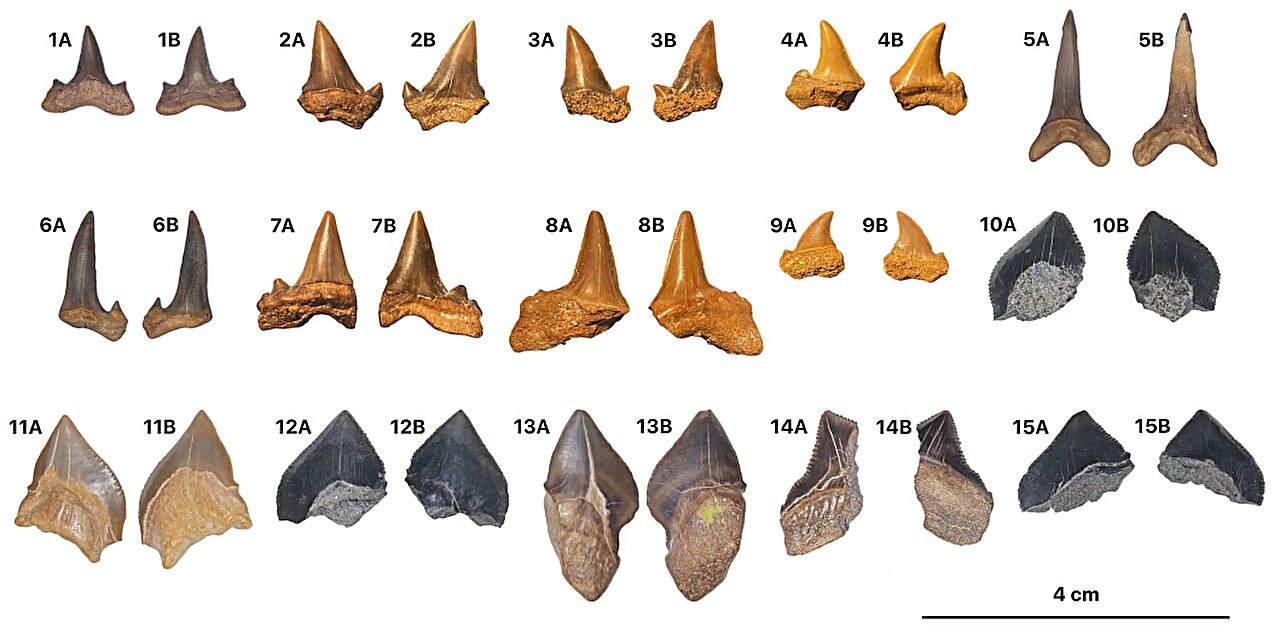
The researchers returned to the area to look for more evidence of sharks in this ancient marine environment. They collected 14 additional fossil teeth from a phosphate bed in the Abu-Tartur mine area.
The teeth varied considerably in shape. Some were needle-like, while others were triangular with serrated edges. Their colors ranged from dark brown to yellow. The researchers identified them by comparing their shapes and other features with published fossil records and specimens held in museums.
Three shark records stand out
The 14 teeth represented at least five additional extinct lamniform shark species. That brings the number of shark species known from the Abu-Tartur region to seven.
Two of the species, Serratolamna serrata and Squalicorax bassanii, had not previously been reported from Egypt.
A third species, Scapanorhynchus raphiodon, is especially notable because it is an ancient relative of the modern goblin shark. The species had not previously been reported anywhere in Africa. The fossils may also represent the youngest known occurrence of Scapanorhynchus raphiodon in the fossil record.
That last possibility remains uncertain. The researchers note that additional specimens and future taxonomic work are needed to confirm whether the Abu-Tartur material truly represents the youngest known occurrence of the species.
The phosphate bed records more than one habitat
The variety of sharks is consistent with an environment rich in nutrients, which the researchers say likely supported a food web extending from small fish to large predators.
But the fossil bed does not necessarily represent a snapshot of the ecosystem at one particular moment.
Because the phosphate deposit formed during periods when sediment accumulated slowly while biological material continued to enter the environment, fossils could have accumulated over time. As a result, remains from different habitats and ecological niches may have become mixed together in the same deposit.
The researchers therefore interpret the shark assemblage as evidence of a nutrient-rich, highly productive marine ecosystem along a phosphate-forming shelf margin during the Late Cretaceous, while recognizing that the fossils may represent organisms from different ecological settings and periods of time.
The study was published in Cretaceous Research.