About 165 million years ago, relatives of today’s crickets and katydids may have produced a surprisingly varied mix of sounds, including calls above the range of human hearing. Fossil wings from Inner Mongolia are allowing scientists to reconstruct what part of that Jurassic soundscape may have sounded like.
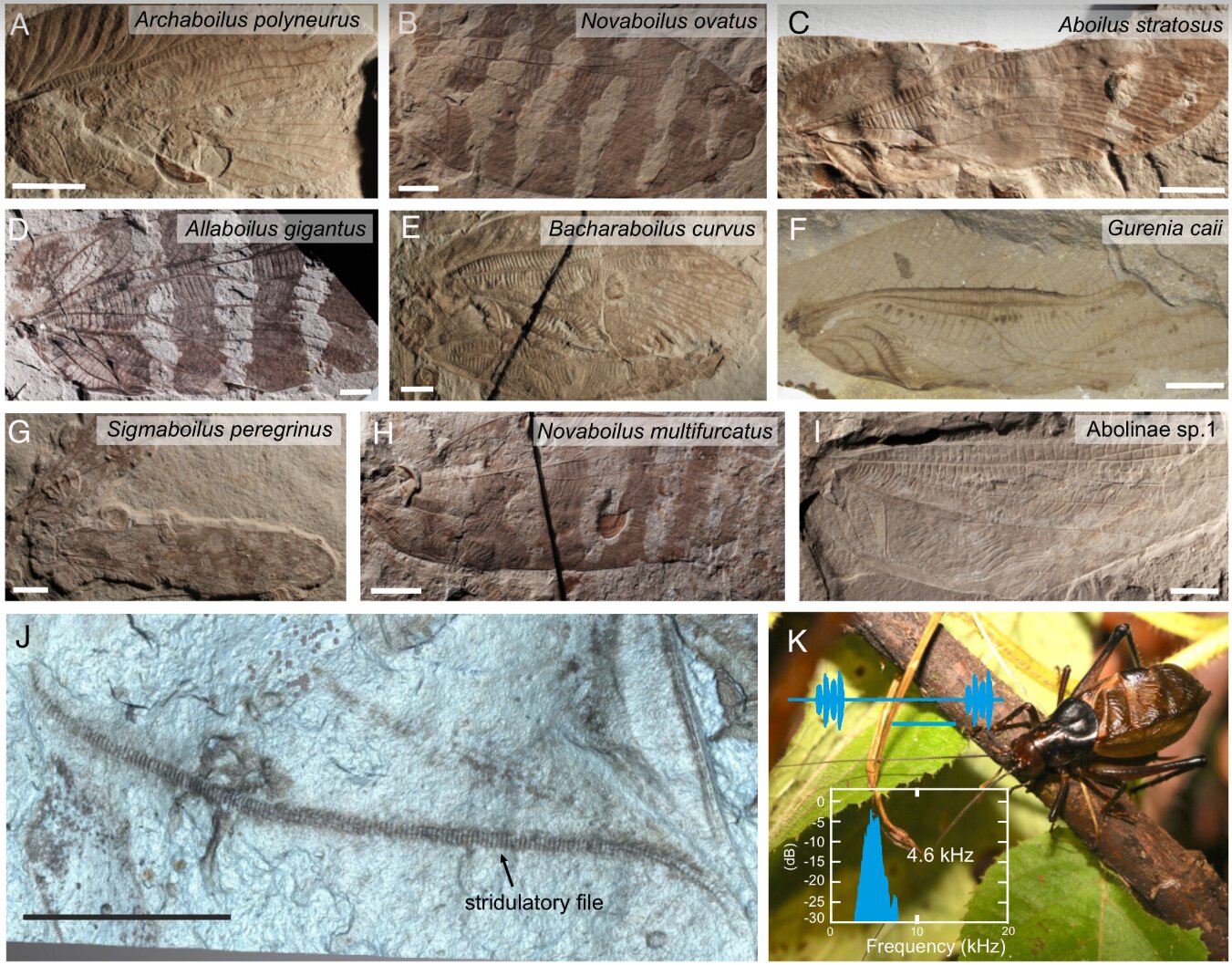
The evidence comes from 20 fossilized wings belonging to nine species of katydid relatives found in Inner Mongolia, China. The fossils date to the Middle Jurassic, about 165 million years ago.
The researchers focused on tiny, tooth-like ridges preserved on the wings. In these insects, a scraper on one wing can rub across those ridges on the other, producing sound. The spacing of the ridges and the size of the part of the wing that vibrates affect the resulting sound.
The team measured these structures across all 20 fossil wings. They combined those measurements with information from living insects and the evolutionary relationships among the species. Computer models were then used to estimate the frequency and basic structure of the ancient calls.
A machine-learning model estimated how frequently the insects likely called, allowing the researchers to construct a hypothetical Jurassic acoustic landscape.
The reconstructed calls were not all alike. The researchers reported evidence for pure tones, a range of different signals and, in some cases, ultrasonic calls.
Some calls may have reached ultrasonic frequencies
Many of the species examined appear to have produced pure-tone calls at about 5 kilohertz, a pitch similar to that of some living crickets.
One species, Sigmaboilus peregrinus, appears to have been different. Its reconstructed call reached above 20 kilohertz, into the ultrasonic range.
That finding bears on a longstanding idea about how ultrasonic communication evolved in katydids. Bats are often proposed as a force that drove the development of ultrasonic signals. But the fossil evidence places these high-frequency calls in katydid relatives from roughly 165 million years ago.
The researchers therefore rejected the idea that bats were the sole driver of ultrasound evolution in katydids.
Different sounds may have helped the insects avoid predators
The researchers suggest that the variety of calls may have been useful in a Jurassic environment containing early mammals and other predators with sensitive hearing.
One possibility is that high-frequency and ultrasonic calls allowed males to attract females nearby while making the insects harder for predators to locate. The researchers also propose that using different frequencies could have helped keep calls from different species from masking one another in the same forest.
These explanations are interpretations of the reconstructed acoustic signals rather than direct observations of how the extinct insects behaved.
The study was published in Proceedings of the National Academy of Sciences.