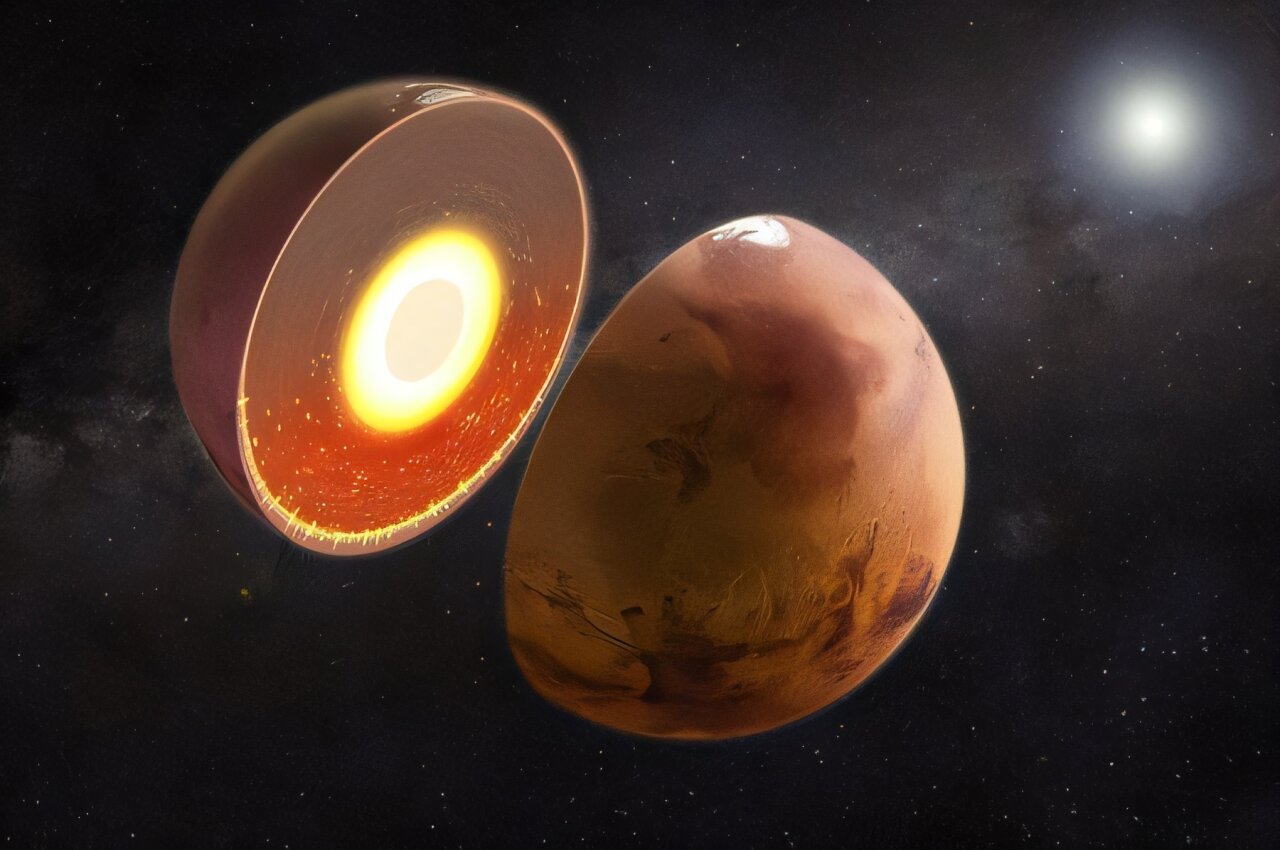
Mars’ southern hemisphere is not only different from the north at the surface. Its interior also appears to be hundreds of degrees hotter, with evidence that part of the region is molten.
The finding comes from a new analysis of Mars’ gravitational field, which allowed researchers to investigate the planet’s interior structure. The study indicates that the southern interior is about 200 to 400 degrees Celsius warmer than the northern half.
The research was led by Alexander Berne, a Caltech alumnus who is now a postdoctoral associate at the University of Arizona. His team used measurements gathered over decades by three Mars spacecraft to build a model of the planet’s interior.
Gravity reveals differences beneath Mars
The researchers examined data from Mars Global Surveyor, Mars Odyssey and Mars Reconnaissance Orbiter. Instead of directly observing deep beneath the surface, they tracked tiny changes in the spacecrafts’ velocities caused by variations in Mars’ gravitational field.
Those measurements can reveal how mass is distributed inside the planet.
Berne developed a model during his graduate studies at Caltech that uses changes in gravitational data to infer the internal structure of a planetary body. For Mars, the team used a technique called tidal tomography.
Mars follows a slightly elliptical orbit around the Sun and has a tilted rotation axis. Because of these characteristics, the Sun’s gravitational influence on Mars changes over seasonal timescales. Tidal tomography uses changes in those gravitational signatures over time to construct a model of the planet’s interior.
The approach allowed the researchers to look beyond the assumption that a planet’s interior is roughly the same in every direction.
“Scientists usually assume that the interiors of planetary bodies are generally spherically symmetric, but this is not necessarily true,” Berne says.
The southern interior is much hotter
Mars already has a pronounced difference between its two hemispheres at the surface. The south contains towering mountains and deep craters, while the north consists largely of low-lying flatlands.
The new analysis indicates that the difference continues deep underground, but in a different form. The southern interior is roughly 200 to 400 degrees Celsius hotter than the northern interior and is partially molten.
The thermal difference may also help explain other observations from Mars.
For example, magnetic anomalies have been detected in iron minerals in the planet’s southern hemisphere. The researchers suggest that a thermal anomaly in the southern mantle could mean that a magnetic field once existed that was strong enough to produce magnetic differences between the northern and southern regions.
The result is also consistent with an earlier observation from NASA’s InSight mission. Seismic waves were found to dissipate more quickly in the south. A hotter southern region could explain that difference.
The heat may be linked to Mars’ history
The contrast between Mars’ northern and southern interiors could also provide information about processes that affected water on the planet.
“The dichotomy that we see between north and south is important to understand because it gives information about processes that may have influenced the hydrology of Mars, including the formation of basins that may have held water,” says Amirhossein Bagheri, a postdoctoral scholar at Caltech and a co-author of the paper. Bagheri is also a former member of the InSight team.
The researchers say the new result adds context for understanding Martian history, including periods when the planet may have had conditions favorable for life.
What caused the southern heat?
The source of the thermal difference remains unresolved. The researchers identify several possible explanations.
One possibility is that a giant impact released heat from the northern part of Mars. Another is that spontaneous convection once occurred in the southern mantle. A third possibility is that thick geological features trapped excess heat and prevented it from escaping.
The available evidence does not yet establish which process created the anomaly.
Berne says that increasingly detailed gravity measurements can help reveal the three-dimensional structure of planetary interiors. Such information can also help guide the design of future missions and scientific exploration of planetary bodies.
The study was published in Nature.