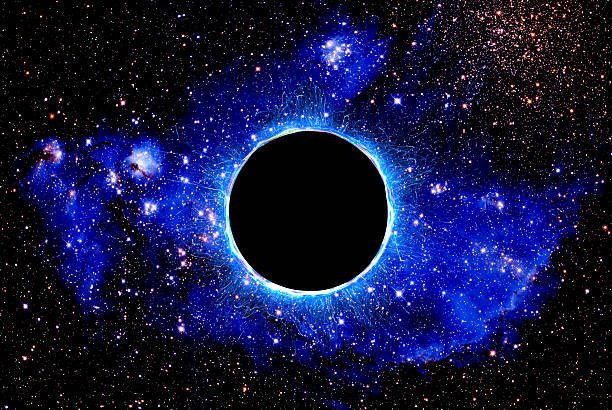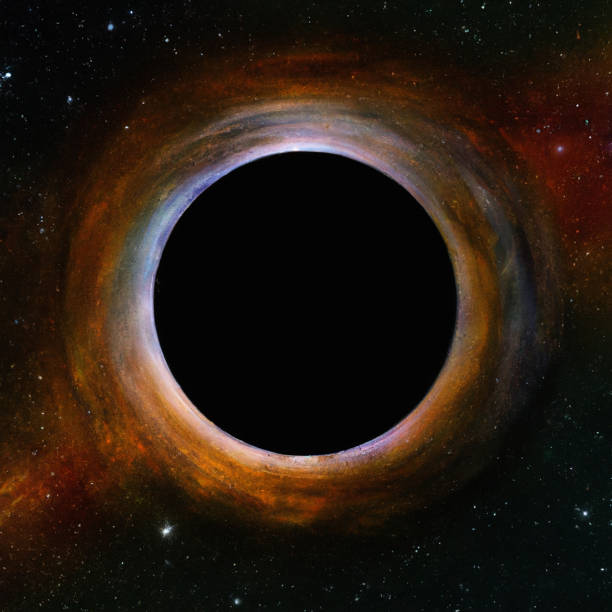
There are places in the universe where the known laws of nature tremble. Regions where light itself cannot escape, where time stretches and twists, and where gravity becomes so overwhelming that it carves a permanent scar into the fabric of spacetime. These places are black holes—cosmic abysses born from the death of massive stars or forged in the early universe’s violent youth. They are not empty voids. They are not cosmic vacuum cleaners roaming space in search of destruction. They are objects of extreme density, astonishing structure, and profound mystery.
Black holes challenge every instinct we have about reality. They are predicted by Einstein’s theory of general relativity, described with precision by mathematics, and now observed directly through gravitational waves and the imaging of their shadows. Yet, for all we know about them, they guard secrets at the deepest level of physics.
Inside black holes lie some of the most profound unanswered questions in science. What happens to matter that falls in? Does information disappear forever? Is there a gateway to another region of spacetime? What truly exists at their core?
In the vast darkness beyond the event horizon, seven cosmic secrets wait. Each one is not merely a puzzle about black holes, but a doorway into the fundamental laws of the universe.
1. The Event Horizon: The Boundary Where Reality Changes
The first secret hidden inside a black hole begins at its surface—not a physical surface of rock or gas, but a mathematical boundary known as the event horizon. The event horizon marks the point of no return. Once crossed, nothing—not even light—can escape back into the wider universe.
To understand the event horizon, imagine gravity so strong that the escape velocity exceeds the speed of light. Since nothing can travel faster than light in a vacuum, escape becomes impossible. The event horizon is the spherical boundary around the black hole where this condition is met.
But the true mystery lies not in the fact that escape is impossible. It lies in how reality behaves near this boundary. To a distant observer, an object falling toward the event horizon appears to slow down, becoming redder and dimmer as time stretches. It never seems to quite cross the boundary. From that vantage point, the object freezes in time.
Yet for the object itself, the journey continues normally. It crosses the event horizon in finite time without noticing anything special at the boundary, at least in the case of sufficiently large black holes where tidal forces at the horizon are not extreme.
This strange disagreement between observers reveals a deep truth about spacetime. Time is not absolute. It flows differently depending on gravity and motion. Near a black hole, time dilation becomes extreme. The event horizon marks the point where our conventional understanding of cause and effect begins to strain.
The secret hidden here is that the event horizon may not be just a boundary in space—it may be a boundary in knowledge. Beyond it, classical physics loses its predictive power. The horizon conceals the internal structure entirely. What happens inside cannot influence the outside universe in any direct way.
Or can it? That question leads to the next secret.
2. The Singularity: Where Physics Breaks Down
At the center of a black hole, according to classical general relativity, lies a singularity—a point of infinite density and zero volume where curvature of spacetime becomes infinite. In simple terms, it is a place where the known laws of physics collapse.
When a massive star exhausts its nuclear fuel, it can no longer support itself against gravity. If its mass is great enough, nothing can stop the inward collapse. Matter compresses beyond neutron degeneracy pressure, beyond any known force that resists compression. The result, in theory, is a singularity.
But infinity in physics is often a sign that a theory is incomplete. Just as classical mechanics failed at atomic scales and required quantum mechanics, general relativity likely fails at the singularity. The true structure at the core of a black hole must involve quantum gravity—a theory not yet fully developed.
Is the singularity truly a point of infinite density? Or is it replaced by some exotic quantum structure, such as a Planck-scale core or a region where spacetime becomes discrete rather than continuous?
This is one of the greatest secrets hidden inside black holes. At the singularity, general relativity and quantum mechanics must merge. Yet the two frameworks are mathematically incompatible in their current forms.
The singularity represents not only the heart of a black hole, but the frontier of theoretical physics. To understand it would mean discovering a unified theory of quantum gravity—perhaps the most profound scientific breakthrough imaginable.
3. The Information Paradox: Does Reality Forget?
One of the deepest mysteries of black holes is not about matter or gravity, but about information.
In quantum mechanics, information is never destroyed. The complete description of a system evolves predictably, even if outcomes appear probabilistic. This principle is fundamental. If information could vanish, the consistency of quantum theory would collapse.
Yet black holes seem to challenge this principle. When matter falls into a black hole, it carries information about its physical state. If the black hole eventually evaporates through a process known as Hawking radiation—a quantum effect predicted by Stephen Hawking—it appears to emit purely thermal radiation, containing no information about what fell in.
If the black hole completely evaporates, where does the information go? Has it been destroyed?
This conflict between general relativity and quantum mechanics is known as the black hole information paradox. Hawking radiation arises because quantum fluctuations near the event horizon allow particle pairs to form. One particle escapes while the other falls inward, leading to gradual loss of mass from the black hole.
For decades, physicists debated whether information is truly lost or somehow encoded in subtle correlations within Hawking radiation. Many now believe that information is preserved, possibly stored on the event horizon itself in accordance with the holographic principle.
The holographic principle suggests that the information content of a volume of space can be described entirely by data on its boundary. If true, a black hole’s event horizon may encode everything that has ever fallen inside it.
The resolution of the information paradox could reveal a new, deeper layer of reality where space itself emerges from quantum information.
4. Spaghettification: The Fate of Matter Inside
As one approaches a black hole, gravity does not pull uniformly. The side of your body closer to the black hole experiences a stronger gravitational pull than the side farther away. This difference is known as tidal force.
Near smaller black holes, tidal forces become extreme even before reaching the event horizon. If a human were to fall toward such a black hole, their body would be stretched lengthwise and compressed sideways in a process dramatically nicknamed spaghettification.
In larger supermassive black holes, such as those found at the centers of galaxies, tidal forces at the event horizon can be relatively mild. An astronaut could cross the event horizon without immediate destruction. But as they move closer to the singularity, tidal forces inevitably increase beyond survivable limits.
The secret hidden here is not merely about physical destruction. It concerns the ultimate fate of matter. At what point does matter lose its familiar structure? When atoms are torn apart, when nuclei disintegrate, when quarks are no longer confined in familiar ways—what remains?
Inside a black hole, matter may be crushed to densities beyond anything else in the universe. Understanding this extreme state could illuminate unknown phases of matter governed by quantum chromodynamics under unimaginable pressures.
Spaghettification is more than a dramatic image. It is a window into the behavior of matter under the most extreme gravitational gradients possible.
5. Wormholes: Gateways or Mathematical Illusions?
Einstein’s equations of general relativity allow for solutions that resemble tunnels connecting distant regions of spacetime. These theoretical structures are known as wormholes.
In principle, certain black hole solutions, such as the maximally extended Schwarzschild solution, suggest the possibility of an Einstein-Rosen bridge—a kind of wormhole linking two separate regions. However, these wormholes are not stable. They pinch off too quickly for anything to traverse them.
Could black holes contain traversable wormholes? Current understanding suggests that maintaining a stable, traversable wormhole would require exotic matter with negative energy density—something not known to exist in sufficient quantities.
Yet quantum effects can produce small negative energy densities under certain conditions. Whether this can stabilize a wormhole remains speculative.
If black holes contain wormhole-like structures, they could connect distant parts of our universe—or even entirely separate universes. While there is no experimental evidence for this, the mathematics leaves the possibility open.
The secret here is not that black holes are proven gateways, but that their geometry hints at deeper connections between space and time. They suggest that spacetime may be more flexible and interconnected than everyday experience implies.
6. The Role of Black Holes in Galaxy Evolution
Black holes are not merely isolated monsters. Supermassive black holes reside at the centers of most galaxies, including our own Milky Way. The one at our galaxy’s center has a mass of about four million times that of the Sun.
Observations reveal a surprising relationship: the mass of a galaxy’s central black hole correlates closely with the mass of the galaxy’s bulge. This suggests a co-evolution. Black holes and galaxies grow together.
As matter spirals into a supermassive black hole, it forms an accretion disk, heating up and emitting enormous amounts of radiation. In active galactic nuclei and quasars, this process can outshine entire galaxies.
These energetic emissions can regulate star formation by heating and expelling gas. Thus, black holes may play a crucial role in shaping the structure and life cycle of galaxies.
The secret hidden here is that black holes, once thought to be purely destructive, are architects of cosmic structure. Without them, galaxies might look very different. They influence the distribution of matter across millions of light-years.
Black holes are not merely endpoints of stellar collapse. They are engines that sculpt the cosmos.
7. Hawking Radiation and the Slow Disappearance
Perhaps the most astonishing secret is that black holes are not entirely black. Due to quantum effects near the event horizon, they emit Hawking radiation and slowly lose mass.
For stellar-mass and supermassive black holes, this evaporation process is extraordinarily slow—far longer than the current age of the universe. But in principle, given enough time, a black hole could completely evaporate.
As it shrinks, its temperature increases, emitting more radiation in the final stages. The ultimate fate of a black hole may be a burst of radiation, leaving behind no classical remnant.
This challenges the notion that black holes are eternal prisons. They may be temporary structures in the long timeline of cosmic evolution.
The secret here is profound. Black holes connect gravity, quantum mechanics, thermodynamics, and information theory. They have entropy proportional to the area of their event horizon, not their volume. This insight reshaped theoretical physics and led to the idea that spacetime itself may have microscopic degrees of freedom.
Hawking radiation suggests that black holes are thermodynamic objects with temperature and entropy. They obey laws analogous to the laws of thermodynamics. This deep connection hints that gravity itself may emerge from statistical principles at a microscopic level.
The Darkness That Illuminates
Black holes are not merely objects in space. They are laboratories of extreme physics. They reveal the limits of our theories and push us toward deeper understanding. Each secret hidden inside them is not just about black holes themselves, but about the foundations of reality.
They challenge our intuitions about time, space, matter, and information. They demand a union of quantum mechanics and general relativity. They influence galaxies and reshape cosmic history. They radiate, evaporate, and possibly encode information on their horizons.
In their darkness lies illumination. In their silence lies revelation. Black holes are not empty voids; they are dense with meaning, dense with unanswered questions, dense with possibility.
The cosmic secrets hidden inside black holes are not locked away forever. With every observation of gravitational waves, with every image of an event horizon’s shadow, with every equation written in pursuit of quantum gravity, humanity inches closer to unlocking them.
And perhaps the greatest secret of all is this: by studying black holes, we are studying the universe at its most extreme—and in doing so, we are discovering the limits and the power of the human mind itself.