Earth often feels stable beneath our feet, a solid and enduring home that seems immune to the passage of time. Mountains appear permanent, oceans eternal, and continents fixed in place. Yet this sense of stability is an illusion shaped by the brevity of human experience. When examined through the lens of deep time, Earth is revealed as a dynamic, restless planet—one that has been continuously reshaped by internal forces, external impacts, chemical transformations, and the evolving presence of life itself. Over billions of years, Earth has changed so profoundly that its earliest form would be nearly unrecognizable today.
These changes are not speculative or philosophical ideas. They are supported by multiple, independent lines of scientific evidence, each rooted in physics, chemistry, geology, and biology. Together, they form a coherent and compelling narrative of a planet in constant motion. The following six scientific proofs demonstrate, with remarkable clarity, how Earth has transformed over immense spans of time and why this transformation is one of the most powerful stories science has ever uncovered.
1. Radiometric Dating Reveals the Immense Age and Evolution of Earth
One of the most direct and reliable proofs that Earth has changed over billions of years comes from radiometric dating, a technique grounded in nuclear physics. Atoms of certain elements are unstable and naturally decay into other elements at predictable rates. These rates, known as half-lives, are constant and unaffected by temperature, pressure, or chemical environment. This makes radioactive decay an extraordinarily precise natural clock.
When Earth formed, its rocks incorporated radioactive isotopes such as uranium, thorium, and potassium. Over time, these isotopes began to decay into stable daughter products, such as lead or argon. By measuring the ratio between parent and daughter isotopes in a rock sample, scientists can calculate how long that decay has been occurring. The result is an age measurement that can extend back billions of years.
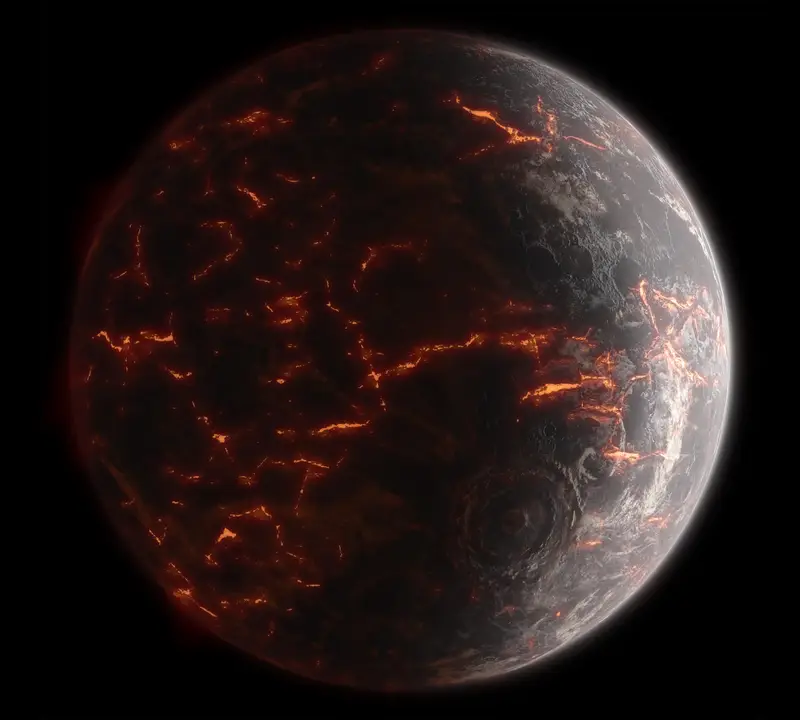
Radiometric dating has revealed that Earth is approximately 4.54 billion years old. More importantly, it has shown that rocks from different periods of Earth’s history record different conditions. The oldest minerals, tiny zircon crystals found in ancient rocks, indicate that Earth cooled from a molten state relatively early in its history. Younger rocks preserve evidence of volcanic activity, shifting continents, changing atmospheres, and evolving oceans.
This method does more than assign dates. It establishes a timeline of transformation. It shows that Earth did not form in its current state, but passed through distinct phases: a fiery beginning, a gradual cooling, the formation of a crust, the emergence of oceans, and the slow stabilization of surface conditions. Radiometric dating anchors Earth’s story in measurable time, turning deep history from speculation into quantifiable reality.
2. The Rock Record Preserves Layers of Planetary Change
Earth’s surface acts like a vast archive, storing its history in layers of rock. This stratification provides one of the most visually striking proofs that Earth has changed dramatically over time. Sedimentary rocks form when particles settle out of water or air, accumulating layer upon layer. Each layer captures the environmental conditions present at the time of its formation.
When geologists examine rock layers, they find orderly sequences that reflect changing environments. Marine sediments appear high in mountain ranges, indicating that these regions were once submerged beneath ancient seas. Desert sandstones, with their distinctive cross-bedding patterns, appear in places now covered by forests or ice. Coal beds reveal the presence of long-vanished swampy ecosystems that once thrived in warm, humid climates.
Even more compelling is the global consistency of these layers. Similar rock sequences appear on different continents, allowing scientists to correlate events across vast distances. A layer rich in volcanic ash, for example, may appear in multiple regions, marking a massive eruption that altered Earth’s atmosphere and climate.
The rock record also preserves evidence of catastrophic change. Certain boundaries between layers show abrupt shifts in fossil content, chemical composition, and mineral structure. These boundaries point to events such as asteroid impacts, massive volcanic eruptions, or rapid climate transitions. Far from being static, Earth’s surface has been repeatedly disrupted and rebuilt.
The emotional power of the rock record lies in its quiet persistence. Each layer represents countless years of deposition, compression, and transformation. Together, they form a physical memory of Earth’s changing face, written not in words, but in stone.
3. Fossils Document the Evolution of Life and Environments
Fossils provide one of the most compelling and intuitive proofs that Earth has changed over billions of years. They are the preserved remains or traces of ancient life, embedded within rocks that formed under specific environmental conditions. By studying fossils, scientists can reconstruct not only the history of life, but also the changing nature of Earth’s surface, atmosphere, and climate.
The fossil record reveals a clear progression of life forms over time. The oldest fossils consist of simple, microscopic organisms, preserved in rocks more than three billion years old. These early life forms lived in oceans that lacked oxygen, reflecting an atmosphere very different from today’s. As time progresses, fossils show increasing complexity: multicellular organisms, marine animals with shells, plants colonizing land, and eventually vertebrates capable of walking, flying, and thinking.
This progression is not random. Fossils appear in a consistent order worldwide, matching predictions made by evolutionary theory. Certain organisms appear, flourish, and then disappear, often coinciding with major environmental changes. Mass extinctions recorded in the fossil record mark periods when Earth’s conditions shifted so dramatically that large portions of life could not survive.
Fossils also reveal changes in climate and geography. The presence of tropical plant fossils in regions now near the poles indicates that Earth’s climate has undergone extreme shifts. Marine fossils found far inland testify to the rise and fall of ancient seas. Even footprints and burrows preserved in stone capture moments of interaction between life and environment long vanished.
The fossil record transforms abstract time into something deeply human. It reminds us that Earth was once ruled by creatures utterly unlike anything alive today, and that the world we inherit is the result of countless experiments in life, most of which ended in extinction. Change is not the exception in Earth’s history; it is the rule.
4. Plate Tectonics Explains the Movement of Continents and Oceans
One of the most revolutionary discoveries in Earth science is the theory of plate tectonics, which explains how Earth’s surface is continuously reshaped by the movement of massive rigid plates floating atop a semi-fluid mantle. This theory provides a powerful, unifying explanation for earthquakes, volcanoes, mountain ranges, and the shifting positions of continents over geological time.
Evidence for plate tectonics comes from multiple independent sources. The shapes of continents suggest that they were once joined together, most notably the complementary coastlines of South America and Africa. Identical rock formations and fossil species found on widely separated continents further support this idea. These similarities are best explained by continental drift, the slow movement of landmasses across Earth’s surface.
The ocean floor offers even stronger proof. Mapping of mid-ocean ridges reveals sites where new crust is constantly being created as molten material rises from below. Magnetic patterns preserved in oceanic rocks record reversals in Earth’s magnetic field, forming symmetrical stripes on either side of these ridges. This pattern demonstrates that ocean floors are spreading outward, pushing continents apart.
Plate tectonics shows that Earth’s geography is temporary. Continents collide to form mountain ranges, then erode and split apart. Oceans open and close. Supercontinents assemble and fragment over cycles lasting hundreds of millions of years. These movements profoundly influence climate, ocean circulation, and biological evolution.
The realization that continents move transforms our understanding of Earth from a static stage into an active participant in its own story. The ground beneath us is not fixed; it is drifting, folding, and recycling itself over time scales far beyond human perception.
5. Ice Cores and Climate Records Reveal a Changing Atmosphere
Earth’s climate has never been constant, and one of the most direct records of its variability comes from ice cores drilled from polar ice sheets and mountain glaciers. These long cylinders of ice contain trapped air bubbles, dust particles, and chemical signatures that preserve a detailed history of Earth’s atmosphere and climate stretching back hundreds of thousands of years.
Each layer of ice represents a single year or season of snowfall. As snow accumulates and compresses into ice, it traps tiny samples of the atmosphere present at the time. By analyzing the gases in these bubbles, scientists can directly measure past concentrations of carbon dioxide, methane, and other greenhouse gases. The ratios of certain isotopes within the ice also reveal past temperatures.
Ice core records show that Earth’s climate has oscillated between cold glacial periods and warmer interglacial periods. These shifts are closely linked to changes in atmospheric composition and Earth’s orbital parameters. The data demonstrate that climate responds sensitively to relatively small changes in energy balance, reinforcing the idea that Earth’s environment is dynamic and responsive rather than fixed.
Beyond ice cores, additional climate records come from tree rings, coral growth patterns, sediment cores, and chemical markers in rocks. Together, these records extend Earth’s climate history back millions of years, revealing long-term trends such as the gradual cooling that led to the formation of polar ice caps and the warming periods that allowed forests to spread toward higher latitudes.
The emotional weight of these records lies in their intimacy. They contain actual samples of ancient air, breathed by long-extinct organisms under skies that looked very different from our own. They remind us that Earth’s atmosphere is not a static backdrop, but a living system that has evolved alongside the planet itself.
6. Isotopic and Chemical Evidence Shows Earth’s Internal Transformation
Deep within Earth, powerful processes have been at work since the planet’s formation, reshaping its interior and influencing its surface. Isotopic and chemical analyses provide compelling proof that Earth’s internal structure and composition have changed over billions of years.
Early in Earth’s history, the planet was hot enough for widespread melting. This allowed heavy elements like iron and nickel to sink toward the center, forming Earth’s core, while lighter materials rose to create the mantle and crust. This process, known as planetary differentiation, is recorded in the distribution of elements and isotopes found in rocks today.
Isotopic ratios of elements such as neodymium, strontium, and lead reveal information about mantle convection, crust formation, and recycling processes. These chemical fingerprints show that Earth’s crust has been continuously created, destroyed, and reformed through volcanic activity and tectonic motion. No part of the surface is truly ancient in isolation; it is all part of an ongoing cycle of transformation.
Volcanic rocks preserve evidence of changes in Earth’s internal heat and chemical composition over time. Older volcanic rocks differ significantly from younger ones, reflecting the gradual cooling of the planet and the evolution of its mantle. These changes have influenced everything from magnetic field generation to atmospheric composition.
This internal transformation is perhaps the most humbling proof of Earth’s change. It reveals that the planet is not just shaped from the outside by impacts and erosion, but driven from within by forces that operate on unimaginable time scales. Earth is not a finished product; it is a process.
Conclusion: A Planet Defined by Change
The six scientific proofs outlined above—radiometric dating, the rock record, fossils, plate tectonics, climate archives, and chemical evidence—converge on a single, unavoidable conclusion: Earth has changed profoundly and continuously over billions of years. These changes are not isolated or coincidental; they are interconnected aspects of a planet governed by physical laws and shaped by time.
Understanding this deep history transforms our relationship with Earth. It teaches us that stability is temporary, that environments evolve, and that life itself is both resilient and vulnerable. The world we know today is a fleeting moment in a much longer story, one written in atoms, minerals, and living cells.
To grasp how Earth has changed is not merely an academic exercise. It is an invitation to see our planet with new eyes—to recognize its fragility, appreciate its complexity, and understand our responsibility within its ongoing evolution. Earth’s past is not distant or irrelevant. It lives beneath our feet, in the air we breathe, and in the very elements that make up our bodies, reminding us that change is the fundamental truth of our planetary home.