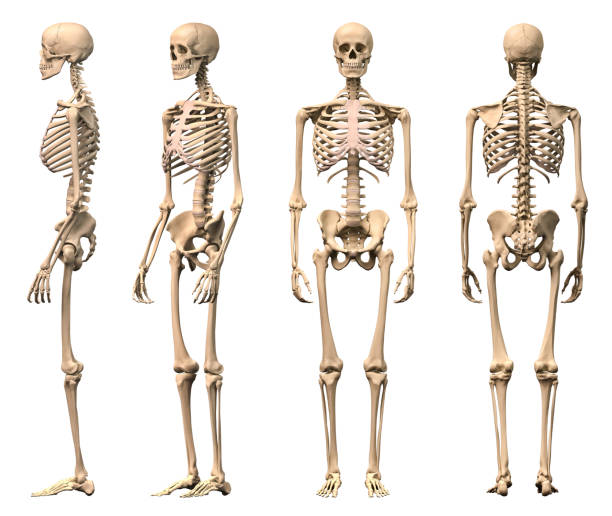
Beneath your skin lies a remarkable structure that silently supports every movement, protects vital organs, and shapes your entire physical existence. The human skeleton is far more than a rigid frame of bones. It is a living, dynamic system that grows, heals, adapts, and constantly renews itself throughout your life.
Most people rarely think about their skeleton unless something goes wrong—a broken arm, a painful joint, or an aging back. Yet this extraordinary internal architecture performs countless functions every second. It allows you to walk, breathe, run, sit, and even smile. Without it, the human body would collapse into a shapeless mass of tissue.
But the skeleton is not just functional—it is astonishing. Hidden within its silent structure are biological wonders that even modern science continues to explore. From bones stronger than steel to cells that build and destroy bone tissue every day, the skeleton is a masterpiece of evolutionary engineering.
Below are ten mind-blowing facts about the human skeleton that reveal just how incredible this internal framework truly is.
1. The Human Skeleton Contains 206 Bones — But Babies Have More
Most adults have 206 bones in their bodies. This number is often taught in classrooms as a simple fact of human anatomy. However, the story is far more fascinating when we consider how the skeleton develops.
At birth, a human baby actually has around 270 bones. These bones are not all fully hardened. Many of them are made of cartilage, a softer and more flexible tissue that gradually transforms into bone as the child grows.
During childhood and adolescence, many of these bones fuse together. For example, several bones in the skull merge to form solid protective plates around the brain. The sacrum, located at the base of the spine, begins as five separate bones that fuse into one. Similarly, the hip bones begin as multiple segments that gradually join together.
This process of fusion strengthens the skeleton and allows it to support the growing body. By early adulthood, the number of bones typically settles at 206.
This transformation is one of the most remarkable aspects of human development. Your skeleton today is not exactly the same skeleton you were born with. It evolved, reshaped itself, and matured along with the rest of your body.
2. Bones Are Stronger Than Concrete
Many people imagine bones as fragile or brittle because they can break. But in reality, bone is an incredibly strong material.
Pound for pound, bone is stronger than concrete and can withstand immense pressure. The outer layer of bone, known as cortical bone, is dense and compact. It provides the majority of the skeleton’s strength and rigidity.
Inside many bones is a lighter, spongy structure called trabecular bone. This internal lattice reduces weight while still maintaining strength. The design is similar to the internal framework used in modern engineering structures, such as bridges and aircraft components.
Scientists often compare bone strength to that of reinforced concrete. A single cubic inch of bone can theoretically withstand thousands of pounds of pressure before breaking.
Despite its strength, bone remains lightweight enough to allow movement and agility. If the skeleton were made entirely of solid material like steel or stone, humans would be far too heavy to move efficiently.
This balance between strength and lightness makes bone one of the most remarkable natural materials on Earth.
3. Your Bones Are Constantly Rebuilding Themselves
Many people think bones are static structures that remain unchanged after childhood. In reality, your skeleton is constantly renewing itself.
Bone tissue undergoes a continuous process called remodeling. Two types of specialized cells are responsible for this cycle. Osteoclasts break down old or damaged bone tissue, while osteoblasts build new bone in its place.
This process occurs throughout your life. Every year, a significant portion of your skeleton is replaced with new bone tissue. In fact, the entire skeleton is effectively renewed approximately every ten years.
Bone remodeling allows the skeleton to repair microscopic damage caused by everyday stresses. It also enables bones to adapt to changes in physical activity. For example, athletes often develop denser bones in response to repeated mechanical stress.
However, the balance between bone breakdown and bone formation changes with age. In older adults, bone loss can begin to exceed bone formation, leading to conditions such as osteoporosis.
Even so, the fact that your skeleton is constantly rebuilding itself is a powerful reminder that bone is living tissue, not inert material.
4. The Smallest Bone in the Human Body Is in Your Ear
Hidden deep inside your middle ear is the smallest bone in the human body. It is called the stapes.
The stapes is incredibly tiny, measuring only about three millimeters in length. Despite its small size, it plays a crucial role in hearing.
Sound waves travel through the ear canal and vibrate the eardrum. These vibrations are transmitted through three small bones in the middle ear known as the ossicles: the malleus, the incus, and the stapes.
The stapes sits at the end of this chain and connects to the inner ear. Its movements transmit sound vibrations into the fluid-filled cochlea, where they are converted into electrical signals for the brain.
Without the stapes and its tiny companions, sound vibrations would not be efficiently transferred into the inner ear. The world would become quiet and muffled.
The delicate bones of the ear demonstrate how the skeleton supports not only movement and protection but also sensory perception.
5. The Femur Is the Longest and Strongest Bone
While the stapes is the smallest bone, the femur holds the opposite distinction. It is the longest and strongest bone in the human body.
The femur runs from the hip to the knee and supports much of the body’s weight during standing, walking, and running. Its thick, dense structure allows it to withstand enormous forces.
During activities such as jumping or sprinting, the femur may experience forces several times greater than a person’s body weight. Despite this stress, fractures of the femur are relatively rare compared to fractures of smaller bones.
The femur also contains a large central cavity filled with bone marrow, which plays a critical role in blood cell production.
This powerful bone acts as a central pillar of human mobility. Without it, the complex movements that define human activity would not be possible.
6. Your Bones Produce Blood Cells
Deep within certain bones lies a soft, spongy tissue known as bone marrow. This tissue performs one of the most essential functions in the body: producing blood cells.
Bone marrow generates red blood cells, white blood cells, and platelets. These cells are critical for oxygen transport, immune defense, and blood clotting.
In children, much of the skeleton contains active bone marrow. As people age, some marrow becomes fatty and less active. However, important blood-forming marrow remains in bones such as the pelvis, ribs, sternum, and vertebrae.
Every second, millions of new blood cells are produced within the skeleton. Without this constant supply, the body would quickly lose its ability to carry oxygen and fight infections.
In this way, the skeleton functions not only as a structural framework but also as a vital factory for the body’s most essential cells.
7. The Human Hand Contains 27 Bones
The human hand is one of the most complex and versatile structures in the body. Remarkably, it contains 27 individual bones.
These bones are divided into three main groups. The carpals form the wrist. The metacarpals form the palm. The phalanges form the fingers and thumb.
This intricate arrangement allows for an extraordinary range of motion and precision. Humans can perform delicate tasks such as writing, threading a needle, or playing a musical instrument.
The opposable thumb plays a particularly important role. Its ability to touch the tips of the other fingers allows humans to grip tools and manipulate objects with exceptional control.
The evolution of the human hand, supported by its intricate skeletal structure, played a major role in the development of technology, art, and culture.
8. Bones Store Important Minerals
Bones serve as a storage system for essential minerals, particularly calcium and phosphorus.
Calcium is crucial for many bodily functions, including muscle contraction, nerve signaling, and blood clotting. When the body requires additional calcium, it can draw from the mineral reserves stored in bones.
Hormones carefully regulate this process to maintain stable calcium levels in the bloodstream. When calcium intake from food is insufficient, the body may gradually remove calcium from bones to maintain essential functions.
Over time, this process can weaken bones if mineral levels are not replenished through diet. This is why adequate nutrition, including calcium and vitamin D, is important for maintaining bone health.
In essence, the skeleton acts as a mineral bank, storing and releasing resources as the body needs them.
9. Your Skeleton Protects Your Most Vital Organs
One of the skeleton’s most critical roles is protection. Many of the body’s most important organs are shielded by bone.
The skull protects the brain, one of the most delicate and vital organs in the body. Its thick plates form a strong protective shell around the brain tissue.
The rib cage surrounds the heart and lungs. These curved bones form a flexible yet sturdy cage that protects these organs from injury while still allowing expansion during breathing.
The vertebral column protects the spinal cord, a bundle of nerve tissue that carries signals between the brain and the rest of the body. Damage to the spinal cord can result in paralysis, which is why the spine’s protective structure is so crucial.
Without these protective bones, many organs would be far more vulnerable to damage.
10. The Skeleton Helps You Move in Complex Ways
Movement is one of the most visible functions of the skeleton. Bones act as levers, joints act as pivot points, and muscles provide the force needed for motion.
When muscles contract, they pull on bones through tendons. Because bones are connected by joints, this pulling action produces movement.
Different types of joints allow different kinds of motion. Ball-and-socket joints in the shoulders and hips allow rotation and wide movement. Hinge joints in the knees and elbows allow bending and straightening. Pivot joints in the neck allow the head to rotate.
The coordination of bones, muscles, and joints allows humans to perform an astonishing range of movements—from simple walking to complex athletic feats.
Every step, gesture, and expression relies on this intricate mechanical system working in perfect harmony.
The Silent Framework of Life
The human skeleton is more than a collection of bones hidden beneath our skin. It is a living system that supports, protects, produces, stores, and adapts. It changes as we grow, repairs itself when damaged, and quietly sustains us throughout our lives.
Most of the time, we hardly notice it. Yet every movement we make, every breath we take, and every drop of blood flowing through our bodies depends on this silent framework.
When we pause to appreciate the skeleton, we discover not something cold and lifeless, but something dynamic, resilient, and deeply connected to the miracle of being human.
Inside each of us stands an extraordinary structure—a masterpiece of biology that has evolved over millions of years to support the complex, vibrant lives we live today.