Long before humanity learned to write, long before cities rose or civilizations formed, the sky itself was a source of terror.
Across the darkness, streaks of fire occasionally tore through the atmosphere—brilliant, fleeting reminders that Earth does not drift through space alone. Most meteors burn harmlessly, dissolving into glowing dust high above us. But sometimes, rarely, something larger arrives. A rock or metal body forged in the early Solar System survives the fiery plunge. It strikes.
And when it strikes with sufficient energy, it changes everything.
A meteoroid becomes a meteor when it enters Earth’s atmosphere. If it survives to reach the ground, it is called a meteorite. When the object is large enough—tens of meters, kilometers, or more—the impact can release energy comparable to nuclear weapons, reshape landscapes, alter climate, and even extinguish entire branches of life.
Here are fifteen of the most destructive meteoritic and asteroid impacts known to science—events that left scars not only on Earth’s surface, but on the history of life itself.
1. The Chicxulub Impact (66 Million Years Ago)
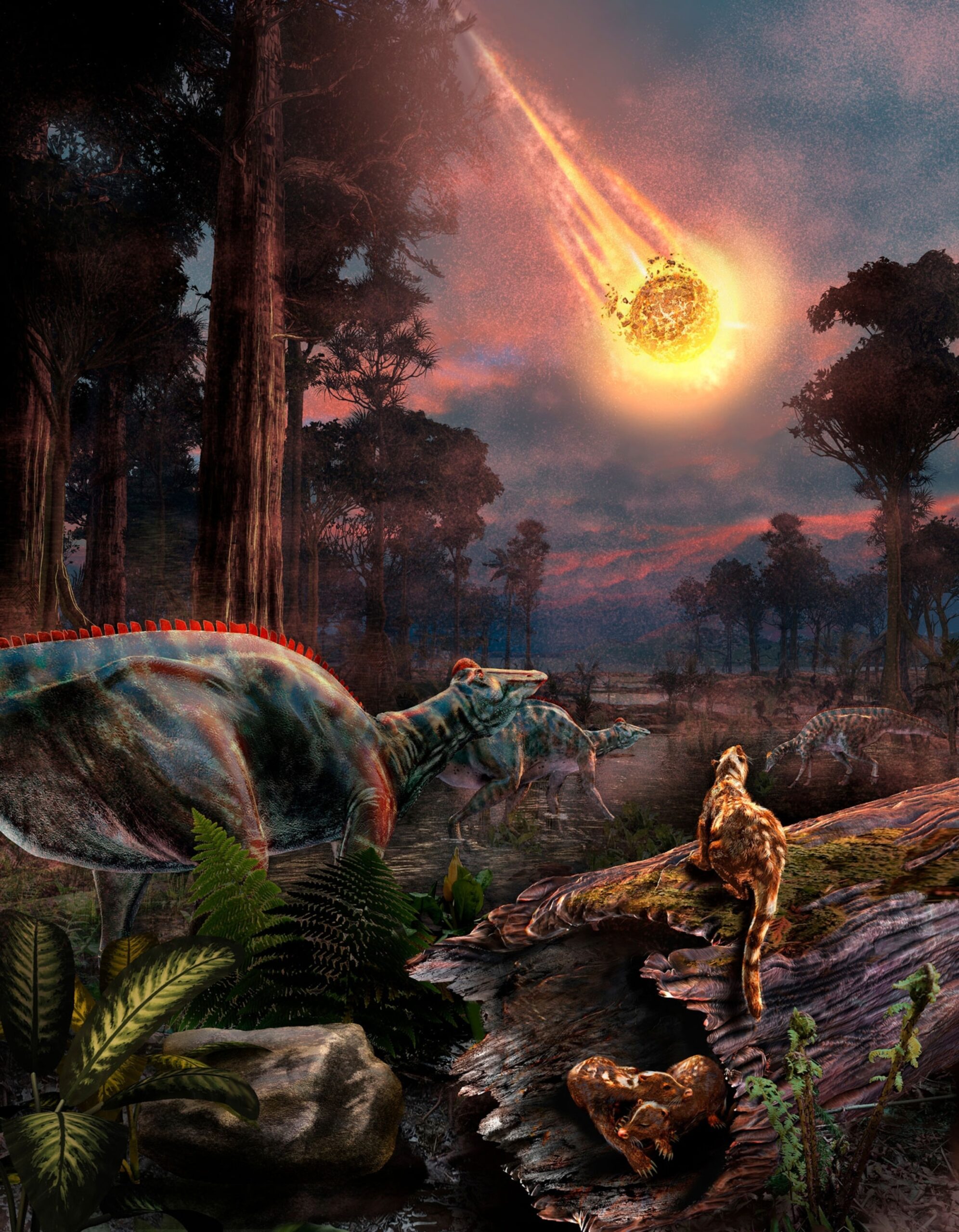
The most famous impact in Earth’s history occurred at the end of the Cretaceous Period, approximately 66 million years ago.
A massive asteroid, estimated at about 10 kilometers in diameter, slammed into what is now the Yucatán Peninsula in Mexico, creating the Chicxulub crater. The collision released energy equivalent to billions of atomic bombs.
The immediate effects were catastrophic. A fireball incinerated vast regions. Shockwaves triggered global earthquakes. Tsunamis hundreds of meters high raced across ancient seas. Debris ejected into the atmosphere re-entered as fiery projectiles, igniting global wildfires.
But the most devastating consequence was atmospheric. Dust, soot, and sulfur aerosols blocked sunlight, plunging Earth into an “impact winter.” Photosynthesis collapsed. Food chains disintegrated.
Approximately 75% of species went extinct, including all non-avian dinosaurs.
This impact did not merely destroy ecosystems—it reshaped evolution. Mammals diversified in the aftermath. Eventually, humans emerged.
Without Chicxulub, there may have been no humanity.
2. The Vredefort Impact (About 2 Billion Years Ago)
In South Africa lies the remnant of the largest confirmed impact structure on Earth: the Vredefort crater.
Formed roughly 2.02 billion years ago, the impacting body may have been 10–15 kilometers across. The original crater likely exceeded 250 kilometers in diameter.
At that time, life on Earth consisted mostly of simple microbial organisms. Yet even primitive life would have faced immense stress from such an impact. The collision released energy on a scale that dwarfs human imagination, vaporizing rock and sending molten ejecta across continents.
Over billions of years, erosion has softened the structure. But the geological scars remain—a testament to the violence of early Earth.
3. The Sudbury Impact (1.85 Billion Years Ago)
In Ontario, Canada, the Sudbury Basin marks another colossal collision.
The impactor, perhaps 10–15 kilometers in diameter, created a crater about 200–250 kilometers wide. The event melted enormous volumes of crust, forming what is now one of the world’s richest deposits of nickel and other metals.
This impact reshaped the local crust and contributed to significant geological reorganization. Like Vredefort, it occurred in deep geological time, but its economic consequences are felt even today through mining industries.
The Earth’s scars often become humanity’s resources.
4. The Manicouagan Impact (214 Million Years Ago)
The circular Manicouagan Reservoir in Quebec marks the remains of an impact from the Late Triassic Period.
Originally about 100 kilometers across, the crater formed when an asteroid several kilometers wide struck Earth. Though not linked to a major mass extinction, the impact occurred during a period of significant biological turnover.
The ring-shaped reservoir visible today is a haunting reminder of cosmic vulnerability.
5. The Popigai Impact (35 Million Years Ago)
In Siberia lies the Popigai crater, formed around 35 million years ago.
The asteroid, roughly 5–8 kilometers in diameter, released enormous energy. The impact pressure was so intense that it transformed graphite in the crust into microscopic diamonds.
Although not associated with a mass extinction, the event contributed to environmental stress during the Eocene epoch.
Even when life survives, it must adapt to shock.
6. The Chesapeake Bay Impact (35 Million Years Ago)
Around the same time as Popigai, another asteroid struck what is now the eastern United States, forming the Chesapeake Bay impact crater.
The impact triggered tsunamis and dramatically altered regional hydrology. Today, the buried structure influences groundwater systems beneath the Chesapeake Bay region.
Ancient impacts continue to shape modern landscapes.
7. The Kara-Kul Impact (5 Million Years Ago)
High in Tajikistan sits Lake Kara-Kul, formed within an impact crater approximately 52 kilometers in diameter.
Though much younger than previous examples, the Kara-Kul crater illustrates how even relatively recent cosmic collisions can leave lasting geological imprints.
By this time, early hominins were evolving in Africa. The Earth was already becoming recognizably modern.
8. The Barringer (Meteor) Crater (50,000 Years Ago)
In Arizona, the Meteor Crater—also known as Barringer Crater—marks one of the best-preserved impact sites on Earth.
Formed about 50,000 years ago by an iron meteorite roughly 50 meters in diameter, the explosion released energy equivalent to several megatons of TNT.
The impact excavated a crater over 1 kilometer wide. If it had struck a populated area today, devastation would have been immense.
This site provided early, compelling evidence that craters on Earth could be formed by extraterrestrial impacts rather than volcanic activity—a major shift in geological understanding.
9. The Tunguska Event (1908)
On June 30, 1908, an object estimated to be 50–60 meters across exploded in the atmosphere above Siberia near the Podkamennaya Tunguska River.
The Tunguska event was not a crater-forming impact but an airburst. The object—likely a stony asteroid or comet fragment—detonated at an altitude of about 5–10 kilometers.
The explosion flattened over 2,000 square kilometers of forest. Trees were knocked down radially from the blast center.
Had the object exploded over a major city, casualties would have been catastrophic.
Tunguska remains the largest impact event in recorded history affecting modern humans.
10. The Chelyabinsk Meteor (2013)
On February 15, 2013, a 20-meter asteroid entered Earth’s atmosphere over Russia.
The Chelyabinsk meteor exploded with energy equivalent to roughly 400–500 kilotons of TNT—far greater than the Hiroshima atomic bomb.
The shockwave shattered windows across the city of Chelyabinsk, injuring over 1,500 people, mostly from flying glass.
This event demonstrated that even relatively small near-Earth objects pose real risks.
11. The Sikhote-Alin Meteorite (1947)
In February 1947, a large iron meteorite broke apart over eastern Russia.
The Sikhote-Alin meteorite fall produced a dramatic fireball and created numerous small craters as fragments struck the ground.
While not globally destructive, it represented one of the largest observed meteorite falls in modern times and provided valuable scientific material.
12. The Campo del Cielo Impact (4,000–5,000 Years Ago)
In Argentina, fragments from the Campo del Cielo mark the fall of a large iron meteorite several thousand years ago.
Multiple craters and large fragments suggest a significant atmospheric breakup.
Indigenous cultures preserved oral traditions of the event, illustrating how cosmic encounters become woven into human memory.
13. The Kaali Crater Impact (Around 1500 BCE)
On the Estonian island of Saaremaa lies the Kaali crater.
Formed by a meteorite perhaps 20–40 meters across, the impact created a main crater and several smaller ones.
Some researchers suggest the event influenced local mythology and cultural practices. While small compared to ancient giant impacts, it occurred during human settlement.
When fire falls from the sky, stories follow.
14. The Rio Cuarto Structures (Possible Impact, Argentina)
In Argentina, elongated depressions known as the Rio Cuarto craters have been debated as possible impact sites.
If confirmed, they may represent a low-angle impact by a fragmented object thousands of years ago.
Though scientific debate continues, the site reflects how even uncertain impact evidence invites investigation into Earth’s cosmic vulnerability.
15. The Almahata Sitta Meteorite (2008)
In 2008, astronomers detected a small asteroid, 2008 TC3, before it entered Earth’s atmosphere.
The object exploded over Sudan, and fragments were recovered as the Almahata Sitta meteorite fall.
This marked the first time a meteoroid was tracked in space prior to impact and then recovered on Earth.
Though not destructive on a large scale, it represented a turning point in planetary defense—humanity witnessing, predicting, and studying a cosmic collision in real time.
The Sky Is Not Empty
From billion-year-old cataclysms that reshaped continents to modern airbursts that shattered windows, meteoritic impacts remind us that Earth exists within a dynamic Solar System.
Most impactors are small. Earth’s atmosphere protects us daily. But history shows that larger bodies do strike—and when they do, consequences can be global.
Modern astronomy now tracks near-Earth objects, seeking to identify potential threats decades in advance. Planetary defense strategies, including kinetic impactors, are under development.
We cannot stop tectonic plates. We cannot halt volcanic eruptions. But with enough warning, we may one day deflect an asteroid.
The scars across Earth’s surface are not merely geological curiosities. They are reminders of our cosmic environment—a reminder that life survives not in isolation, but in negotiation with the universe.
Fire has fallen before.
And someday, it will again.
The difference now is that we are watching the sky.