Look up at the night sky and it feels serene, almost empty. We know thousands of artificial satellites circle above us—communication relays, weather monitors, navigation systems. We know the Moon, our constant companion, dominates the celestial scene.
But beyond these familiar presences, Earth is not alone.
Around our planet drift objects that are neither traditional moons nor operational satellites. Some are fragments of ancient cosmic collisions. Some are captured wanderers from deep space. Others are ghosts of human ambition, relics of early space exploration long forgotten. A few defy easy categorization, blurring the line between asteroid, space debris, and temporary moon.
They move quietly in darkness, governed by gravity’s invisible hand. They are scientifically real, carefully tracked, and endlessly fascinating.
Here are seven mysterious objects orbiting Earth that aren’t satellites.
1. 3753 Cruithne — Earth’s “Second Moon” That Isn’t a Moon
In 1986, astronomer Duncan Waldron discovered a small near-Earth asteroid that would later capture public imagination. Its official designation is 3753 Cruithne.
At first glance, headlines called it Earth’s “second moon.” But that label is misleading.
3753 Cruithne does not orbit Earth in the traditional sense. Instead, it orbits the Sun. However, it shares a remarkable gravitational relationship with our planet. Cruithne follows a horseshoe-shaped orbit relative to Earth, locked in a 1:1 orbital resonance. It takes almost exactly one year to orbit the Sun—just like Earth.
From our perspective, its path appears to loop and weave, creating a complex pattern that resembles a horseshoe when viewed in a rotating reference frame. This unusual motion arises from gravitational interactions between Earth and the asteroid.
Cruithne is about 5 kilometers in diameter. It never comes particularly close to Earth compared to true satellites. Instead, it maintains a stable orbital dance that will likely persist for thousands of years.
Scientifically, Cruithne is classified as a quasi-satellite. It remains gravitationally influenced by Earth without being bound to it as a moon.
It is not a companion in the way the Moon is. It is more like a cosmic partner—locked in synchronized motion, circling the Sun while always staying near.
A second moon? No.
But a gravitational dance partner—yes.
2. 469219 Kamoʻoalewa — Earth’s Tiny Quasi-Moon
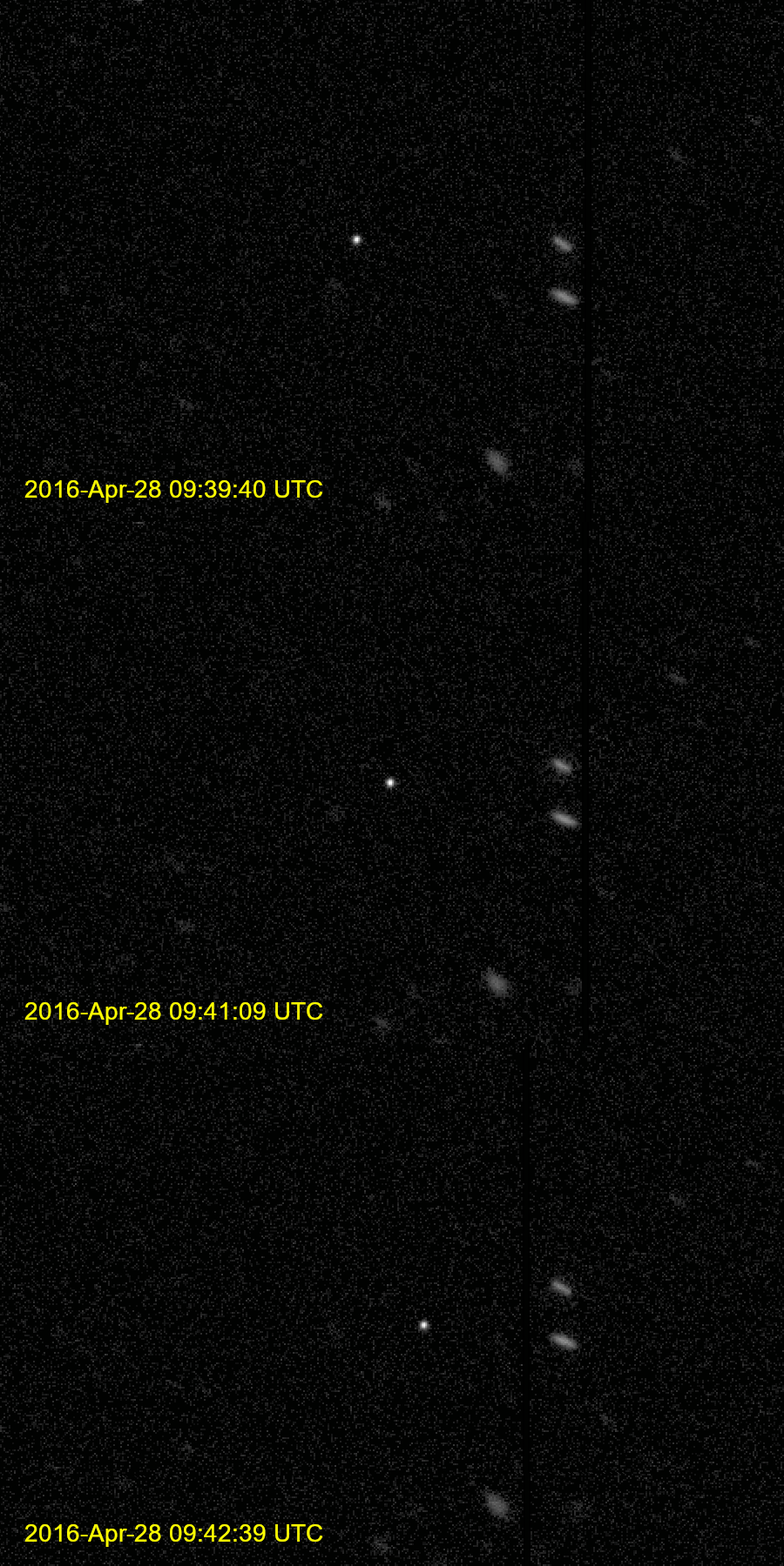
Discovered in 2016 by the Pan-STARRS telescope in Hawaii, 469219 Kamoʻoalewa is one of the most stable quasi-satellites known.
Also called 2016 HO3, Kamoʻoalewa is small—between 40 and 100 meters in diameter. Yet its orbital behavior is extraordinary.
Like Cruithne, it orbits the Sun. But its path is shaped by Earth’s gravity so that it remains near our planet for centuries at a time. It loops around Earth in a complex corkscrew-like motion while never truly being captured.
Detailed observations suggest that Kamoʻoalewa may actually be a fragment of the Moon itself, possibly ejected during an ancient impact. Spectroscopic analysis indicates its composition resembles lunar rock more than typical asteroids.
If confirmed, that would make it a wandering shard of our own satellite—an echo of a violent past drifting through near-Earth space.
Kamoʻoalewa is currently Earth’s most stable quasi-satellite, and orbital models suggest it may remain in this configuration for several hundred years.
It is not bound to Earth.
But it refuses to leave.
3. 2006 RH120 — The Temporary Moon
In September 2006, astronomers detected a small object near Earth. It was initially unclear whether it was space debris or a natural body. Further analysis revealed it was a tiny asteroid, roughly 2 to 3 meters across.
Its name is 2006 RH120.
Unlike quasi-satellites, 2006 RH120 actually became gravitationally bound to Earth. For about a year—from 2006 to 2007—it orbited Earth as a temporary natural satellite.
Then it escaped.
This phenomenon is known as temporary capture. Small near-Earth objects occasionally become trapped in Earth’s gravitational field if their trajectories and velocities align just right. They may orbit for months or years before being flung back into heliocentric orbit.
2006 RH120 was one of the first confirmed examples of such a “minimoon.”
Simulations suggest Earth may regularly host small temporary moons, typically less than a few meters wide. Most go undetected due to their small size and faintness.
For a brief moment in cosmic time, Earth had another moon.
And then it was gone.
4. 2020 CD3 — Earth’s Short-Lived Companion
In February 2020, astronomers at the Catalina Sky Survey announced another discovery: a tiny object temporarily orbiting Earth.
This object, 2020 CD3, had likely been captured around 2018. It was estimated to be about 1 to 2 meters in diameter.
Like 2006 RH120, it was a natural object—not human debris. Orbital analysis confirmed it was gravitationally bound to Earth before eventually escaping back into solar orbit.
These temporary captures highlight the dynamic gravitational environment around our planet. Earth’s gravity does not simply pull objects straight in or let them pass by. Instead, it can trap them in delicate orbital loops influenced by the Moon and the Sun.
2020 CD3 remained in orbit for several years before drifting away.
A fleeting visitor.
A quiet companion.
Proof that Earth’s gravitational reach extends farther than we once imagined.
5. The Black Knight Satellite — Myth and Reality
Few objects have generated as much speculation as the so-called Black Knight Satellite.
For decades, conspiracy theories claimed a mysterious alien probe has orbited Earth for 13,000 years. Stories linked it to unusual radio signals detected by Nikola Tesla in the early 20th century and to unidentified objects photographed during space missions.
The scientific reality is far less dramatic.
Images often cited as proof were later identified as pieces of thermal blanket material lost during a 1998 space shuttle mission. No credible evidence supports the existence of an ancient alien satellite orbiting Earth.
The Black Knight story persists because space is vast, mysterious, and poorly understood by the public. But astronomically, there is no verified object matching the myth.
What makes the Black Knight fascinating is not its existence—but humanity’s longing for cosmic company.
Sometimes, mystery arises not from unknown objects, but from imagination filling the void.
6. 2023 FW13 — A Long-Term Quasi-Satellite
In 2023, astronomers confirmed another quasi-satellite: 2023 FW13.
What makes 2023 FW13 remarkable is its stability. Orbital calculations indicate it has been in a quasi-satellite state for at least a century and may remain so for several centuries more.
Like others in this category, it orbits the Sun but remains gravitationally synchronized with Earth. Its path oscillates in a complex pattern, keeping it nearby without direct capture.
Objects like 2023 FW13 are reminders that orbital dynamics are subtle. Gravity from Earth, the Moon, and the Sun combine in intricate ways to produce stable yet nontraditional relationships.
These bodies are not moons.
They are co-orbiters.
They share Earth’s journey around the Sun like silent companions pacing us across space.
7. Space Debris That Became “Mysterious Objects”
Not all mysterious orbiters are natural.
Some are relics of early space exploration—spent rocket stages, abandoned spacecraft, and mission fragments whose origins were temporarily forgotten.
For example, in 2020, astronomers identified an object designated 2020 SO that appeared to be a near-Earth asteroid. Further analysis revealed it was likely the upper stage of a Centaur rocket launched in 1966 during NASA’s Surveyor program.
These objects sometimes drift into heliocentric orbit before returning to Earth’s vicinity decades later. When first detected, their nature may be unclear.
Unlike operational satellites, these objects are uncontrolled, inactive, and often tumbling through space.
They remind us that humanity has left traces beyond Earth—fragments of our technological infancy circling the Sun and occasionally revisiting our planet.
They are not natural moons.
They are artifacts.
Ghosts of ambition suspended in orbit.
The Invisible Neighborhood Around Earth
Earth’s orbital environment is more dynamic than it appears.
Gravity forms a constantly shifting web. Small asteroids approach, some are captured briefly, some share our orbit, others pass by never to return. Human-made objects drift, sometimes mistaken for natural bodies.
The distinction between satellite, moon, asteroid, and debris is not always intuitive. A satellite is typically artificial and operational. A moon is a natural body gravitationally bound in stable orbit. Quasi-satellites and temporary moons exist in intermediate gravitational states.
Physics governs them all.
Newton’s law of gravitation describes the force. Einstein’s general relativity refines our understanding of spacetime curvature. Orbital mechanics calculates trajectories with extraordinary precision.
And yet, to the human imagination, these objects remain mysterious.
Because they challenge our sense of isolation.
We think of Earth as having one Moon and thousands of satellites.
But in truth, our planet travels through a constantly evolving gravitational landscape filled with wandering rocks, temporary companions, and relics of exploration.
Some stay for centuries.
Some stay for months.
Some never existed beyond myth.
Together, they tell a deeper story about motion, gravity, and humanity’s place in the cosmos.
The sky above us is not empty.
It is alive with movement—silent, precise, and endlessly fascinating.