For tens of thousands of years, the Earth was not the exclusive home of a single human species. Our modern world, dominated entirely by Homo sapiens, can give the illusion that humanity was always alone. But the deep past tells a different story. The planet once hosted multiple human relatives who walked upright, crafted tools, hunted animals, buried their dead, and stared up at the same stars. Among them, one species stands out as both hauntingly familiar and tragically absent: the Neanderthals.
The story of Neanderthals and modern humans is one of the most compelling dramas in evolutionary history. Two intelligent species sharing the same world, sometimes occupying the same landscapes, sometimes even meeting face to face. One ultimately survived and spread across every continent. The other vanished roughly forty thousand years ago, leaving behind only bones, stone tools, and a genetic echo inside our DNA.
Why did Homo sapiens endure while Neanderthals disappeared? The answer is not simple, and it is not a story of superiority in the crude sense often imagined in the past. Instead, it is a complex tale involving climate shifts, cultural flexibility, social networks, population dynamics, and perhaps a small amount of chance. The difference between survival and extinction may have hinged on subtle advantages that accumulated over thousands of years.
Understanding this story requires traveling back into the Ice Age world, where glaciers crept across continents and small groups of humans struggled to survive in harsh and unpredictable environments.
The Discovery That Changed Human History
The existence of Neanderthals was first recognized in the mid-nineteenth century, when unusual human bones were discovered in the Neander Valley in Germany in 1856. The skull fragments and limb bones looked different from those of modern humans. They were thicker, heavier, and more rugged. At first, scientists debated whether the remains belonged to a diseased modern human or an entirely different type of human being.
As more fossils emerged across Europe and western Asia, the answer became clear. Neanderthals were not simply strange humans. They were a distinct species of ancient humans who had lived across much of Eurasia during the Ice Age.
These discoveries transformed our understanding of humanity. Before the nineteenth century, many people believed that humans had appeared suddenly and unchanged in their modern form. The Neanderthal fossils revealed something far more fascinating: humanity had a deep evolutionary past filled with diversity.
Neanderthals were not monsters or primitive brutes. They were humans of another kind—close relatives who shared a common ancestor with us hundreds of thousands of years earlier.
Origins of the Neanderthals
The evolutionary roots of Neanderthals stretch back more than half a million years. Around six hundred thousand years ago, populations of early humans spread across Africa, Europe, and Asia. Over time, groups that became isolated in different regions began to evolve along separate paths.
In Africa, the lineage that would eventually produce Homo sapiens continued to evolve. In Europe and western Asia, another lineage adapted to colder climates and gradually developed the distinctive features we associate with Neanderthals.
By about four hundred thousand years ago, the Neanderthal ancestors were already recognizable as a separate group. Over many generations, they became increasingly specialized for life in Ice Age environments.
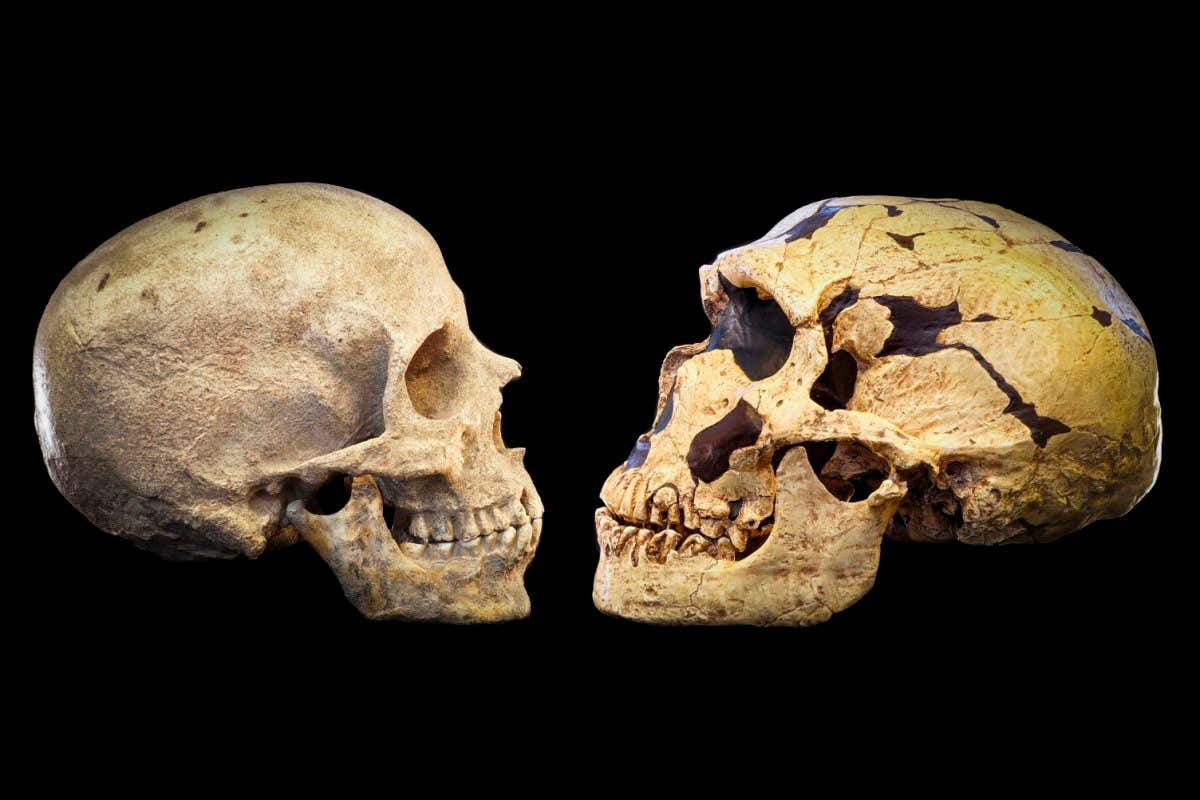
Their bodies were compact and powerful, with broad chests, strong limbs, and thick bones. These features helped conserve heat in cold climates. Their skulls were long and low, with prominent brow ridges and large noses—another adaptation that may have helped warm cold air before it entered the lungs.
Neanderthals were superbly adapted to the environments of Ice Age Europe and western Asia. For hundreds of thousands of years, they thrived in landscapes shaped by glaciers, harsh winters, and migrating herds of large animals.
The Arrival of Homo Sapiens
While Neanderthals were flourishing in Eurasia, another human story was unfolding in Africa. Around three hundred thousand years ago, the earliest Homo sapiens appeared.
These early modern humans possessed anatomical features that define our species today: high rounded skulls, smaller brow ridges, lighter skeletons, and faces tucked beneath the braincase rather than projecting forward.
But anatomy was only part of the transformation. Evidence from archaeological sites suggests that Homo sapiens were developing increasingly complex behaviors. They crafted sophisticated tools, used pigments such as ochre, and possibly created early symbolic objects.
For tens of thousands of years, Homo sapiens remained primarily within Africa. Then, beginning roughly seventy thousand years ago, some groups began expanding outward. Over generations, these travelers moved through the Middle East and eventually into Europe, Asia, and beyond.
When modern humans entered Eurasia, they were stepping into lands long occupied by Neanderthals.
First Encounters
The meeting between Neanderthals and Homo sapiens was not a single moment but a prolonged period of overlap. In regions such as the Middle East and Europe, the two species lived in the same landscapes for thousands of years.
Archaeological evidence suggests that they sometimes used similar tools and hunted similar animals. They may have competed for territory and resources. They may have observed each other across valleys or encountered one another in forests and river valleys.
Genetic evidence now shows that they did more than merely cross paths. They also interbred.
Today, most people of non-African ancestry carry a small percentage of Neanderthal DNA—typically between one and two percent. This means that ancient encounters between Neanderthals and Homo sapiens occasionally produced children whose descendants survive to this day.
The story of Neanderthals and modern humans is therefore not purely one of conflict or replacement. It also includes moments of connection and shared ancestry.
Yet despite this mingling, the Neanderthals eventually disappeared.
Life in the Ice Age
To understand why Neanderthals vanished, it helps to imagine the world they inhabited. Ice Age Europe was a harsh and dynamic environment. Vast glaciers advanced and retreated over thousands of years. Temperatures fluctuated dramatically. Forests gave way to open tundra and then returned again.
Neanderthals lived primarily as hunter-gatherers. They relied heavily on large animals such as mammoths, woolly rhinoceroses, bison, and deer. Their stone tools—known as Mousterian technology—were skillfully crafted and well suited for hunting and butchering.
Evidence from fossil bones suggests that Neanderthals were formidable hunters who often confronted large prey at close range. Their skeletons show injuries similar to those experienced by modern rodeo riders, suggesting dangerous encounters with powerful animals.
They also used fire, constructed shelters in some areas, and cared for injured members of their groups. Some Neanderthal individuals survived serious injuries that would have been fatal without assistance, indicating that their communities provided care.
Neanderthals were not solitary wanderers. They lived in social groups and relied on cooperation to survive.
The Neanderthal Mind
For much of the twentieth century, Neanderthals were portrayed as intellectually inferior to modern humans. Popular images depicted them as brutish cave dwellers with limited intelligence.
Modern research paints a very different picture.
Neanderthals had brains that were, on average, slightly larger than those of modern humans. Brain size alone does not determine intelligence, but it suggests that they possessed significant cognitive capacity.
Archaeological evidence shows that Neanderthals created tools with skill and precision. Some sites reveal the use of pigments, possibly for body decoration. In certain caves, Neanderthals may even have produced simple forms of symbolic expression.
They buried their dead in several locations, suggesting ritual behavior or emotional awareness of mortality. In one remarkable case from Shanidar Cave in Iraq, pollen traces suggested that flowers might have been placed in a grave, though this interpretation remains debated.
Neanderthals also cared for elderly or injured individuals who could not hunt effectively, indicating empathy and social bonds.
In many ways, Neanderthals were deeply human.
The Cultural Edge of Homo Sapiens
If Neanderthals were intelligent and capable, what gave Homo sapiens an advantage?
One possibility lies in culture. Archaeological evidence suggests that modern humans developed more rapidly changing and diverse cultural traditions.
In Africa and later in Eurasia, Homo sapiens created a wide variety of tools made not only from stone but also from bone, antler, and ivory. They crafted needles for sewing clothing, spear throwers for hunting at a distance, and finely shaped blades.
They also produced art.
Cave paintings in places such as France and Spain depict animals with extraordinary skill. Small carved figurines, personal ornaments made from shells or teeth, and engraved objects suggest a rich symbolic culture.
Symbolic communication may have strengthened social bonds and allowed ideas to spread more quickly between groups. Culture could accumulate and evolve, giving Homo sapiens an adaptive advantage.
Neanderthals, by contrast, appear to have changed their technologies more slowly over time.
Social Networks and Population Size
Another key difference may have involved social networks.
Evidence suggests that Neanderthal populations were relatively small and scattered across large territories. Small populations are vulnerable to environmental shocks, disease, and random events that can reduce genetic diversity.
Homo sapiens groups may have maintained broader social networks connecting distant communities. Such networks allow for the exchange of tools, ideas, and resources.
When one group experiences hardship, allies in other regions can provide support or knowledge about alternative survival strategies.
Larger interconnected populations also foster innovation. New ideas spread more easily and can accumulate across generations.
If Homo sapiens maintained wider social networks than Neanderthals, this could have given them greater resilience during times of environmental stress.
Climate Change and Environmental Pressure
The period during which Neanderthals disappeared coincided with dramatic climate fluctuations. Ice Age conditions were unstable, with rapid shifts between colder and warmer periods.
These environmental changes altered habitats and animal populations. Herds of large mammals migrated or declined. Forests expanded and contracted.
Species with flexible diets and adaptable lifestyles were better positioned to survive these changes.
Homo sapiens appear to have been more versatile in their food choices. Archaeological sites show evidence that they exploited a broader range of resources, including fish, birds, and small mammals.
Neanderthals may have relied more heavily on large game animals. If those populations declined during climatic shifts, Neanderthal communities would have faced severe challenges.
Environmental change alone probably did not eliminate Neanderthals, but it may have placed them under increasing pressure.
Competition and Contact
When Homo sapiens entered Europe roughly forty-five thousand years ago, Neanderthals had already been living there for hundreds of thousands of years. For several thousand years, the two species coexisted.
Competition for resources may have intensified as modern human populations expanded. Even small advantages in hunting strategies, social organization, or technological innovation could have gradually tipped the balance.
Direct conflict between the two species is difficult to prove, and there is little clear evidence of large-scale violence. However, competition does not require warfare. If one group is more efficient at exploiting resources, the other may slowly decline.
Over time, Homo sapiens populations grew while Neanderthal populations shrank.
Interbreeding and Absorption
One of the most fascinating discoveries of modern genetics is that Neanderthals did not vanish entirely. Part of them lives on within us.
When researchers first sequenced the Neanderthal genome in the early twenty-first century, they discovered that modern humans outside Africa carry small fragments of Neanderthal DNA.
These genetic traces reveal that interbreeding occurred multiple times between the two species.
Some scientists suggest that Neanderthals may have been partially absorbed into expanding Homo sapiens populations through interbreeding. In this scenario, the disappearance of Neanderthals was not solely extinction but also genetic merging.
However, the amount of Neanderthal DNA in modern humans is small, indicating that most Neanderthal lineages ultimately vanished.
Disease and Vulnerability
Another factor that may have contributed to Neanderthal decline is disease. When two populations that have been separated for long periods come into contact, they may carry different pathogens.
Modern humans migrating out of Africa could have introduced diseases to which Neanderthals had little immunity. Conversely, Neanderthals may have transmitted pathogens to modern humans.
Even a modest impact from disease could have been devastating for small populations already under stress from climate change and competition.
While the evidence for disease-driven extinction remains indirect, it is considered a plausible contributing factor.
The Last Neanderthals
The final chapter of the Neanderthal story unfolded roughly forty thousand years ago. Archaeological evidence suggests that the last Neanderthal populations survived in isolated regions of Europe, including parts of the Iberian Peninsula.
Gradually, their numbers dwindled. Their archaeological traces became rarer. Eventually, they disappeared from the fossil record.
Their extinction was not a sudden catastrophe but a slow fading. Generation after generation, their communities grew smaller until the last Neanderthal children were born into a world where their species was already nearing its end.
The silence they left behind would endure for tens of thousands of years until modern scientists rediscovered their bones.
The Neanderthal Legacy
Today, Neanderthals occupy a powerful place in our understanding of human history. They remind us that our species was not the inevitable outcome of evolution but one branch among many.
They were intelligent, adaptable, and successful for hundreds of thousands of years—far longer than Homo sapiens has existed so far.
Their genes still influence aspects of modern human biology, including immune responses and even susceptibility to certain diseases.
But perhaps their greatest legacy lies in how they reshape our perception of humanity. The line between “us” and “them” is far thinner than once imagined.
Neanderthals were not aliens. They were cousins.
Why We Survived
The question of why Homo sapiens survived while Neanderthals vanished does not have a single answer. It appears to have been the result of multiple interacting factors.
Modern humans likely possessed broader social networks, more flexible cultural traditions, and greater adaptability to changing environments. They may have maintained larger populations and exchanged ideas across wider regions.
Climate change placed pressure on both species, but Homo sapiens may have been better able to adjust their diets and technologies.
Interbreeding blurred the boundary between the species, allowing some Neanderthal genes to persist within the expanding Homo sapiens population.
In the end, the difference between survival and extinction may have been subtle. A slight advantage in communication, cooperation, or innovation could accumulate over generations until one species flourished while the other faded away.
A Mirror to Humanity
The story of Neanderthals is more than an ancient mystery. It is also a mirror held up to our own species.
It reminds us that intelligence alone does not guarantee survival. Adaptability, cooperation, and cultural creativity may be just as important.
It also reminds us that extinction is a natural part of evolution. Many human species once walked the Earth: Homo erectus, Homo floresiensis, Homo naledi, Denisovans, and others. Today, only one remains.
We are the last surviving humans.
Yet within our DNA and our imagination, echoes of our lost relatives remain. The Neanderthals still speak to us across the ages—not with words, but with bones, tools, and fragments of ancient genes.
Their story is part of our story, a reminder that the path of evolution is never simple, never predetermined, and never without mystery.