The human brain is an intricate landscape of billions of neurons, constantly communicating to define who we are, how we move, and how we feel. For centuries, humans have introduced external substances into this delicate ecosystem, seeking relaxation, stimulation, or a shift in perspective. Among the most prevalent of these are cannabis and tobacco. While their social and legal status has shifted dramatically over the decades, a massive new scientific effort is revealing the physical toll these substances take on the very architecture of our minds.
By synthesizing over a century of data, researchers have begun to map out a story of structural change, where the vibrant regions of the brain responsible for memory, emotion, and movement appear to physically shrink under the influence of regular use.
The Quiet Architecture of the Mind
To understand what is happening, we must first look at the biological machinery that these substances highjack. In the case of cannabis, the primary actor is tetrahydrocannabinol, more commonly known as THC. When a person consumes cannabis, THC seeks out and binds to cannabinoid type 1 receptors, or CB1 receptors. These specialized ports are scattered throughout the brain, where they normally help manage essential life functions like pain, anxiety, and appetite.
Tobacco follows a different but equally invasive path. Its main psychoactive component, nicotine, targets nicotinic acetylcholine receptors, or nAChRs. These receptors act as vital junctions for communication between nerve cells. They are the engines behind the brain’s neuroplasticity, which is the organ’s remarkable ability to adapt, learn, and rewire itself in response to new experiences.
A Tale of Three Distinct Perspectives
Science rarely finds a definitive answer in a single experiment. To truly see the impact of these substances, a research team published a landmark study in the journal Addiction, conducting a “meta-analysis” that pooled together 103 independent studies. This massive undertaking involved data from more than 72,000 people, creating one of the clearest pictures ever seen of how our habits sculpt our biology.
The researchers didn’t just look at one type of data; they used a method called “triangulation.” First, they examined cross-sectional studies, which act like a snapshot in time, comparing the brains of users and non-users at a specific moment. Then, they looked at longitudinal studies, which function more like a documentary, following the same individuals over several years to watch how their brains changed as they continued their habits. Finally, they employed Mendelian randomization, a sophisticated technique that uses genetic data to determine if the substance use was the actual cause of the brain changes, rather than just a coincidence.
The Shrinking Map of Emotion and Memory
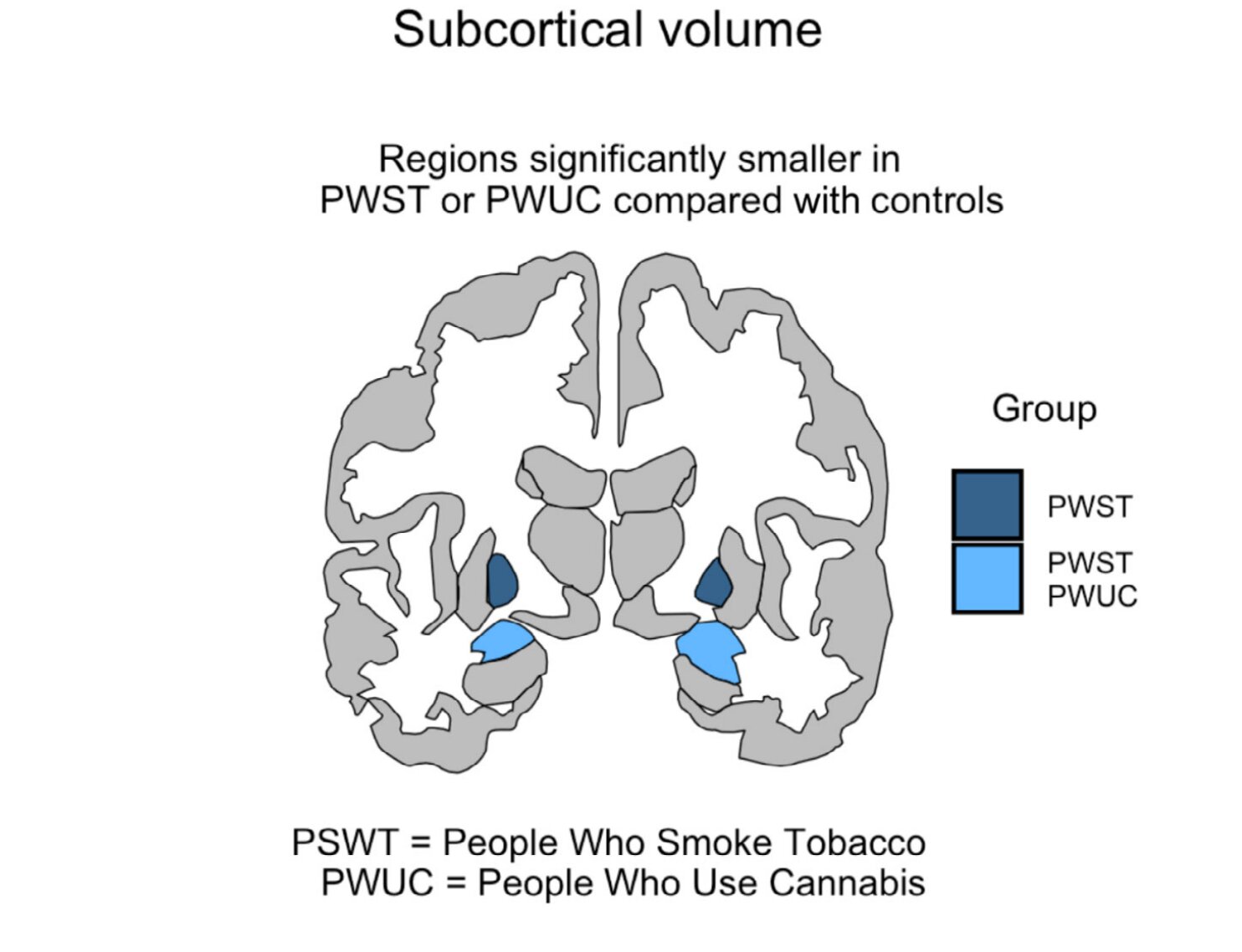
When the data from these thousands of participants were combined, a startling pattern emerged. For regular cannabis users, the most significant change was found in the amygdala. This almond-shaped structure, buried deep within the brain’s temporal lobe, is the center for emotional regulation and the primary driver of the fight-or-flight response. The study found that regular use was linked to a reduced volume in this critical area, potentially altering how the brain processes fear and stress.
Tobacco use, however, seemed to leave a wider footprint of structural reduction. Beyond the amygdala, tobacco was associated with volume loss in the insula and the pallidum. The insula is a hidden fold of the brain that serves as a bridge for self-awareness and emotion, while the pallidum is essential for maintaining movement and motivation.
The genetic portion of the study added an even more specific warning: the more cigarettes a person smoked per day, the smaller their hippocampus was likely to be. Because the hippocampus is the primary engine for memory and learning, this physical shrinkage suggests a direct impact on the brain’s ability to store and recall information.
The Slow Erosion of the Vital Gray
Perhaps the most concerning finding involves the brain’s gray matter. This is the tissue that contains the majority of the brain’s neuronal cell bodies; it is the “processing power” of the mind. The researchers discovered that as the years pass, the differences between users and non-users become increasingly stark. People who smoke tobacco showed a much faster decline in total gray matter volume compared to those who do not smoke.
Because gray matter is a primary marker of overall brain health, its loss is more than just a statistical curiosity. It is deeply tied to cognitive performance and mental well-being. When this volume decreases prematurely, it can have a “cascading” effect on how an individual thinks, feels, and functions in their daily life. With nearly 1.8 billion tobacco users and 228 million cannabis users worldwide, these structural changes are not just individual concerns—they represent a global shift in neurological health.
Turning Data into a Clearer Conversation
This research matters because it moves the conversation from the abstract to the concrete. For a long time, warnings about cannabis and tobacco were vague or focused solely on long-term respiratory or cardiovascular risks. By pinpointing exactly which regions—like the amygdala, insula, and pallidum—are affected, healthcare professionals now have a “show-and-tell” tool for their patients.
Instead of speaking in generalities, doctors can explain to young and vulnerable populations exactly how these substances are physically reshaping the hardware of their brains. Understanding that a habit might be shrinking the centers of motivation, memory, and emotional control provides a powerful, evidence-based incentive for people to consider the long-term health of their most vital organ. This study serves as a map, showing us that while these substances may offer a temporary change in feeling, they leave behind a permanent change in the very structure of the mind.
Study Details
Katherine Sawyer et al, Associations of cannabis use, tobacco use and co‐use with brain volume: A systematic review and meta‐analysis, Addiction (2026). DOI: 10.1111/add.70361