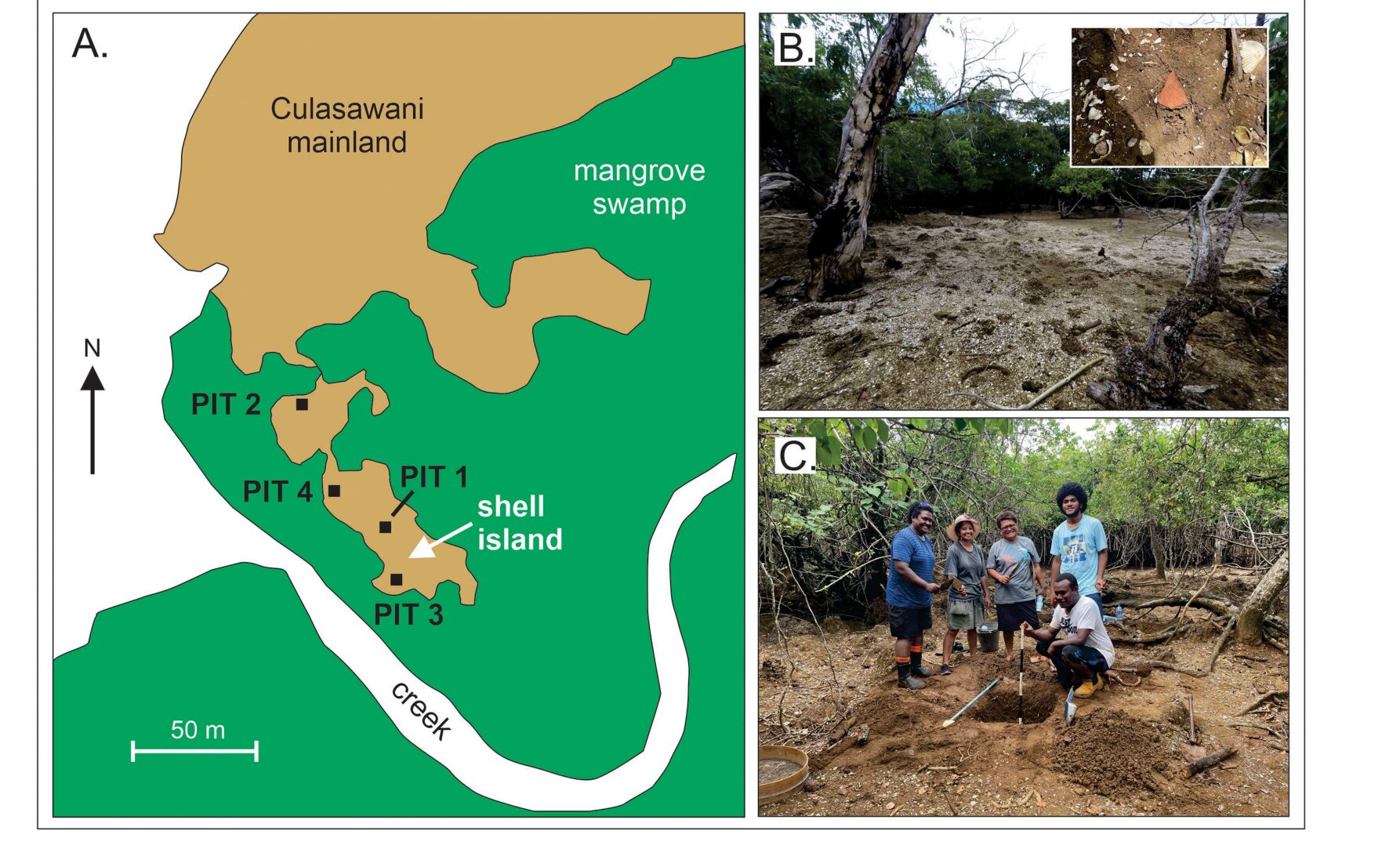
Off the sun-drenched coast of Culasawani in the Fiji archipelago, a tiny speck of land measuring roughly 3,000 square meters hides a secret that tastes remarkably like dinner. At first glance, the island appears to be just another part of the tropical landscape, nestled among the tangled roots of mangroves and separated from the mainland by a winding creek. However, when researchers began to look beneath the surface of this small landmass, they realized they weren’t standing on ancient volcanic rock or coral sand. Instead, they were standing on a massive, discarded feast that has endured for over a millennium.
A Secret Hidden Beneath the Tides
The story of this discovery began in January 2017 during a general survey of the Fijian coast. Scientists were exploring the fringes of Vanua Levu, Fiji’s second-largest island, an area that has historically received far less archaeological attention than other parts of the country. As they navigated the coastal waters, they spotted this curious landmass. It sat low in the water, rising only 20 to 60 centimeters above the surface during high tide. It seemed unassuming, but a group of unlikely assistants had already begun excavating its secrets: burrowing crabs. These local crustaceans, in their daily labor of digging homes, had inadvertently acted as miniature archaeologists, pushing materials from 30 to 50 centimeters deep up to the surface.
When the researchers inspected the mounds of earth the crabs had moved, they didn’t find typical soil. They found a dense concentration of shellfish remains mixed with weathered fragments of pottery. Initial analysis was staggering, suggesting that between 70% and 90% of the entire island’s composition was made of discarded shells. This wasn’t just a beach with a few shells scattered about; this was a geological feature seemingly built from the leftovers of ancient meals. The discovery set the stage for a deeper investigation into whether this island was a freak accident of nature or a monument to human persistence.
The Ghost of an Ancient Kitchen
By 2024, the research team returned to the site, determined to understand how such a place came to exist. They weren’t alone in their quest; working alongside local residents, they began the arduous process of “tasting” the island’s history through core samples. Using long, tube-like tools known as hand-auger cores, the team extracted 20 narrow samples from various locations across the island to see if the composition was consistent all the way through. To complement these vertical snapshots, they dug four 1-meter-by-1-meter square pits, carefully sifting through the layers of the past.
The evidence pointing toward a human origin was compelling. Every single shell examined belonged to an edible species. In the Western Pacific, seafood has been the lifeblood of islanders for over three millennia, and even in modern Fijian communities, shellfish can account for 15% of the daily diet. To confirm the timeline of this massive seafood processing site, the team turned to radiocarbon dating. They specifically selected Anadara shells—a type of clam—because they are known to provide exceptionally reliable dating results. The tests revealed a consistent age: the deposits were approximately 1,200 years old. This timeline places the birth of the island around 760 CE, a period when early settlers were busy navigating and inhabiting the lush coastlines of the archipelago.
Two Tales of a Lone Island
As the data piled up, the researchers had to weigh two competing theories for how the island formed. The first was a story of catastrophe: a muddle island. In this scenario, a massive, prehistoric tsunami or a gargantuan wave would have torn across the seafloor, ripping up existing shell beds and dumping them in a single, chaotic pile. It would have been an instantaneous birth of a landmass, a violent gift from the sea. However, nature is rarely a picky eater. A tsunami would have deposited a random jumble of every shell species on the seafloor—edible, inedible, large, and small alike.
The second theory, and the one the researchers ultimately favored, was the story of the midden island. A midden is essentially an ancient refuse heap, a place where people systematically discard the remains of their lives. The team proposed that this island was a specialized site, a dedicated “processing plant” where people from the nearby mainland traveled to prepare vast quantities of shellfish. The island grew slowly, layer by layer, as centuries of discarded shells and broken pottery accumulated in the same spot. The absence of stone tools or animal bones further supported this “task-specific” theory; it wasn’t a permanent village where people lived and died, but a workplace where the primary focus was the harvest of the sea.
Why the Discarded Past Matters
Finding a midden island is like finding a library where the books are made of bone and shell. For archaeologists and anthropologists, these sites are gold mines because they provide an unfiltered look at paleo-landscapes and how humans shaped the world around them. This research, recently published in Geoarchaeology, does more than just solve a local mystery; it fills a significant “knowledge gap” regarding the history of Vanua Levu and the survival strategies of early Pacific islanders. By studying these 1,200-year-old leftovers, scientists can reconstruct the cultural practices, living patterns, and past diets of a people who turned their kitchen waste into a permanent part of the geography.
The journey isn’t over. The team now plans to look toward the Culasawani mainland to find the contemporary settlements where these ancient fishers actually lived. By linking the mainland homes to the shell-built island, they hope to fully map out the subsistence economy of the region. This small island stands as a testament to the fact that human footprints aren’t always found in the sand; sometimes, they are built into the very ground we walk on, one shell at a time.
Study Details
Patrick D. Nunn et al, Shell‐Dense Island Off Culasawani, Vanua Levu Island, Fiji: Midden or Muddle?, Geoarchaeology (2026). DOI: 10.1002/gea.70052