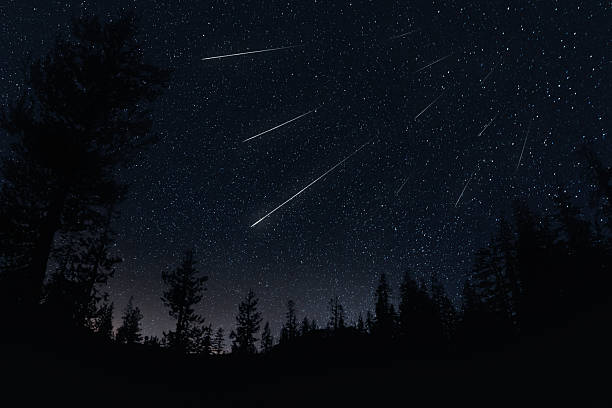
On a clear night far from city lights, the sky can suddenly come alive. A bright streak flashes overhead. Then another. Soon dozens of glowing lines appear, racing silently across the darkness before vanishing in an instant. To many people, these fleeting flashes are “shooting stars,” mysterious sparks that seem to fall from heaven.
Yet these beautiful displays are not stars at all.
They are meteors—tiny fragments of cosmic debris burning up in Earth’s atmosphere. When many meteors appear over a short period of time, the event is known as a meteor shower. These celestial spectacles are among the most accessible and awe-inspiring astronomical events visible to the naked eye. No telescope is required. No special equipment is needed. All it takes is a dark sky, patience, and a willingness to look upward.
What makes meteor showers particularly fascinating is that they connect us directly to ancient comets that have traveled through the Solar System for thousands, and sometimes millions, of years. Every meteor streaking across the sky is part of a story that began long before human civilization existed.
The light you see during a meteor shower may be produced by a grain of dust no larger than a pebble. Yet that tiny particle could have once been embedded within a comet that formed during the earliest days of the Solar System over 4.5 billion years ago.
Meteor showers are therefore more than beautiful sky shows. They are reminders of our cosmic origins and evidence that Earth continually moves through a dynamic and ever-changing Solar System.
Understanding the Difference Between Meteors, Meteorites, and Meteoroids
Before exploring meteor showers in detail, it helps to understand some terminology that often causes confusion.
A meteoroid is a small rocky or metallic object traveling through space. Meteoroids vary greatly in size. Some are tiny grains of dust, while others can be several meters across.
When a meteoroid enters Earth’s atmosphere, friction and compression heat the surrounding air, causing the object to glow. This bright streak of light is called a meteor.
If part of the object survives its fiery descent and reaches the ground, the remaining fragment becomes a meteorite.
These terms describe different stages of the same object.
In the context of meteor showers, most meteoroids are extremely small. Many are no larger than grains of sand. Despite their tiny size, they can produce brilliant flashes because they enter Earth’s atmosphere at tremendous speeds.
What Exactly Is a Meteor Shower?
A meteor shower occurs when Earth passes through a stream of debris left behind by a comet or, in some cases, an asteroid.
As Earth travels around the Sun, it occasionally crosses these debris trails. When countless tiny particles collide with our atmosphere, they create numerous meteors over a relatively short period.
The result is a meteor shower.
During an active shower, observers may see several meteors per hour, dozens per hour, or even hundreds during particularly intense events.
Unlike random meteors that appear on any night, meteors within a shower seem to originate from the same area of the sky. This point is called the radiant.
The meteors are actually traveling along nearly parallel paths, but perspective causes them to appear to diverge from a single location, much like railroad tracks seem to converge in the distance.
This visual effect helps astronomers identify and classify meteor showers.
The Ancient Comet Connection
The story of most meteor showers begins with comets.
Comets are often described as dirty snowballs. They consist of ice, dust, rock, and frozen gases that formed during the birth of the Solar System.
Many comets spend most of their existence in the cold outer regions of the Solar System. When their orbits bring them closer to the Sun, solar heat begins to vaporize their icy surfaces.
As the ice turns into gas, it escapes into space, carrying dust and rocky particles with it.
This process creates the spectacular tails for which comets are famous.
But the tail is only part of the story.
Each time a comet approaches the Sun, it leaves behind countless particles scattered along its orbital path. Over time, these particles form vast streams of debris stretching millions of kilometers through space.
Long after the comet itself has moved on, the debris remains.
When Earth later intersects one of these ancient trails, a meteor shower occurs.
In essence, meteor showers are encounters with the dusty remains of comets.
A Journey Billions of Years in the Making
One of the most remarkable aspects of meteor showers is their connection to the earliest history of the Solar System.
The dust particles producing meteor showers are not newly created.
Many originated from material that formed alongside the planets over 4.5 billion years ago.
Comets act as cosmic time capsules, preserving ancient matter from the Solar System’s infancy. Because they spend much of their lives in cold outer regions, many of their original ingredients remain relatively unchanged.
When a comet sheds debris, some of that primordial material becomes part of a meteor stream.
As these particles eventually encounter Earth, they provide scientists with opportunities to study ancient matter that predates our planet’s modern surface.
Every meteor represents a tiny fragment of cosmic history.
How Meteor Showers Form
The formation of a meteor shower is a gradual process.
As a comet repeatedly circles the Sun, it continually releases material. Each passage adds new dust and debris to its orbital path.
Initially, the particles remain relatively concentrated near the comet.
Over time, gravitational influences from planets, particularly Jupiter, spread the debris along the comet’s orbit.
Eventually, the stream may become an enormous ribbon of particles extending around much of the Solar System.
When Earth’s orbit intersects this ribbon, meteoroids enter our atmosphere.
The density of the debris stream determines the intensity of the resulting meteor shower.
Some streams contain relatively few particles and produce only modest displays. Others are packed with debris and can generate spectacular meteor storms.
Why Meteors Glow
Many people assume meteors glow because they catch fire.
The reality is slightly different.
When a meteoroid enters Earth’s atmosphere, it travels at extremely high speeds, often tens of kilometers per second.
At these velocities, the object compresses air molecules in front of it.
The compressed air becomes extraordinarily hot, causing both the surrounding gases and the meteoroid’s surface material to glow intensely.
This process creates the bright streak visible from the ground.
Most meteoroids vaporize completely before reaching Earth’s surface.
The brilliant flash lasts only a moment, but during that brief instant, a tiny particle can outshine many stars.
The Incredible Speed of Meteor Showers
Meteor shower particles move at astonishing speeds.
Some enter Earth’s atmosphere at around 11 kilometers per second, while others exceed 70 kilometers per second.
To put this into perspective, even the slowest meteors travel many times faster than a rifle bullet.
At such speeds, even microscopic particles carry enormous kinetic energy.
This energy is converted into heat and light during atmospheric entry.
The speed of a meteor depends on the geometry of its orbit relative to Earth’s motion.
Some particles collide with Earth almost head-on, increasing their apparent velocity.
Others approach from more favorable angles and appear slower.
Regardless of their exact speed, meteors rank among the fastest natural phenomena visible to the human eye.
Why Meteor Showers Occur at Predictable Times
Unlike many astronomical events, meteor showers are highly predictable.
This predictability arises because both Earth and the debris streams follow stable orbital paths.
Earth completes one orbit around the Sun every year.
If a debris stream crosses Earth’s orbit, our planet encounters it at approximately the same time annually.
As a result, major meteor showers recur each year on nearly identical dates.
Astronomers can forecast when showers will occur, when they will peak, and how many meteors observers might expect.
This regularity allows skywatchers to plan observations months or even years in advance.
The Perseids: A Summer Sky Favorite
Among the most famous meteor showers is the Perseid meteor shower.
The Perseids occur each year during July and August and are associated with the comet Comet Swift-Tuttle.
This comet takes approximately 133 years to orbit the Sun.
Despite its infrequent appearances, the debris it leaves behind generates one of the most reliable meteor showers visible from Earth.
The Perseids are beloved because they often produce bright meteors, frequent activity, and pleasant observing conditions during warm summer nights in the Northern Hemisphere.
Under dark skies, observers may witness dozens of meteors per hour during peak activity.
Many Perseid meteors leave glowing trails that linger briefly after the meteor itself disappears.
The Leonids and Meteor Storms
Not all meteor showers are equally dramatic every year.
The Leonid meteor shower provides a striking example.
The Leonids originate from debris shed by Comet Tempel-Tuttle.
Most years, the shower is relatively modest.
However, approximately every 33 years, when the comet returns to the inner Solar System, Earth may encounter dense concentrations of fresh debris.
During these periods, meteor activity can increase dramatically.
Historically, the Leonids have produced spectacular meteor storms.
In some cases, observers reported seeing thousands of meteors per hour.
During major storms, meteors appear so frequently that they seem to rain from the sky.
These events rank among the most breathtaking astronomical spectacles ever witnessed.
The Geminids: A Different Kind of Shower
Most meteor showers originate from comets, but there are exceptions.
The Geminid meteor shower is linked to an unusual object called 3200 Phaethon.
Phaethon behaves somewhat like an asteroid yet also exhibits characteristics associated with comets.
Scientists are still investigating its nature.
The Geminids occur each December and are widely considered one of the year’s finest meteor showers.
They often produce bright, colorful meteors and impressive activity rates.
Their existence demonstrates that meteor showers can arise from sources other than traditional icy comets.
Fireballs and Bolides
While most meteor shower particles are tiny, occasionally larger fragments enter Earth’s atmosphere.
These objects can produce exceptionally bright meteors known as fireballs.
A fireball may shine brighter than Venus, the brightest planet in the night sky.
Some become so luminous that they briefly rival the Moon.
Particularly energetic fireballs may explode in the atmosphere.
Such events are known as bolides.
The explosion can create shock waves, sonic booms, and fragmentation.
Although dramatic, these events are relatively rare.
Most meteor shower particles remain far too small to produce such spectacular effects.
Meteor Showers Throughout Human History
Humans have observed meteor showers for thousands of years.
Ancient civilizations often interpreted them through religious or supernatural frameworks.
Sudden displays of fiery streaks across the sky could seem mysterious, frightening, or awe-inspiring.
Historical records from China, Korea, Japan, Europe, and the Middle East contain descriptions of remarkable meteor events.
Some of the most detailed accounts come from Chinese astronomers, whose meticulous observations span centuries.
These records provide valuable information for modern scientists studying long-term meteor shower behavior.
By comparing historical descriptions with contemporary observations, researchers can better understand how meteor streams evolve over time.
The Science of Meteor Observation
Today, meteor showers are studied using sophisticated scientific tools.
Astronomers employ cameras, radar systems, satellites, and computer models to analyze meteors.
Photographs help determine meteor trajectories.
Radar detects meteors even during daylight.
Spectroscopy reveals chemical compositions by analyzing emitted light.
These techniques allow researchers to investigate the origins and properties of meteor particles.
Scientists can identify which elements are present and compare them with materials found in comets, asteroids, and meteorites.
Meteor science provides important insights into the composition and evolution of the Solar System.
What Meteor Showers Teach Us About Comets
Meteor showers serve as natural laboratories for studying comets.
Direct spacecraft missions to comets are expensive and technically challenging.
Meteor showers offer a different approach.
By analyzing meteoroids entering Earth’s atmosphere, scientists can examine material originating from cometary bodies.
These studies reveal information about dust composition, particle size, and structural properties.
Researchers have discovered that cometary material often contains organic compounds and complex molecules.
Such findings contribute to broader investigations into the origins of life and the distribution of organic chemistry throughout the Solar System.
The Role of Jupiter
Jupiter exerts a profound influence on meteor showers.
As the Solar System’s largest planet, its gravity significantly affects comet orbits and debris streams.
Jupiter can alter trajectories, concentrate particles, disperse streams, or even eject objects entirely from the Solar System.
Many meteor shower characteristics reflect Jupiter’s gravitational influence.
Over centuries and millennia, these interactions reshape debris streams and modify shower intensity.
Without Jupiter, the meteor shower landscape observed from Earth would likely look very different.
Can Meteor Showers Be Dangerous?
For people watching from the ground, meteor showers are generally harmless.
The vast majority of particles burn up high in the atmosphere.
However, meteor showers do present some challenges for spacecraft.
Even tiny particles traveling at enormous velocities can damage satellites.
Engineers carefully monitor meteor activity when planning certain space operations.
Fortunately, major impacts remain relatively uncommon.
Earth’s atmosphere serves as an effective shield, protecting life from most incoming debris.
Without this protective layer, meteor showers would be far more hazardous.
Why Dark Skies Matter
One reason meteor showers captivate observers is their accessibility.
Unlike many astronomical phenomena, meteors are visible without specialized equipment.
Yet viewing conditions matter greatly.
Light pollution can dramatically reduce the number of visible meteors.
Bright city lights wash out faint streaks.
Moonlight can have a similar effect.
Under pristine dark skies, the difference is astonishing.
Observers may see several times more meteors than they would from urban environments.
Dark skies reveal the true beauty of meteor showers and reconnect people with the natural night sky that humans experienced for most of history.
Meteor Showers and Human Emotion
Few astronomical events create the emotional response associated with meteor showers.
Part of their appeal lies in their unpredictability.
Even during active showers, observers never know exactly where the next meteor will appear.
Each streak arrives unexpectedly.
Each flash lasts only a moment.
This fleeting nature makes meteor showers feel special.
They remind us that beauty can be temporary.
Many cultures associate shooting stars with wishes, dreams, and hope.
While these traditions are not scientific, they reflect a universal human reaction to the experience of witnessing something rare and beautiful.
A meteor shower transforms the night sky into a living performance.
The Future of Meteor Shower Research
Scientific interest in meteor showers continues to grow.
Advances in technology allow increasingly detailed observations.
Global camera networks track meteors across continents.
Artificial intelligence helps identify patterns in enormous datasets.
Spacecraft monitor comets and their evolving debris streams.
Researchers are learning more about how meteor showers change over time and how cometary material disperses throughout the Solar System.
Future studies may reveal new meteor showers, improve forecasting accuracy, and deepen our understanding of planetary formation.
The night sky still holds many secrets.
Meteor showers remain an important tool for uncovering them.
Looking Up at Ancient Dust
Perhaps the most remarkable fact about meteor showers is how ordinary and extraordinary they are at the same time.
On one level, they are simply tiny particles colliding with Earth’s atmosphere.
On another, they are encounters with material older than Earth itself.
The dust producing a meteor tonight may have traveled through space for millions of years.
It may have originated from a comet that began its journey long before human beings existed.
Its brief flash represents the final chapter of an ancient voyage.
For a fraction of a second, that tiny grain announces its presence with a streak of light visible across vast distances.
Then it disappears forever.
Conclusion
Meteor showers are among nature’s most beautiful reminders that Earth is part of a much larger cosmic environment. They occur when our planet passes through streams of debris left behind by ancient comets and, in some cases, unusual asteroid-like bodies. These particles, often no larger than grains of sand, enter Earth’s atmosphere at tremendous speeds and create the brilliant flashes we call meteors.
Far from being random celestial fireworks, meteor showers are predictable events tied to the orbital history of comets. Each shower represents a meeting between Earth and material that may have formed during the earliest stages of the Solar System more than 4.5 billion years ago.
Beyond their scientific importance, meteor showers inspire wonder. They connect modern observers to ancient cosmic processes and remind us that the universe is constantly in motion. Every shooting star is a tiny messenger from deep time, carrying a story that began long before humanity looked toward the heavens.
The next time you see a meteor streak across the night sky, remember that you are witnessing the glowing remains of an ancient traveler—a fragment of a comet’s forgotten trail, completing a journey that has lasted billions of years.