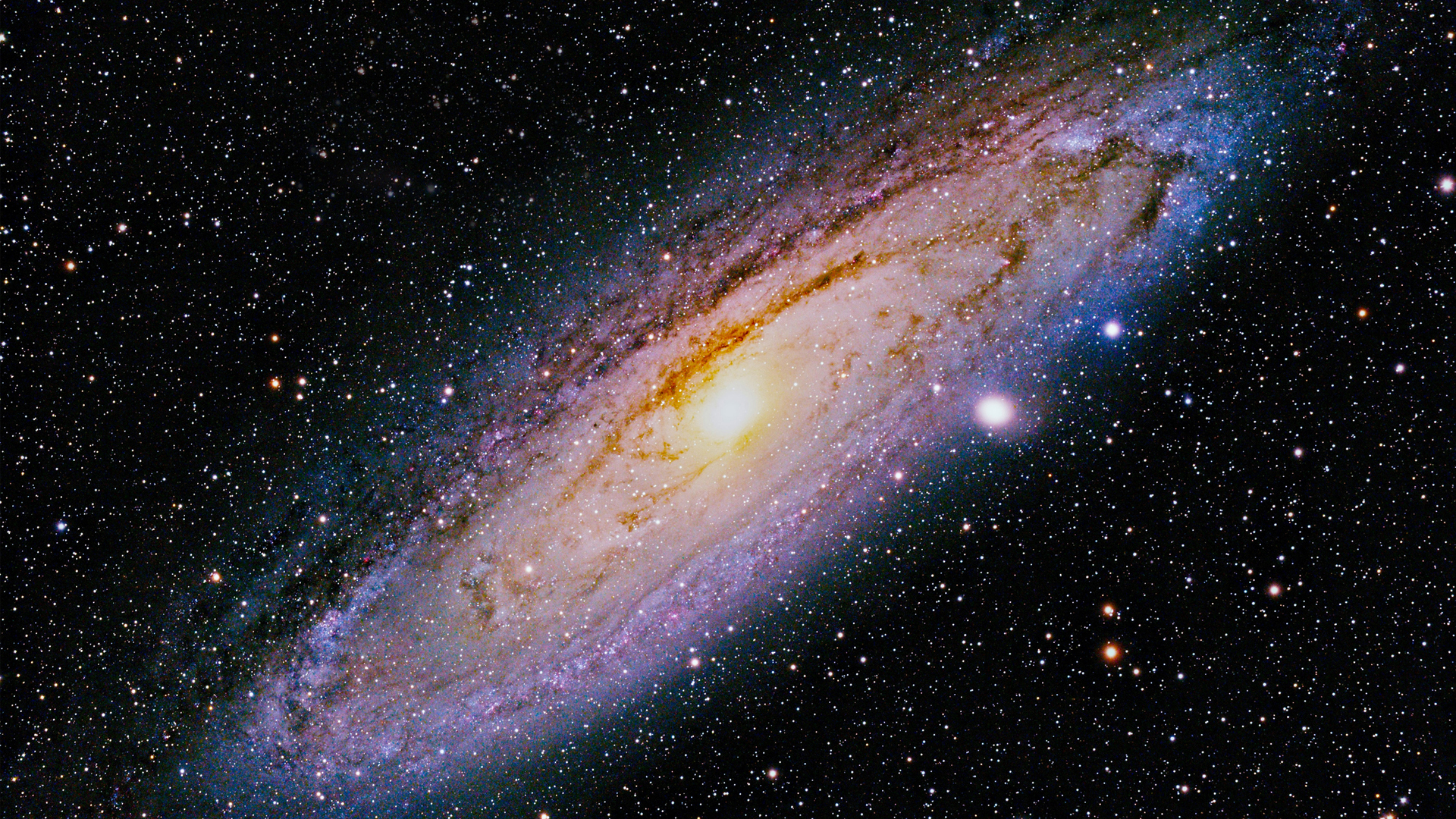
On a clear, moonless night far from city lights, a faint, glowing band stretches across the sky like a river of stars. For thousands of years, people around the world have admired this mysterious celestial path. Ancient Greeks believed it was milk spilled by the goddess Hera. Many Indigenous cultures saw it as a road traveled by spirits, while others imagined it as a great river flowing across the heavens.
Today, science has revealed an even more astonishing truth.
That pale band is not a cloud or a collection of nearby stars. It is the glowing disk of our home galaxy—the Milky Way. Every star visible to the naked eye belongs to it. Our Sun, Earth, the planets, countless nebulae, star clusters, and billions of other worlds are all tiny parts of this enormous cosmic city.
The Milky Way is so vast that even light—the fastest thing in the universe—takes about 100,000 light-years to travel from one side of its stellar disk to the other. It contains hundreds of billions of stars, immense clouds of gas and dust, mysterious dark matter, and a supermassive black hole hidden deep within its center.
Yet despite centuries of astronomical research, scientists continue to uncover surprising discoveries about our galaxy. New space telescopes, radio observatories, and the European Space Agency’s Gaia mission are constantly refining our understanding of this extraordinary structure.
The more we learn, the more remarkable our galactic home becomes.
Here are fifteen scientifically fascinating facts about the Milky Way that reveal just how extraordinary our corner of the universe truly is.
1. The Milky Way Is Astonishingly Large
The Milky Way is one of the largest galaxies in our local region of the universe.
Its visible stellar disk spans roughly 100,000 to 120,000 light-years across, although some studies suggest that its outermost gas and dark matter extend much farther. To appreciate this scale, imagine traveling at the speed of light—about 300,000 kilometers every second. Even at that incredible speed, crossing the galaxy from one side to the other would require around 100,000 years.
Human minds naturally struggle to grasp such distances.
If the Sun were reduced to the size of a grain of sand, the Milky Way would still stretch for thousands of kilometers on the same scale.
The galaxy is not simply wide; it is also relatively thin. Most of its stars lie within a disk only a few thousand light-years thick, giving it the appearance of a giant cosmic pancake with spiral arms wrapped around its center.
This immense structure serves as home to every object humanity has ever directly observed beyond our Solar System.
2. We Live Far from the Galactic Center
Many people imagine that our Solar System sits somewhere near the center of the Milky Way.
In reality, we live far from the galactic core.
The Sun orbits approximately 26,000 to 27,000 light-years from the center, located within a smaller spiral feature called the Orion Arm, or Orion Spur. This region lies between two larger spiral arms known as Sagittarius and Perseus.
Our location turns out to be remarkably fortunate.
The galactic center is an extremely crowded environment packed with stars, dense gas clouds, energetic radiation, and frequent stellar interactions. Conditions there are far more hazardous than in our relatively quiet neighborhood.
Being positioned in the outer regions provides Earth with a comparatively stable environment that has likely contributed to the long-term development of complex life.
In a sense, humanity occupies a peaceful suburban neighborhood rather than the bustling downtown of our galaxy.
3. The Milky Way Contains Hundreds of Billions of Stars
Astronomers cannot count every individual star directly because many are too faint, hidden behind dust, or located vast distances away.
Instead, they estimate the total population using observations, statistical modeling, and measurements of stellar density.
Current estimates suggest that the Milky Way contains between 100 billion and 400 billion stars.
Some are enormous blue giants shining millions of times brighter than the Sun.
Others are tiny red dwarfs so faint they cannot be seen without telescopes.
Many stars exist in binary or multiple-star systems, orbiting one another through gravity.
Every visible star in the night sky belongs to this enormous population.
And each of those stars may host planets of its own.
4. Our Galaxy May Contain Hundreds of Billions of Planets
One of the most exciting discoveries of modern astronomy is that planets are extraordinarily common.
Space missions such as Kepler and TESS have shown that planetary systems form around many stars.
Astronomers now estimate that the Milky Way likely contains at least as many planets as stars—and possibly many more.
This means our galaxy may host hundreds of billions of planets.
Some are scorching worlds orbiting close to their stars.
Others are frozen giants drifting far from stellar warmth.
Many may resemble Earth in size and composition.
Some planets wander through interstellar space without orbiting any star at all, having been ejected from their original planetary systems.
The realization that planets are common fundamentally changed humanity’s understanding of the universe.
Earth is no longer viewed as an exceptional planetary occurrence.
5. A Supermassive Black Hole Hides at the Center
At the very heart of the Milky Way lies one of its most extraordinary inhabitants.
Astronomers have discovered a supermassive black hole called Sagittarius A*.
It contains approximately four million times the mass of the Sun.
Unlike the dramatic portrayals often seen in science fiction, Sagittarius A* is relatively quiet today. It does not actively consume large amounts of surrounding material.
Scientists confirmed its existence by observing stars orbiting an invisible object with tremendous gravitational influence.
These stars complete rapid, highly elliptical orbits around something that emits little light but possesses enormous mass concentrated into an extremely small volume.
The evidence overwhelmingly supports the existence of a supermassive black hole.
In 2022, astronomers released the first direct image of Sagittarius A* using the Event Horizon Telescope, providing humanity’s first glimpse of the dark heart of our galaxy.
6. The Milky Way Is Constantly Rotating
Our galaxy is not stationary.
Every star, gas cloud, and star cluster moves through space under gravity.
The Sun travels around the Milky Way’s center at approximately 220 kilometers per second.
That is nearly 800,000 kilometers per hour.
Despite this tremendous speed, the galaxy is so enormous that completing one orbit takes roughly 225 to 250 million years.
Astronomers sometimes call this period a “cosmic year.”
The last time Earth occupied its current galactic position, dinosaurs had not yet appeared.
Since Earth’s formation about 4.5 billion years ago, our Solar System has completed only around twenty galactic orbits.
7. Dark Matter Dominates the Galaxy
Everything we can see—stars, planets, gas, and dust—accounts for only a small fraction of the Milky Way’s total mass.
Most of the galaxy appears to consist of invisible dark matter.
Dark matter neither emits nor reflects light, making it impossible to observe directly with telescopes.
Scientists infer its existence through gravity.
Stars orbit the galaxy faster than visible matter alone can explain.
Without additional unseen mass, many stars would escape into intergalactic space.
Instead, the galaxy remains gravitationally bound.
Dark matter forms a vast halo surrounding the Milky Way, extending far beyond its visible disk.
Although researchers still do not know the true nature of dark matter, its gravitational influence shapes the structure and evolution of our galaxy.
8. New Stars Are Being Born Right Now
The Milky Way is not a static collection of ancient stars.
It is constantly creating new ones.
Gigantic molecular clouds composed primarily of hydrogen gas drift throughout the galaxy.
Within these clouds, gravity gradually compresses dense regions until nuclear fusion begins.
A new star is born.
The Milky Way currently produces roughly one to two new stars each year.
Famous stellar nurseries such as the Orion Nebula showcase this ongoing process.
Powerful telescopes reveal glowing clouds filled with infant stars, protoplanetary disks, and energetic stellar winds.
Every newborn star represents the beginning of another potential planetary system.
9. Stars Also Die in Spectacular Ways
Just as stars are continually born, others reach the ends of their lives.
Small stars like the Sun eventually become white dwarfs after shedding their outer layers.
More massive stars experience far more dramatic endings.
They explode as supernovae, briefly shining brighter than entire galaxies.
These explosions scatter heavy elements—including oxygen, carbon, calcium, iron, and gold—into interstellar space.
Future generations of stars and planets form from this enriched material.
Every atom of calcium in your bones and much of the iron in your blood originated inside ancient stars that died billions of years before the Sun formed.
In a very real scientific sense, human beings are made of recycled stardust.
10. The Milky Way Has Spiral Arms
Seen from above, the Milky Way resembles a giant spiral.
Its arms are not rigid structures.
Instead, they are regions where stars, gas, and dust become temporarily concentrated due to gravitational density waves.
These spiral arms contain abundant molecular clouds and active star formation.
Some of the Milky Way’s best-known spiral arms include Perseus, Scutum-Centaurus, Sagittarius, and Norma.
Our Solar System resides within the smaller Orion Spur connecting larger arms.
The graceful spiral appearance that has inspired countless artistic illustrations reflects the dynamic movement of billions of stars over cosmic time.
11. The Galaxy Is Surrounded by Smaller Galaxies
The Milky Way is not alone in space.
More than fifty known dwarf galaxies orbit our galaxy as gravitational companions.
Among the best known are the Large and Small Magellanic Clouds, visible from the Southern Hemisphere.
These neighboring galaxies interact gravitationally with the Milky Way.
Some gradually lose stars to our galaxy.
Others may eventually merge with it entirely.
Astronomers have also discovered streams of stars stretching across the sky—remnants of smaller galaxies that were torn apart by the Milky Way’s gravity over billions of years.
Our galaxy continues to grow by absorbing these smaller systems.
12. The Milky Way Is Slowly Colliding with Another Giant Galaxy
One of the most extraordinary future events in cosmic history has already begun.
The Milky Way and the Andromeda Galaxy are moving toward one another.
Their collision is expected to begin in roughly 4 to 5 billion years.
Fortunately, the word “collision” can be misleading.
Because stars are separated by enormous distances, direct stellar collisions will be extremely rare.
Instead, gravity will gradually reshape both galaxies.
Their spiral structures will distort.
Gas clouds will compress, triggering bursts of star formation.
Eventually, the two galaxies will merge into a much larger elliptical or lenticular galaxy.
By that time, the Sun itself will be nearing the end of its life.
13. Invisible Magnetic Fields Fill the Galaxy
The Milky Way is threaded with enormous magnetic fields extending across thousands of light-years.
Although invisible, these fields influence the motion of charged particles and help shape interstellar gas clouds.
Radio telescopes detect these magnetic structures indirectly by observing polarized radio waves and cosmic rays.
Researchers believe galactic magnetic fields play important roles in star formation, cosmic ray transport, and the overall evolution of galaxies.
Studying these invisible forces remains one of modern astrophysics’ active research areas.
14. We Can Never Photograph the Milky Way from Outside
Nearly every stunning image showing the entire Milky Way from above is an artist’s illustration.
No spacecraft has ever traveled far enough to photograph our galaxy externally.
The reason is simple.
We live inside it.
Imagine trying to photograph an entire forest while standing among its trees.
Astronomers reconstruct the Milky Way’s appearance by combining observations from radio telescopes, infrared surveys, visible-light observations, and measurements of stellar positions.
The European Space Agency’s Gaia spacecraft has measured the positions and motions of more than a billion stars, allowing scientists to build increasingly accurate three-dimensional maps of our galaxy.
Even without an external photograph, humanity now possesses an extraordinarily detailed understanding of our galactic home.
15. The Milky Way Is Only One Galaxy Among Trillions
For centuries, people believed the Milky Way was the entire universe.
Even after telescopes improved, many astronomers assumed the spiral nebulae visible in the sky belonged to our own galaxy.
That understanding changed dramatically during the early twentieth century.
Observations showed that galaxies such as Andromeda lie far beyond the Milky Way.
Today, astronomers estimate that the observable universe contains hundreds of billions to perhaps around two trillion galaxies, depending on observational methods and extrapolations from deep surveys.
Our magnificent galaxy—immense beyond ordinary imagination—is itself only one member of an unimaginably vast cosmic population.
Each distant galaxy contains its own billions of stars, planets, nebulae, and perhaps even civilizations asking the same questions humanity asks today.
Our Place in the Milky Way
The Milky Way is far more than a collection of stars scattered across space. It is a dynamic, evolving system shaped by gravity, time, and the lives of countless generations of stars. It has been forming new suns for billions of years while recycling the remains of ancient stellar explosions into new worlds and, eventually, into living organisms like ourselves.
Every human who has ever lived was born within this galaxy. Every mountain on Earth, every ocean, every tree, every animal, and every person exists because of processes that unfolded within the Milky Way long before the Solar System formed.
When we look up on a dark night and see that faint ribbon of light stretching across the sky, we are not merely looking at distant stars. We are looking inward—across the immense disk of the galaxy that has been our home for 4.6 billion years.
The Milky Way reminds us that we occupy only a tiny corner of an immense cosmic structure. Yet it also reminds us of something equally profound: despite its staggering size and complexity, the human mind has learned to measure its stars, map its spiral arms, discover its central black hole, and uncover its history. Every new observation reveals another piece of the story, ensuring that our understanding of our galactic home continues to grow with every passing year.