When most people picture a galaxy, they imagine something like our own Milky Way—a graceful spiral of stars with elegant arms curving around a bright central bulge. For many years, astronomers believed that galaxies generally fit into a handful of familiar categories: spiral, elliptical, or irregular. But as telescopes grew more powerful and surveys reached deeper into the cosmos, a surprising truth emerged. The universe is far stranger than anyone had imagined.
Across billions of light-years, astronomers have discovered galaxies that look like glowing rings suspended in space, galaxies with no visible dark matter, galaxies almost entirely composed of dark matter, galaxies that create stars at unbelievable rates, galaxies with multiple black holes, and even galaxies so diffuse that they appear almost invisible despite being as large as the Milky Way.
These bizarre objects are more than cosmic curiosities. They challenge existing theories about galaxy formation, dark matter, gravity, and the evolution of the universe. Every unusual galaxy offers astronomers an opportunity to test scientific models under extreme conditions. Some discoveries have forced researchers to rewrite textbooks, while others remain active mysteries at the frontiers of astrophysics.
The following ten galaxies are among the weirdest ever discovered. Each stands apart from the billions of ordinary galaxies scattered across the observable universe, revealing just how creative nature can be on the grandest scales imaginable.
1. Hoag’s Object – The Galaxy That Looks Like a Perfect Cosmic Ring
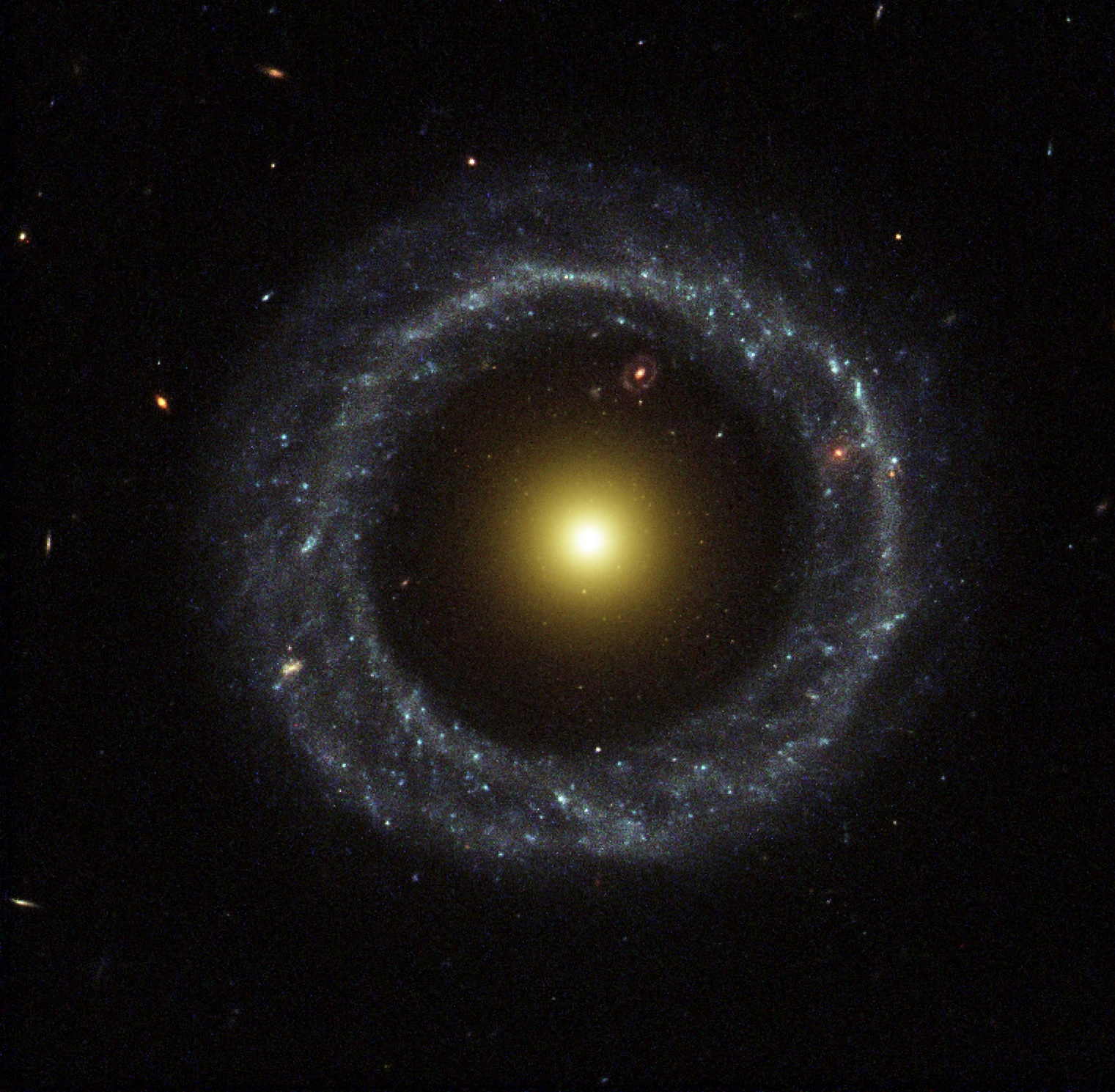
Among the most visually stunning galaxies ever found is Hoag’s Object.
At first glance, it almost appears artificial. A nearly perfect golden ring of brilliant blue stars surrounds a detached yellow central core, separated by an enormous gap that seems almost impossibly empty. Unlike ordinary spiral galaxies, no visible arms connect the center to the outer ring.
Discovered in 1950 by astronomer Arthur Hoag, this remarkable galaxy immediately puzzled scientists.
Ring galaxies are known to form when one galaxy passes through another, generating outward-moving waves of star formation. However, Hoag’s Object lacks convincing evidence of the kind of collision expected to produce such a perfect structure.
Another possibility is that the ring formed through internal gravitational processes over billions of years, perhaps involving a rotating bar that later disappeared. Yet this explanation also struggles to account for the galaxy’s extraordinary symmetry.
The outer ring contains numerous young, hot blue stars, indicating relatively recent star formation, while the central core consists primarily of much older yellow stars. This contrast suggests that different parts of the galaxy evolved at dramatically different times.
Even more intriguing, telescopes have detected another distant ring galaxy visible through the gap between Hoag’s Object’s center and outer ring, creating one of the universe’s most extraordinary cosmic alignments.
Despite decades of study, astronomers still debate exactly how this nearly perfect galactic ring came into existence.
2. Messier 87 – The Giant That Launches a Black Hole Jet
Located about 53 million light-years away, Messier 87 is already extraordinary simply because of its size. This massive elliptical galaxy contains trillions of stars, making it one of the largest galaxies in the nearby universe.
Its greatest claim to fame, however, lies at its center.
Messier 87 hosts one of the most massive black holes ever directly observed, containing roughly 6.5 billion times the mass of the Sun.
In 2019, it became the first black hole ever imaged by the Event Horizon Telescope Collaboration, producing the famous image of a glowing ring surrounding a dark central shadow.
Yet the galaxy’s strangest feature extends far beyond the black hole itself.
A narrow jet of energetic particles shoots outward from the galaxy’s center at nearly the speed of light, stretching thousands of light-years into space.
This jet is powered by matter spiraling toward the supermassive black hole. As gas falls inward, powerful magnetic fields channel some material away from the black hole rather than allowing it to cross the event horizon.
The result is one of the most energetic structures in the nearby universe.
The jet emits radio waves, visible light, X-rays, and gamma rays, allowing astronomers to study it across the electromagnetic spectrum.
Understanding how black holes generate such enormous jets remains one of the major challenges of modern astrophysics.
3. Dragonfly 44 – The Galaxy Made Mostly of Dark Matter
Most galaxies contain visible stars embedded within much larger halos of invisible dark matter.
Then astronomers discovered Dragonfly 44.
At first glance, the galaxy hardly seems to exist at all.
Its stars are spread so thinly across space that the galaxy appears ghostly and transparent.
Despite being nearly as large as the Milky Way, it contains only a tiny fraction of our galaxy’s visible stars.
Initially, measurements suggested that Dragonfly 44 possessed an enormous amount of dark matter—possibly accounting for more than 99 percent of its total mass.
If true, it would represent one of the darkest galaxies ever discovered.
Later observations complicated the picture, with some studies indicating substantially less dark matter than originally estimated.
This ongoing debate makes Dragonfly 44 scientifically valuable.
Whether it possesses an enormous dark matter halo or something much smaller, the galaxy challenges astronomers to understand how galaxies with so few stars can form and survive.
Its faint appearance reminds researchers that the universe may contain many more nearly invisible galaxies waiting to be discovered.
4. NGC 1052-DF2 – The Galaxy That Appears to Lack Dark Matter
If Dragonfly 44 seemed to contain unusually large amounts of dark matter, another galaxy appeared to possess almost none at all.
NGC 1052-DF2 shocked astronomers when detailed observations suggested that its stars moved as though very little dark matter were present.
This was astonishing.
Current models of galaxy formation generally predict that dark matter plays a crucial role in assembling galaxies.
Without substantial dark matter, many astronomers wondered how such a galaxy could even exist.
The discovery immediately sparked intense debate.
Some researchers questioned the original distance measurements.
Others reanalyzed stellar motions using improved observations.
Although discussion continues, NGC 1052-DF2 remains one of the strongest candidates for a galaxy containing remarkably little dark matter.
If confirmed, it would demonstrate that dark matter and ordinary matter can become separated under certain conditions, offering important clues about galaxy evolution and the nature of gravity itself.
5. IC 1101 – The Largest Known Giant Elliptical Galaxy
If someone asked what the largest galaxy in the observable universe looks like, the answer would likely involve IC 1101.
Located roughly one billion light-years away, this enormous galaxy dwarfs the Milky Way.
Its diameter is estimated to exceed five million light-years, making it dozens of times larger than our home galaxy.
Its immense size likely resulted from repeated mergers over billions of years.
As smaller galaxies fell toward the cluster’s center, gravitational interactions gradually combined them into one colossal system.
The central supermassive black hole may contain tens of billions of solar masses, although its exact mass remains uncertain.
IC 1101 demonstrates that galaxies are not static objects.
Given enough time, gravity continuously reshapes the universe, allowing giant galaxies to grow through countless cosmic collisions.
6. The Cartwheel Galaxy – A Cosmic Ripple Frozen in Time
Among the most spectacular galaxies ever photographed is Cartwheel Galaxy.
Its appearance resembles the wheel of an old wooden wagon.
Astronomers believe this remarkable structure formed when a smaller galaxy plunged directly through a much larger spiral galaxy.
The collision generated a powerful density wave that propagated outward like ripples across a pond after a stone is thrown into water.
As the wave moved through gas clouds, it compressed material and triggered intense star formation.
The result is a brilliant outer ring filled with young blue stars.
Recent observations by the James Webb Space Telescope revealed unprecedented details of the Cartwheel Galaxy, including hidden dust structures and regions of ongoing stellar birth.
The galaxy provides astronomers with a rare opportunity to observe the long-term consequences of a dramatic galactic collision.
7. ESO 137-001 – The Jellyfish Galaxy
Some galaxies appear to swim through space.
ESO 137-001 has become one of the best-known examples of a “jellyfish galaxy.”
As it races through the extremely hot gas filling its galaxy cluster, enormous pressure strips away its own gas.
This process, known as ram-pressure stripping, creates spectacular tails stretching tens of thousands of light-years behind the galaxy.
Remarkably, these tails are not simply debris.
Astronomers have observed new stars forming within them.
The galaxy effectively leaves behind glowing trails of stellar birth as it moves through intergalactic space.
ESO 137-001 illustrates how environments inside galaxy clusters can dramatically transform galaxies over time.
8. NGC 1275 – The Galaxy with Multiple Personalities
At the center of the Perseus Cluster lies one of the most complicated galaxies astronomers have ever studied: NGC 1275.
Rather than appearing as a single coherent system, it seems to involve two galaxies moving through each other.
One galaxy contains older stars.
The other contributes gas moving at different velocities.
Enormous filaments of glowing hydrogen extend outward for hundreds of thousands of light-years, illuminated by energy from the central supermassive black hole.
Powerful jets inflate gigantic bubbles within the surrounding hot cluster gas.
These bubbles help regulate cooling throughout the galaxy cluster, preventing excessive star formation.
NGC 1275 represents a laboratory for studying galaxy mergers, black hole feedback, and the interaction between galaxies and their environments.
9. Henize 2-10 – A Small Galaxy with a Surprisingly Powerful Black Hole
For many years, astronomers believed that only massive galaxies hosted giant central black holes.
Then they carefully studied Henize 2-10.
Although relatively small compared with giant spiral galaxies, Henize 2-10 contains an actively feeding massive black hole.
Even more surprisingly, observations suggest that energy flowing outward from this black hole may actually trigger star formation rather than suppress it.
This finding challenges traditional assumptions.
Black hole activity often heats surrounding gas, making star formation more difficult.
In Henize 2-10, however, the outflow appears capable of compressing gas clouds enough to stimulate new stellar birth.
The galaxy provides valuable insight into how black holes may have influenced the earliest generations of galaxies in the young universe.
10. GN-z11 – One of the Most Distant Known Galaxies
Sometimes a galaxy becomes extraordinary simply because of when it existed.
GN-z11 is among the most distant galaxies ever observed.
Its light began traveling toward Earth only about 400 million years after the Big Bang.
Observing GN-z11 is therefore equivalent to looking back more than 13 billion years into cosmic history.
Astronomers expected galaxies from such an early era to be relatively small and immature.
Instead, GN-z11 appears surprisingly bright and well developed.
Its existence raises important questions about how rapidly galaxies formed after the first stars ignited.
Recent observations by the James Webb Space Telescope continue to refine our understanding of this remarkable object, offering a glimpse into one of the earliest chapters of cosmic evolution.
What Makes a Galaxy Weird?
The galaxies on this list differ dramatically from one another, yet they share a common characteristic: each challenges expectations.
Some possess unusual shapes created by violent collisions.
Others contain unexpected amounts of dark matter—or almost none at all.
Some launch enormous jets powered by supermassive black holes.
Others stretch across millions of light-years or formed astonishingly early in cosmic history.
Their diversity reminds astronomers that galaxy evolution is far more complex than simple textbook classifications suggest.
How Astronomers Discover Strange Galaxies
Modern astronomy relies on much more than visible light.
Radio telescopes detect cold hydrogen gas.
Infrared observatories peer through cosmic dust.
Ultraviolet instruments reveal young stars.
X-ray telescopes observe hot gas and black hole activity.
Space observatories such as the James Webb Space Telescope and the Hubble Space Telescope provide extraordinary detail across vast cosmic distances.
Meanwhile, massive sky surveys employing automated software and artificial intelligence identify unusual galaxies hidden among millions of ordinary ones.
Many of today’s strangest discoveries were initially overlooked because they appeared too faint, too diffuse, or simply too unusual to fit existing classifications.
Why Weird Galaxies Matter
It is tempting to think of these galaxies as mere oddities, but they play a central role in modern astrophysics.
Scientific theories are tested most rigorously under extreme conditions.
An unusual galaxy can reveal weaknesses in existing models that millions of ordinary galaxies never expose.
Galaxies lacking dark matter test theories of gravity.
Ring galaxies illuminate the physics of collisions.
Jet-producing galaxies reveal how black holes influence cosmic evolution.
Ultra-diffuse galaxies challenge our understanding of star formation.
Extremely distant galaxies probe the earliest stages of the universe.
Every strange galaxy expands humanity’s understanding of how the cosmos works.
The Universe Is Stranger Than Imagination
The Milky Way feels familiar because it is home. Yet beyond our galactic neighborhood lies a universe filled with structures so unusual that they often resemble works of abstract art more than astronomical objects.
Perfect rings float in space without obvious explanation.
Invisible galaxies drift through the darkness.
Colossal black holes launch beams stretching across intergalactic distances.
Ghostly galaxies challenge theories of dark matter.
Ancient galaxies shine from a time when the universe itself was still young.
These discoveries remind us that nature is under no obligation to match human expectations.
Every new telescope reveals stranger galaxies than the last.
Every deeper survey uncovers objects that force astronomers to rethink established ideas.
In a universe containing hundreds of billions of galaxies—and perhaps far more—the weirdest galaxies ever discovered are unlikely to remain the weirdest for long. Somewhere beyond the limits of today’s observations, even stranger cosmic worlds are almost certainly waiting to be found.