Astronomers have identified a rare pulsar traveling faster than the expanding debris cloud left behind by the supernova that created it. Moving at more than 1,400 kilometers per second, the neutron star has escaped the shell of material surrounding its birthplace, offering a valuable opportunity to study some of the fastest-moving objects in the Milky Way.
The discovery emerged unexpectedly from a project investigating a different astronomical puzzle: why astronomers have found far fewer supernova remnants in our galaxy than they believe should exist.
Pulsars are rapidly spinning neutron stars formed when the cores of massive stars collapse during supernova explosions. They emit beams of radiation from their magnetic poles. When one of these beams sweeps across Earth, telescopes detect a series of remarkably regular pulses.
The explosions that create pulsars also eject enormous quantities of gas and dust, forming expanding structures known as supernova remnants. These shells gradually spread into surrounding space and typically dissipate within about 100,000 years.
But the newly identified pulsar appears to have moved faster than the debris from its own explosion, leaving it well outside the expanding shell.
A rare escape from a stellar explosion
Pulsars do not always remain near the places where they form. The explosion that produces a neutron star can also give it a powerful push, sending it speeding away from the center of the supernova remnant.
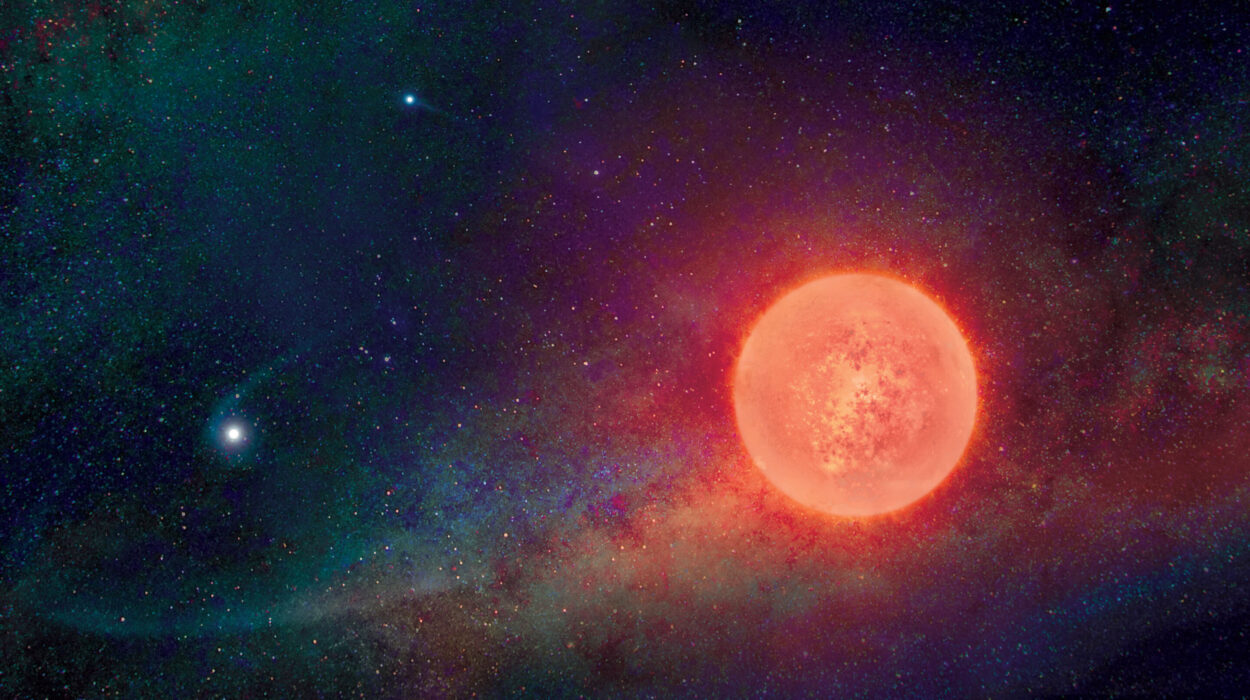
As a pulsar travels through surrounding gas, it can produce a trail of material resembling a comet’s tail. Such features can help astronomers trace the direction of its movement and connect it to its birthplace.
However, escaping the expanding debris entirely is unusual. Rohit Dokara, formerly at the Max Planck Institute for Radio Astronomy, says only a handful of comparable cases have been identified.
“As far as I know, there are four cases where, after a core-collapse supernova explosion, a pulsar has formed moving faster than the diffuse ejecta that eventually becomes a shell,” Dokara explains. “Such cases offer unique views of some of the fastest compact objects in our galaxy.”
The discovery adds another example to this small group and could help astronomers investigate how some neutron stars acquire such extraordinary speeds.
The origins of these powerful kicks remain incompletely understood.
Searching radio surveys for missing supernova remnants
Dokara and his colleagues originally set out to investigate another problem: the apparent shortage of supernova remnants in the Milky Way.
Astronomers estimate that roughly 2,000 such remnants should exist across the galaxy, but only about 400 have been discovered.
To investigate the discrepancy, the team combined observations from several large-scale radio surveys conducted by radio telescopes around the world over the past two decades. The surveys covered a wide range of radio frequencies and provided information about both supernova remnants and pulsars.
Radio telescopes can detect emissions produced when electrons spiral through magnetic fields in the expanding shells of supernova remnants. The same observations can reveal pulsars and the trails of material associated with them.
The researchers combined these images with existing measurements of pulsar timing to investigate possible connections between neutron stars and nearby supernova remnants.
Three measurements were particularly important.
First, the team used changes in each pulsar’s rotation rate to estimate its age. Pulsars gradually slow down as they rotate, and astronomers can measure this change by precisely recording the arrival times of their pulses.
Second, the researchers measured the apparent separation between a pulsar and the center of a suspected supernova remnant in radio images.
Third, they estimated the distance to the objects by measuring how much the arrival times of radio waves vary with frequency. Lower-frequency radio waves travel more slowly through the free electrons scattered between stars, producing measurable delays compared with higher-frequency signals.
Together, these measurements allowed the team to estimate a pulsar’s speed and assess the size and evolutionary stage of its associated supernova remnant.
A chance connection reveals an exceptionally fast pulsar
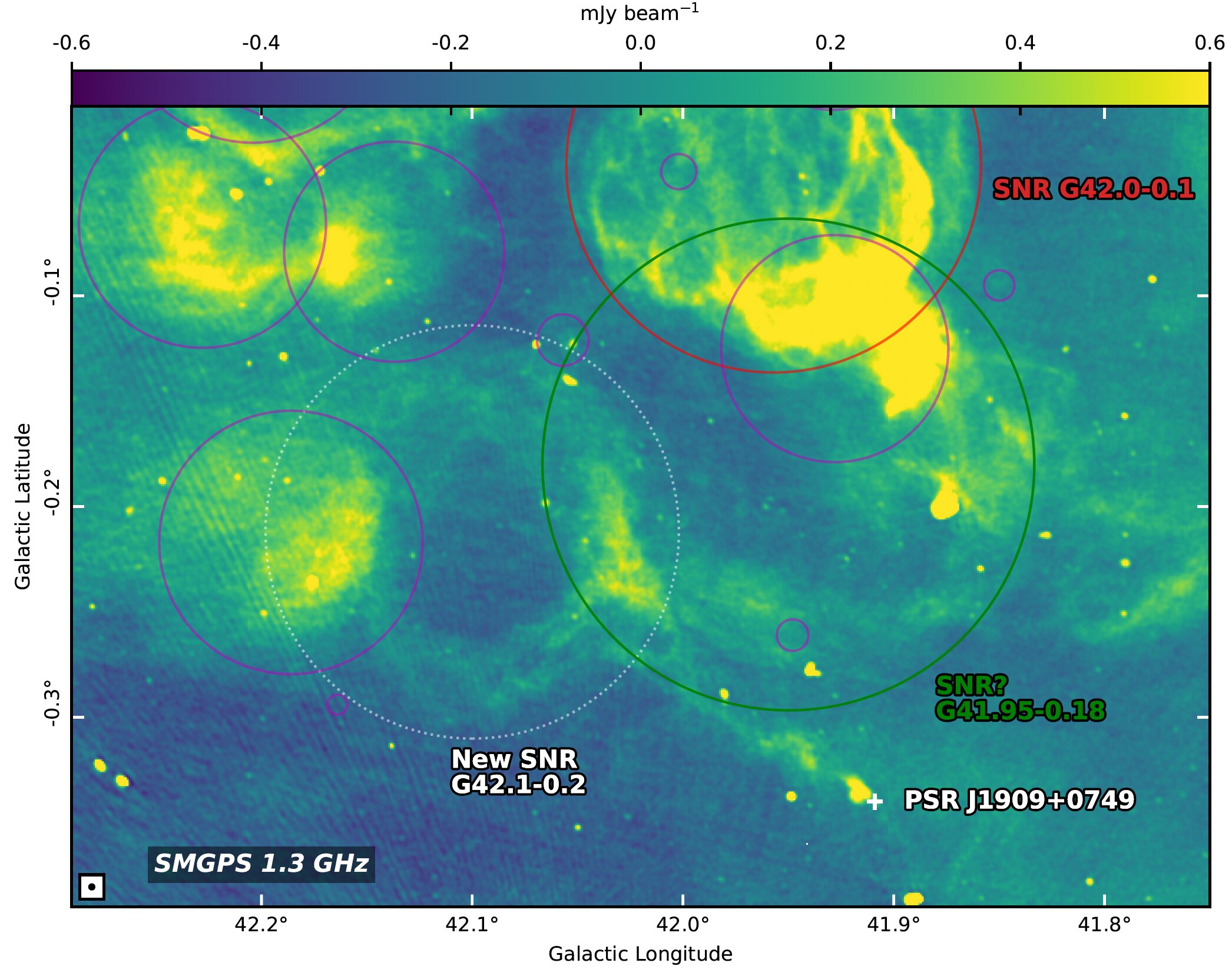
While examining the combined observations, Dokara noticed an association that had not previously been recognized: a known pulsar positioned well beyond a newly identified supernova remnant shell.
Its radio tail, however, pointed clearly toward the shell’s center, suggesting a connection between the two objects.
“By chance, I found a new supernova remnant shell and a known pulsar to be well outside this shell, but with its tail very clearly pointing to the center of the shell,” he says. “We estimated its transverse velocity to be over 1,400 kilometers per second (870 miles per second), making it one of the largest values for Milky Way pulsars.”
Transverse velocity describes an object’s motion across the sky, rather than its movement toward or away from Earth. The estimated speed therefore represents the pulsar’s sideways motion as seen by astronomers.
The combination of its position outside the shell and the direction of its tail makes the association particularly interesting. It suggests that the pulsar received an unusually strong kick during the explosion and subsequently moved beyond the expanding supernova debris.
The discovery was made using radio images from MeerKAT, a newer-generation radio telescope whose sensitivity and resolution helped reveal the shell and the pulsar’s tail.
More discoveries could follow
The researchers believe that increasingly sensitive radio telescopes could make it easier to identify other pulsars that have escaped their supernova remnants.
Large-scale surveys conducted with newer facilities may reveal similar structures that earlier observations missed. Combining data from different surveys could also help astronomers identify unusual connections between objects that might otherwise appear unrelated.
“The science potential for each such survey is enormous, and this work is just one small example of combining data from such surveys using standard methods to discover and identify rare associations,” Dokara adds.
Finding more examples could help researchers investigate the mechanisms that accelerate pulsars to extreme speeds. It may also contribute to efforts to understand why so many expected supernova remnants remain undetected in the Milky Way.
For now, the newly identified pulsar provides another rare case of a neutron star moving faster than the debris of the explosion that formed it.
The study is available on the arXiv preprint server.