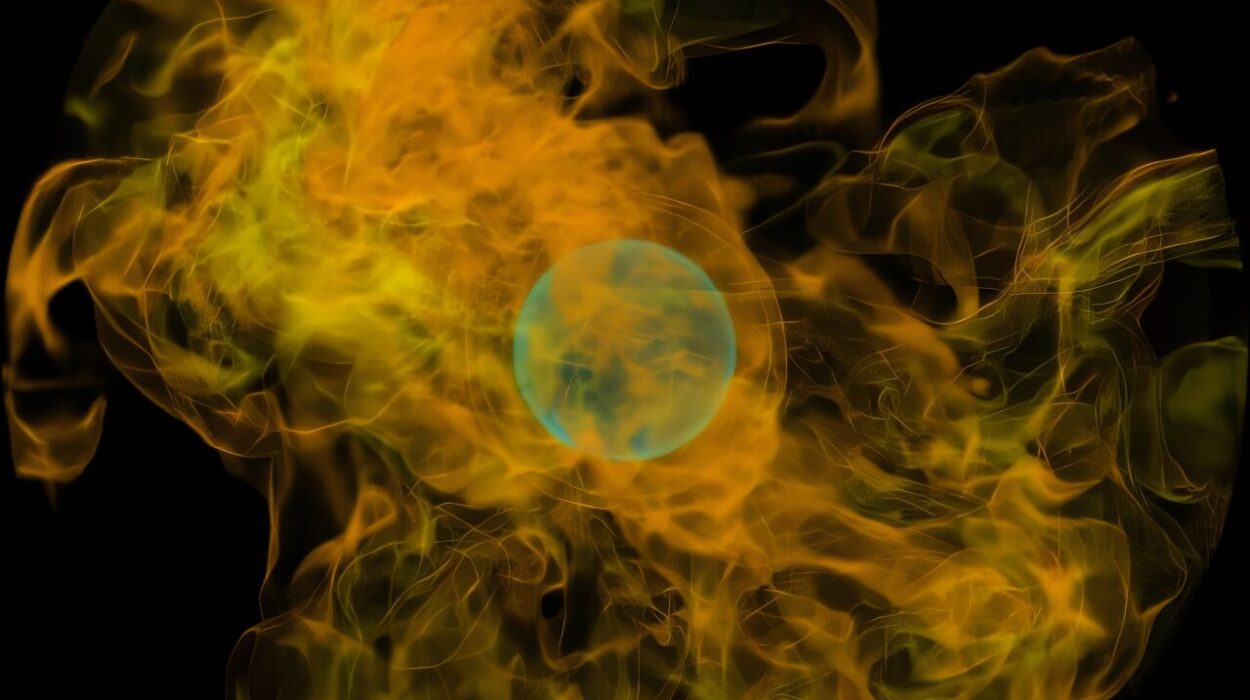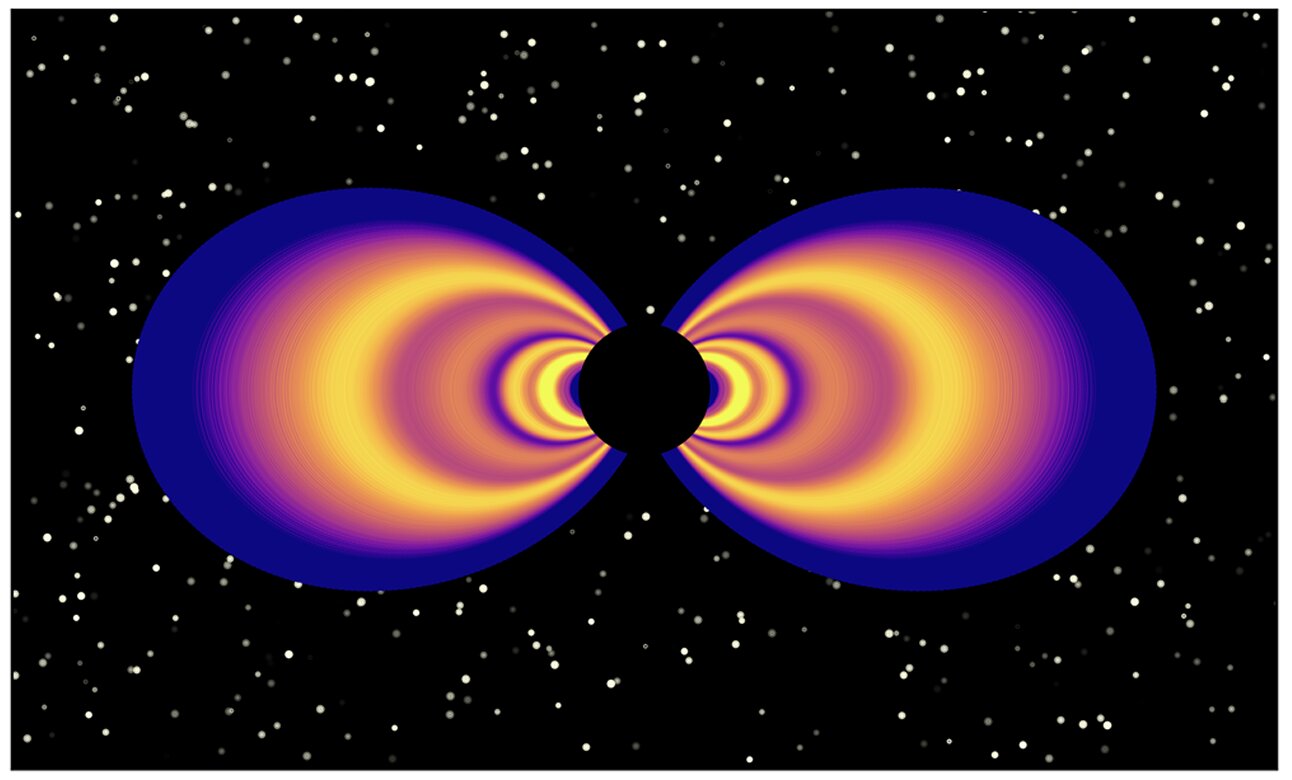
An intense solar storm in May 2024 temporarily transformed Earth’s familiar two radiation belts into four distinct belts, revealing how dramatically the planet’s radiation environment can change during extreme space weather. The unusual arrangement lasted more than four weeks before the belts returned to their usual configuration in August.
Earth is surrounded by two doughnut-shaped regions of energetic charged particles known as the Van Allen radiation belts. Held in place by Earth’s magnetic field, these belts contain high-energy electrons and other particles. Under normal conditions, they are separated by a region where relatively few energetic particles are found.
But this arrangement is not fixed. Powerful solar storms can disturb Earth’s magnetic environment, pushing particles into new regions and changing the distribution of radiation around the planet.
The May 2024 event, known as the Mother’s Day geomagnetic storm, produced an especially striking example. By analyzing satellite measurements collected after the storm, researchers identified four separate electron radiation belts rather than the usual two. Their findings also help explain why these additional belts form, although the exact physical processes remain uncertain.
A rare opportunity to study changing radiation belts
The possibility of additional radiation belts is not entirely new. In 2012, NASA’s Van Allen Probes detected a temporary third belt after a solar storm. It remained for approximately four weeks before disappearing.
Researchers proposed that the storm had pushed energetic electrons into the normally particle-sparse region between the two main belts. At the same time, electromagnetic waves may have removed electrons from other parts of the radiation environment, creating a new separation between particle-rich regions.
However, the explanation was difficult to establish. When solar activity reached a peak in 2014–15, the same three-belt arrangement did not appear.
The Mother’s Day storm in May 2024 offered another opportunity to investigate the phenomenon. It was the strongest geomagnetic storm observed in 20 years, making it an important event for examining how Earth’s radiation belts respond to extreme solar activity.
Satellite measurements reveal four distinct belts
A research team led by Viviane Pierrard of the Royal Belgian Institute for Space Aeronomy examined energetic-electron measurements from the particle telescope aboard the European Space Agency’s PROBA-V satellite.
Orbiting approximately 820 kilometers above Earth, the satellite recorded changes in the concentration of energetic electrons. The researchers mapped those measurements along Earth’s magnetic field lines to reconstruct the overall distribution of the radiation belts.
To distinguish lasting structures from temporary fluctuations, they counted a region as a belt or a gap only if it persisted for more than five days.
The analysis revealed that four distinct electron radiation belts developed in June 2024, following the May storm. The unusual configuration persisted for more than four weeks, with the familiar two-belt arrangement returning in August.
The researchers also identified three-belt structures following several later geomagnetic storms between 2024 and 2026. This suggests that additional radiation belts are not necessarily one-time events but can emerge repeatedly under suitable conditions.
The four-belt pattern was not present across every electron energy range examined. It appeared at several measured energies but was absent at the highest energies, indicating that the storm’s effects depended partly on the energy of the particles.
How a storm can divide the radiation belts
The researchers found evidence that electrons driven by the storm entered the normally sparse gap between the two main belts. This helped create an additional particle-rich region.
At the same time, new gaps appeared elsewhere in the radiation environment, separating the particles into more distinct belts.
The team suspects that electromagnetic waves played an important role in creating these gaps. Such waves can interact with energetic electrons, changing their paths and potentially causing them to lose enough energy to enter Earth’s atmosphere.
However, the precise processes responsible for forming the new gaps have not yet been established. The researchers also want to determine how much of the effect comes from naturally occurring electromagnetic waves and how much might involve human-generated radio signals, including powerful transmissions used to communicate with submarines.
Why the changing belts matter
Earth’s radiation belts are an important consideration for spacecraft operating in orbit. Energetic particles can damage satellite electronics and expose astronauts to radiation, making it important to understand where these particles accumulate and how their distribution changes.
A better understanding of how solar storms rearrange the belts could help scientists improve radiation assessments and inform the design of satellites intended to operate in Earth’s space environment.
Pierrard’s team plans to investigate the mechanisms behind the additional belts using computer simulations and mathematical modeling. More observations will also be needed to distinguish the effects of natural electromagnetic activity from those of human radio transmissions.
The research was published in npj Space Exploration.