A male rufous hummingbird has set a new migration record, traveling 6,526 kilometers (4,055 miles) from Alabama to Alaska in 38 days. The remarkable journey was documented using a tiny solar-powered tracking device that could help scientists uncover migration routes that have been difficult to study in these exceptionally small birds.
Hummingbirds may be among the smallest birds in the world, but their size does not prevent them from making extraordinary journeys. Some migrate thousands of miles between breeding and wintering grounds, yet following their movements has long been a challenge for researchers.
Traditional tracking devices are generally too heavy for birds weighing less than 5 grams (0.18 ounces). Even a relatively small transmitter can add a significant burden to such a lightweight animal.
A research team led by Emma M. Rhodes of the University of Memphis tackled this problem by developing a tracking device small enough for hummingbirds to carry. Their technology has now revealed not only a record-breaking migration but also some unexpected movements along the way.
A tracking device weighing just 0.06 grams
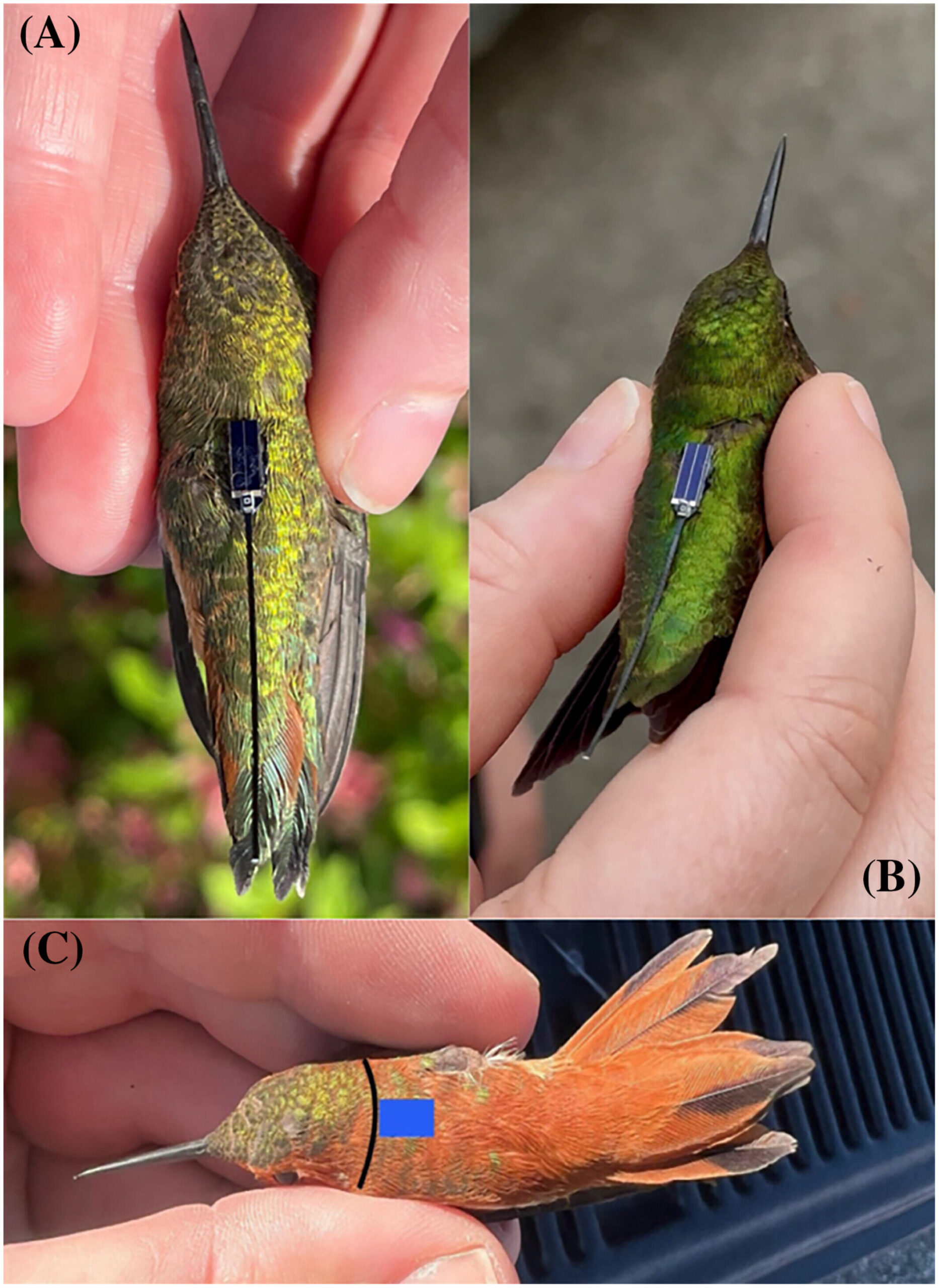
The device, called BlūMorpho, is a solar-powered transmitter weighing just 0.06 grams (0.002 ounces). It uses Bluetooth technology to communicate with nearby electronic devices.
Rather than relying on conventional satellite tracking, the system takes advantage of existing networks of smartphones, tablets and computers. The transmitter emits a unique signal every three seconds. When a compatible device comes within approximately 200 meters (656 feet) of a tagged bird, it can automatically and anonymously send the bird’s location data to an online database.
This allows researchers to monitor movements in near real time without requiring a dedicated tracking station at every location.
During spring 2025, the team attached the transmitters to four rufous hummingbirds (Selasphorus rufus) and seven ruby-throated hummingbirds (Archilochus colubris) in coastal Alabama and Florida.
The devices were glued to a small patch of trimmed feathers between the birds’ shoulder blades. Including the attachment, their weight amounted to no more than 3% of each bird’s body weight.
Thousands of location records reveal unexpected routes
The tracking system collected 23,784 location points across 23 U.S. states, Mexico and Canada.
On average, the researchers obtained tracking data for approximately 47 days per bird. The longest tracking period lasted 128 days.
The standout result came from a male rufous hummingbird that traveled 6,526 kilometers (4,055 miles) from Alabama to Alaska in just 38 days. It is the longest hummingbird migration documented to date.
But the other tracked birds also revealed movements that researchers might not have expected.
One rufous hummingbird initially traveled north before turning back south. It completed a large loop of 345 kilometers (214 miles) before changing direction again and heading east.
A ruby-throated hummingbird also took an unusual route, flying southeast from Alabama into Florida rather than following the expected northward or northeastern migration pattern.
These observations show that individual hummingbirds can follow routes that differ from the anticipated direction of seasonal migration. However, the small number of tracked birds means the findings cannot establish how common these movements are across either species.
Keeping the trackers attached is the next challenge
Although BlūMorpho has demonstrated its potential, the technology still has limitations. The researchers want to monitor hummingbirds for longer periods, but keeping the transmitters attached to individual birds remains a challenge.
“Currently, it is not longevity of the unit itself that is a limitation but retention time on the individual,” the study authors wrote.
There is also an important unanswered question about the potential effects of carrying the devices.
The study did not assess whether the transmitters influence hummingbirds’ behavior, physical condition or chances of survival over the long term. As the authors acknowledge, “This study was not designed to quantify potential behavioral, physiological, or survival effects of transmitters and attachment.”
That distinction matters when evaluating a tracking technology intended for such small animals. A device that is light enough to carry is not necessarily one that has no biological effects.
For now, the results demonstrate that an exceptionally lightweight tracking system can collect thousands of location records and document long-distance movements that would otherwise be difficult to follow. The 4,055-mile journey from Alabama to Alaska is the most striking example, but the unexpected routes taken by other birds suggest there is still much to learn about how hummingbirds navigate their seasonal migrations.
The research was published in the journal Ecology and Evolution.