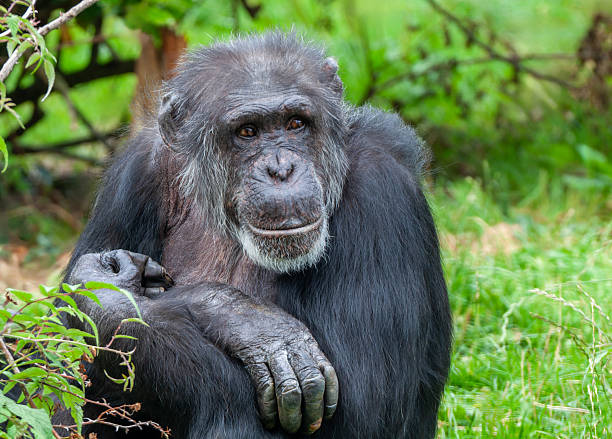
Humans appear to have inherited their unusually slow aging rate from ancient ape ancestors rather than evolving it recently, according to a new study analyzing mortality data from 39 primate species. The findings suggest that while primate lifespans vary dramatically, the biological pace of aging has remained remarkably stable for 20–30 million years, pointing scientists toward cross-species research to uncover the mechanisms behind healthy aging.
Living longer than our closest evolutionary relatives has long made humans an exception among primates. But exactly when this unusually slow pace of aging emerged has remained an open question.
Now, researchers from Calico Life Sciences LLC, CleMetric, and the University of Wisconsin–Madison have taken a closer look at aging across the primate family tree. Their findings, published in Proceedings of the Royal Society B, indicate that the slow aging seen in humans may have originated much earlier in evolutionary history than previously understood.
Reconstructing the Aging History of Primates
To investigate how aging evolved, the researchers estimated aging parameters for 39 different primate species, including apes, monkeys, lemurs, lorises, tarsiers, and humans. They then used those estimates to reconstruct the aging characteristics of long-extinct ancestral primates.
According to first author Eugene Melamud, the study was motivated by a long-standing scientific observation that humans age more slowly than most other mammals.
Historical work dating back to 1825, when Benjamin Gompertz analyzed mortality records from England, estimated that the human risk of death increases by roughly 8% per year during adulthood. That concept became the starting point for asking a deeper evolutionary question: how far back does this slow aging rate extend?
Answering that question required lifespan information from as many primate species as possible.
Building One of the Largest Comparative Primate Aging Analyses
The researchers turned to the Primate Aging Database (PAD), a large collection of life-history data assembled with support from the National Institute on Aging. The database contains mortality and lifespan records gathered from zoos and animal conservation sites around the world.
Working with PAD curator Wendy Newton, the team curated lifespan histories for 39 primate species, creating the foundation for their analysis.
Rather than simply comparing average lifespans, the researchers focused on measuring aging rate—how quickly the probability of dying increases after an animal reaches early adulthood.
To estimate these values, they relied on statistical approaches based on the Gompertz model of mortality, a mathematical framework widely used to describe how mortality risk rises with age.
The team also combined multiple modeling techniques, including phylogenetically informed life tables and Bayesian models that allowed them to analyze many related species simultaneously. The strong agreement among these independent methods gave the researchers confidence in reconstructing aging patterns in ancestral primates.
Lifespans Changed Dramatically, but Aging Rates Barely Did
One of the study’s most surprising discoveries was that large differences in lifespan among primates were not primarily explained by changes in aging rate.
Instead, the researchers found that aging rates remained relatively consistent across primate evolution, while baseline mortality risk—the likelihood that an animal dies after reaching adulthood—varied much more substantially between species.
In other words, closely related primates can have very different average lifespans even though the biological speed at which aging progresses remains remarkably similar.
This distinction suggests that lifespan and aging rate, although related, are not always driven by the same biological factors.
An Ancient Origin for Slow Aging
Perhaps the most striking conclusion came from reconstructing the characteristics of ancient primate ancestors.
The researchers estimated that the common ancestors shared by apes and Old World monkeys had aging rates that were approximately the same as those observed in humans today.
That means the slow pace of human aging may have evolved early in ape evolution and remained largely unchanged for approximately 20–30 million years.
Rather than representing a uniquely modern human adaptation, slow aging appears to be an inherited trait that has persisted across millions of years of evolutionary history.
Why Human Studies Alone May Not Reveal the Answer
The findings also carry important implications for future aging research.
If the biological mechanisms responsible for slow aging originated long before humans evolved, studying human populations alone may not be enough to identify the underlying genetics.
Instead, the researchers argue that comparisons across many different primate species will likely provide stronger clues about the genes and biological pathways associated with slower aging.
Examining similarities and differences across the broader primate lineage could reveal patterns that remain invisible when focusing exclusively on humans.
The Next Step: Searching for Biological Clues
The team plans to continue using the extensive resources available in the Primate Aging Database to explore additional dimensions of aging.
Future research will examine a wide range of biochemical and physiological measurements collected from primates. By comparing these biological markers with aging rates, the researchers hope to identify molecular signatures that consistently predict slower aging.
Those discoveries could eventually improve scientists’ understanding of the biological processes that influence how quickly organisms age.
Why This Matters
The study challenges the assumption that humans evolved their slow aging rate relatively recently. Instead, it suggests that this defining characteristic has deep evolutionary roots stretching back 20–30 million years to ancient ape ancestors.
Just as importantly, the research highlights that lifespan alone does not tell the whole story of aging. While primates differ greatly in how long they typically live, the biological pace of aging itself has remained surprisingly stable across much of their evolutionary history.
By shifting attention toward comparative studies involving many primate species, the findings provide a new direction for scientists searching for the molecular foundations of slow aging. Understanding why this ancient trait has endured for millions of years could ultimately help reveal the biological mechanisms that shape healthy aging across species—including our own.