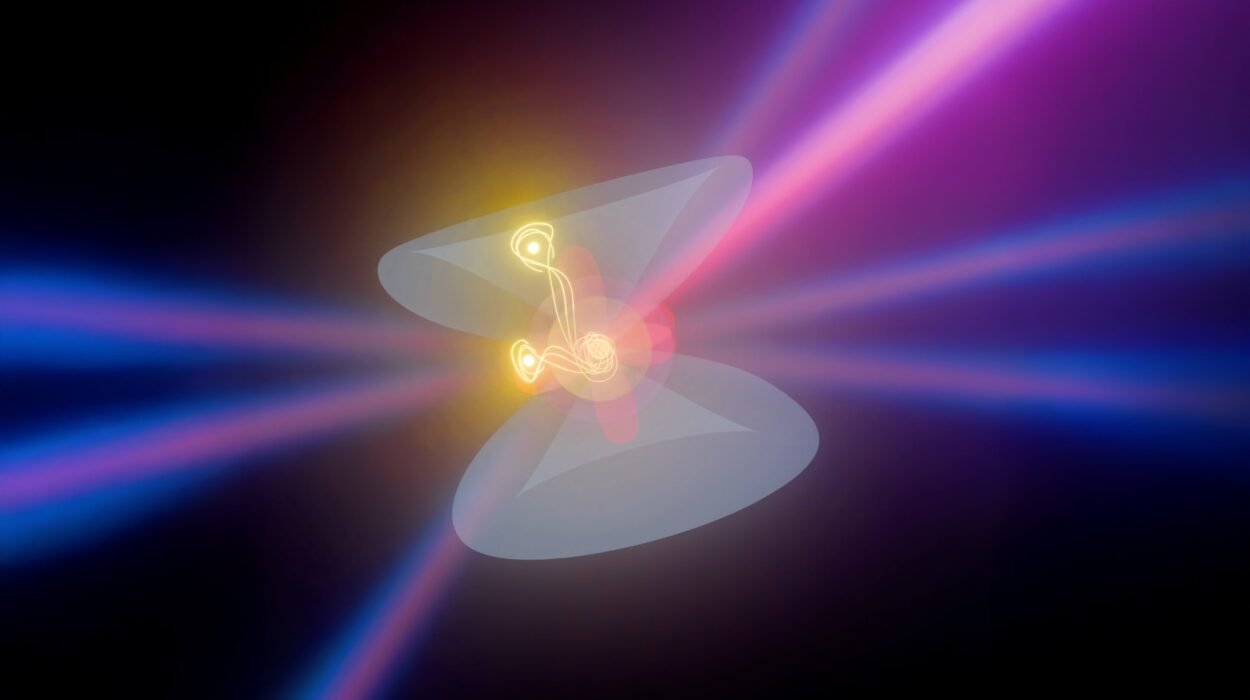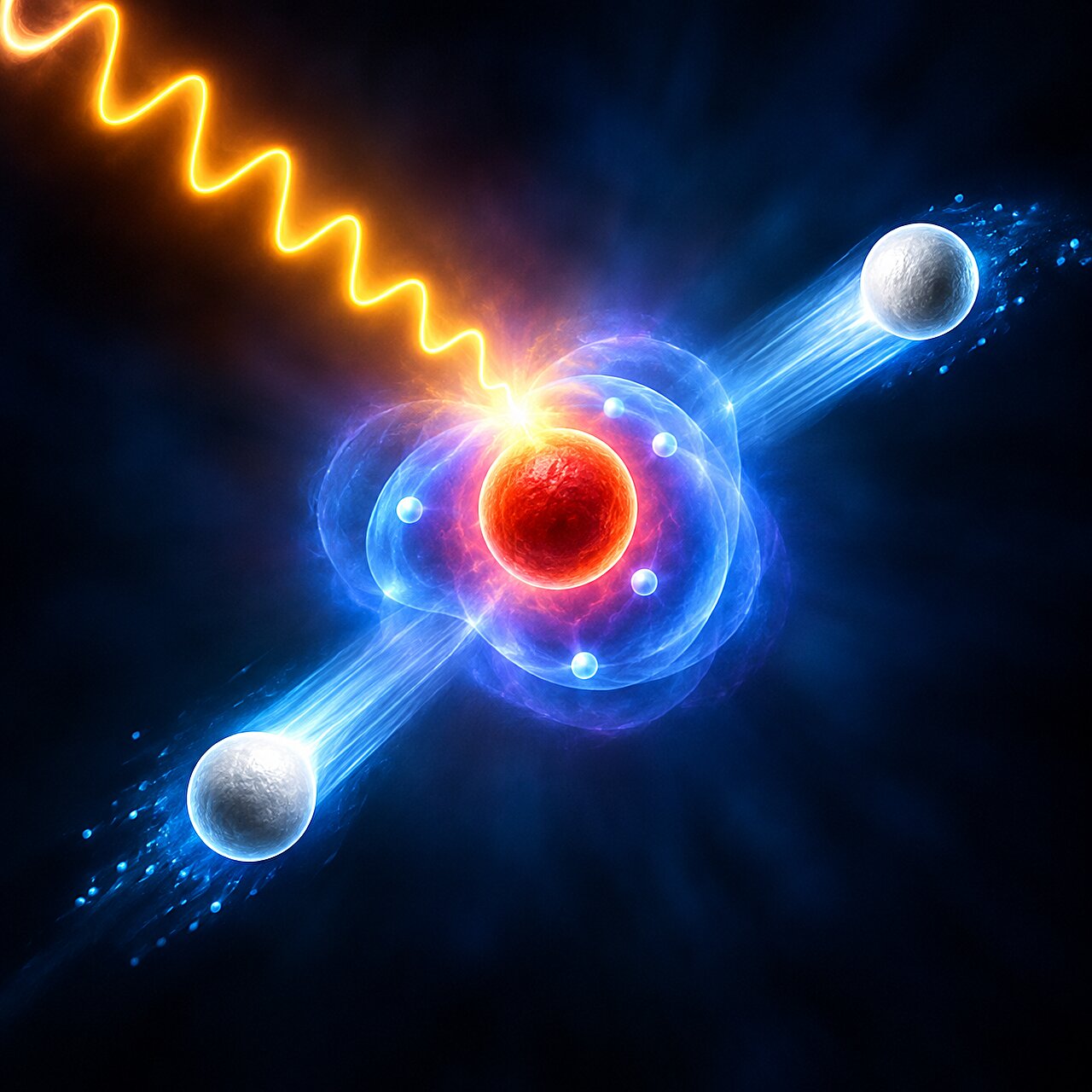
A single X-ray photon can break both hydrogen–oxygen bonds in a water molecule within just a few quadrillionths of a second, producing a highly reactive neutral oxygen atom. The process happens so quickly that the atoms separate before the molecule’s electrons have finished responding to the incoming radiation, revealing an unusually fast route for X-ray-driven chemical reactions.
Water molecules are often used to study how radiation interacts with matter. Their relatively simple structure makes it easier to follow the changes that occur when a molecule absorbs energy. But new research shows that even a molecule as familiar as water can undergo a surprisingly rapid transformation after absorbing a single X-ray photon.
The researchers found that both hydrogen atoms can separate from the oxygen atom before the molecule completes a process known as electronic relaxation. The result is an excited, electrically neutral oxygen atom that can take part in further chemical reactions.
The finding also helps explain unusual signals in previous X-ray experiments on water, which scientists had associated with different molecular fragments.
Watching a water molecule break apart
The research team studied isolated water molecules in the gas phase, exposing them to X-rays at two large-scale research facilities: PETRA III at DESY in Hamburg, Germany, and MAX IV in Lund, Sweden.
When a water molecule absorbs an X-ray photon, one of its inner-shell electrons is removed. This creates an unstable state called a core-ionized state. The molecule typically responds by releasing another electron through a process called Auger decay, in which an electron from a higher energy level fills the vacancy left behind by the first electron, transferring energy that ejects another electron.
This electronic relaxation happens extremely quickly. To investigate what takes place during the brief interval between X-ray absorption and electron emission, the researchers used high-resolution electron spectroscopy, which measures the energies of emitted electrons with great precision.
The measurements revealed unusually sharp features in the electron spectra. These signals did not match the expected behavior of an intact water molecule or its commonly considered fragments.
Instead, theoretical calculations indicated that both O–H bonds had already broken before electronic relaxation was complete. The resulting neutral oxygen atom was left in an excited state.
Its subsequent decay produced electrons at highly specific energies. Those energy patterns served as a distinctive signature, allowing the researchers to identify the atomic oxygen directly.
“What makes this result particularly exciting is that we see the molecule break apart before the electronic relaxation has even finished. Both O–H bonds rupture within the lifetime of the oxygen core hole, so the nuclear motion is essentially winning the race against the electrons,” says first author of the study Florian Trinter, FHI, Berlin.
Why identifying the oxygen atom matters
The team detected the same characteristic electron signal in experiments at both PETRA III and MAX IV. This agreement provided independent experimental support for the proposed fragmentation pathway.
Theoretical calculations were equally important. By comparing predicted electron spectra from molecular and atomic processes, the researchers could distinguish the signal from excited neutral oxygen from those produced by hydroxyl fragments.
Hydroxyl is a molecular fragment containing one oxygen atom bonded to one hydrogen atom. Earlier interpretations of similar high-energy electron signals had linked them to the decay of these fragments.
The higher-resolution measurements, combined with the calculations, instead point to neutral atomic oxygen as the source of the observed features.
“The energy of the emitted electrons provides a kind of fingerprint of the state that is formed. Our calculations show that the observed features are consistent with the decay of an excited neutral oxygen atom that has already separated from the water molecule,” says co-author Ludger Inhester, CFEL, DESY, Hamburg.
When atomic motion outpaces electronic relaxation
The speed of the breakup is linked to the strongly repulsive nature of the particular electronic state created when water absorbs the X-ray photon.
In this state, the forces acting within the molecule favor the separation of its atoms. Both O–H bonds can therefore rupture within the lifetime of the oxygen core hole, before the electronic relaxation process is finished.
The result highlights how closely the movement of atomic nuclei and changes in a molecule’s electrons are connected during radiation-driven reactions. Although electronic relaxation is generally expected to occur rapidly after X-ray absorption, the experiment shows that atomic motion can proceed even faster under certain conditions.
Neutral atomic oxygen is especially important because it is highly reactive and can initiate additional chemical reactions. Understanding how it forms could help scientists interpret the chemical changes triggered by X-rays in water and more complicated environments.
The findings also suggest that similarly rapid fragmentation pathways may occur in other small molecules and molecular clusters. Whether such pathways can be identified in those systems remains an open question.
The study was published in the journal Physical Review Letters.