One of the biggest challenges in nuclear fusion is keeping extremely hot plasma stable long enough to produce energy. Now, researchers have developed a mathematical model that explains what triggers a major improvement in plasma confinement and how much heating power is needed to achieve it. The model also offers predictions for two future fusion machines, including ITER and SPARC, helping scientists assess whether their planned heating systems will be sufficient.
Nuclear fusion works by combining light atomic nuclei, releasing energy in the process that powers the Sun. Reproducing this reaction on Earth requires heating gas to extreme temperatures until it becomes plasma, an electrically charged state of matter. The challenge is keeping that plasma hot enough for long enough to make fusion energy production possible.
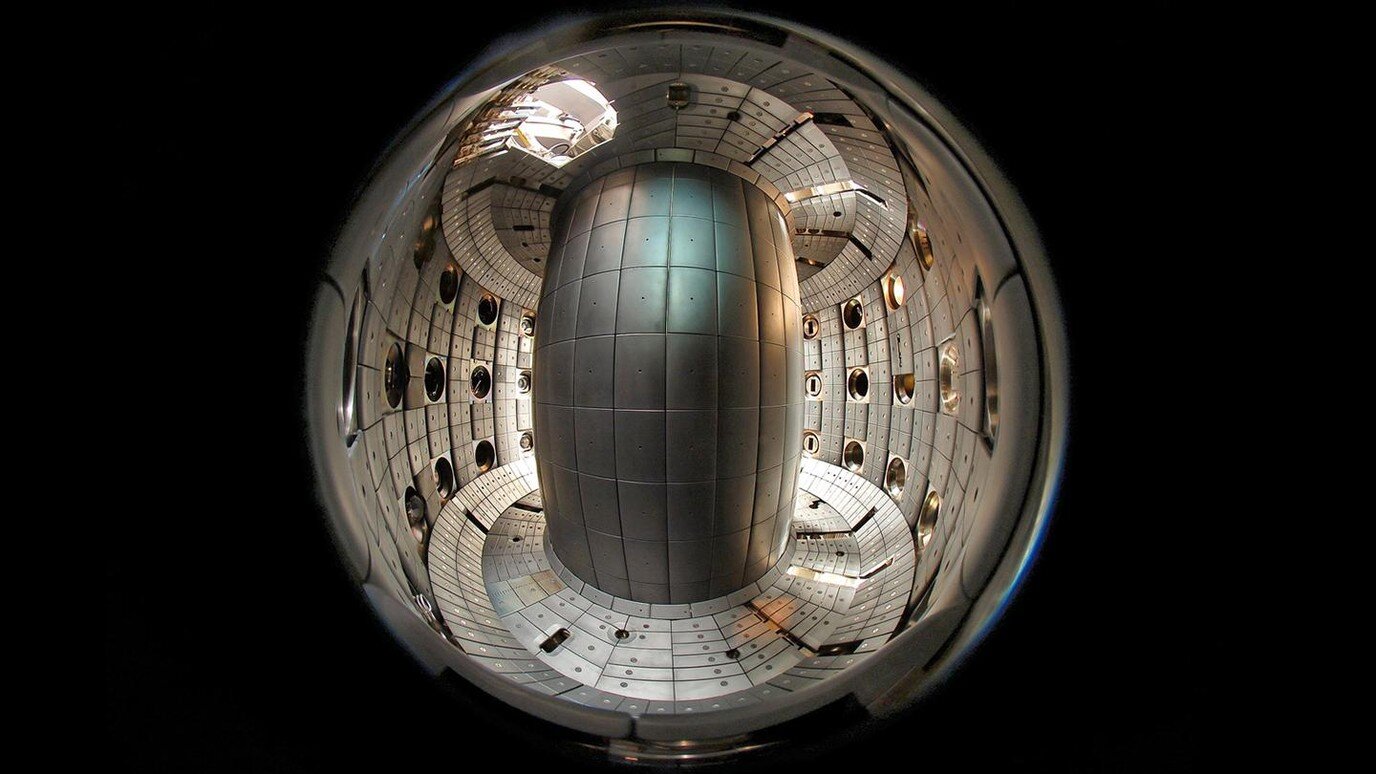
In many experimental fusion devices, scientists use machines called tokamaks. These devices confine plasma inside a doughnut-shaped chamber using powerful magnetic fields. But the plasma is far from calm. Turbulence creates fluctuations that carry heat away, making it harder to maintain the conditions required for fusion.
A major advance in understanding this problem came in 1982, when researchers discovered that increasing the heating power beyond a certain threshold could trigger an abrupt change in plasma behavior. Turbulence near the plasma’s outer edge drops sharply, allowing it to retain energy more effectively.
This improved state is known as high-confinement mode, or H-mode. The previous state is called low-confinement mode, or L-mode.
H-mode is particularly important for future fusion reactors, including ITER, the large international experiment being built in France. Yet scientists have struggled to predict exactly how much heating power is needed to trigger the transition.
The difficulty is that the threshold depends on several operating conditions, including plasma density and the direction of the magnetic field. Existing theories have not fully explained how these factors work together.
How turbulence can help suppress turbulence
A research team at EPFL’s Swiss Plasma Center has developed a theory that brings these effects together in a single physical framework.
Led by Brenno De Lucca, a doctoral assistant at the center, the team investigated how plasma behavior changes as heating power increases inside a tokamak. They used computer simulations to reproduce the transition, identified the physical processes involved and developed a mathematical model. They then compared the model’s predictions with experimental measurements from existing tokamaks.
The simulations showed that turbulence can generate flows moving at different speeds across the plasma’s outer region. These differences in flow speed help suppress the turbulence that initially carries heat away.
As turbulence weakens, heat losses decline and the plasma becomes better at retaining energy. This helps explain how increasing heating power can trigger the sudden shift from L-mode to H-mode.
The team also examined why reversing the direction of the magnetic field can change the heating power required for the transition.
Their calculations indicate that magnetic field direction, plasma flows and collisions between particles interact to make the transition easier in one magnetic configuration than in the other.
This provides a common explanation for two important features of the H-mode threshold: its dependence on plasma density and its sensitivity to magnetic field direction.
What the model predicts for ITER and SPARC
Beyond explaining the transition, the researchers derived equations showing how the required heating power changes with plasma density and other operating conditions.
One important result is that the relationship between density and heating power is not always straightforward. In one operating regime, the required power increases as plasma density rises. In another, it decreases.
The model predicts a density at which the heating requirement reaches its lowest point. This helps explain why the threshold can behave differently under different plasma conditions.
The researchers then applied their theory to two future fusion devices to estimate the heating power needed to reach H-mode.
For ITER, the model predicts a minimum heating requirement of 43 megawatts. That is below the machine’s planned heating capacity of 73 megawatts.
The picture is tighter for SPARC, a compact, high-field tokamak being developed by the U.S. company Commonwealth Fusion Systems. The researchers estimate that it will need at least 26 megawatts to reach H-mode, compared with its planned heating capacity of 25 megawatts.
The predicted requirement is therefore slightly higher than SPARC’s planned capacity, leaving considerably less room for uncertainty.
These figures are theoretical predictions based on the researchers’ model, not measurements of H-mode operation in either future machine. Their accuracy will ultimately depend on how well the model describes plasma behavior under the conditions encountered in those devices.
The work gives fusion researchers a physics-based way to estimate the power needed to achieve improved plasma confinement. It could help guide the assessment of heating requirements in future experiments, where reaching H-mode will be an important step toward maintaining the conditions needed for fusion.
The study was published in Physical Review Letters.