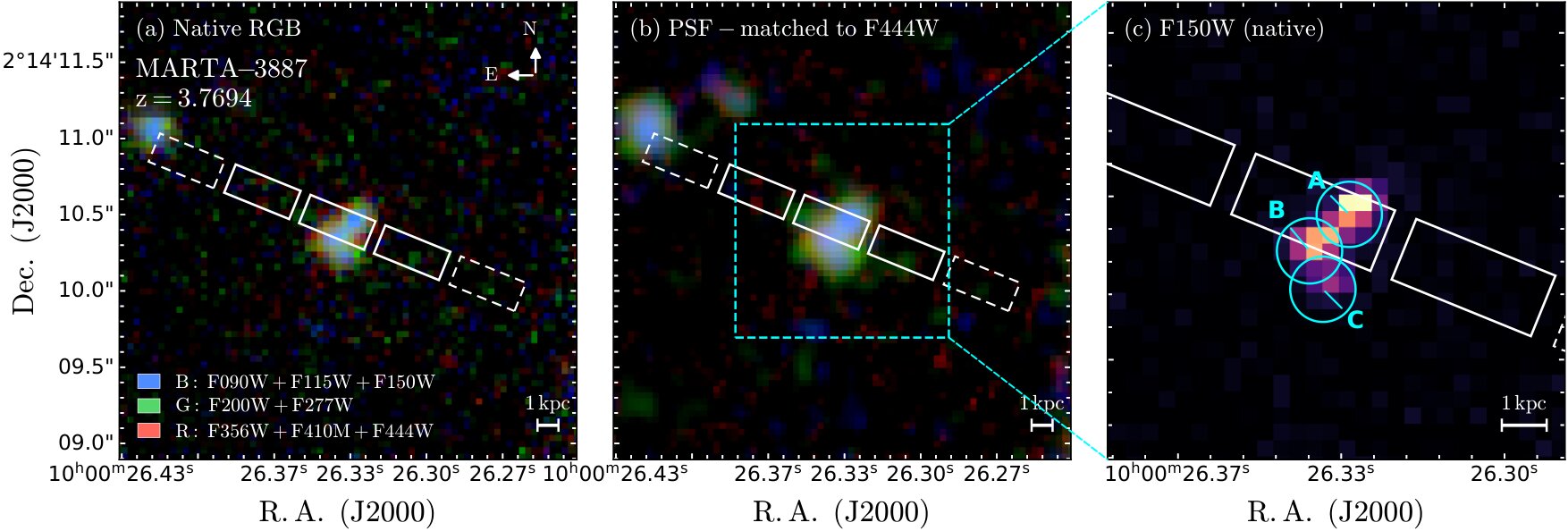
Astronomers have identified a possible black hole in a young, metal-poor galaxy that appears unusually massive compared with the stars surrounding it. The object, estimated at 3.3 million times the Sun’s mass, may offer clues to how black holes grew so large so early in cosmic history.
The galaxy, known as MARTA 3887, is seen as it was about 12 billion years ago. Despite containing only about 145 million solar masses in stars, it may host a black hole whose growth has far outpaced the development of its host galaxy.
That imbalance is particularly interesting because astronomers are still trying to explain how some black holes reached masses of hundreds of millions or even billions of suns within the universe’s first billion years. The candidate in MARTA 3887 is much smaller than those giants, but its apparent size relative to its galaxy could help researchers investigate how early black holes grew.
The evidence comes from observations across multiple wavelengths, combining spectroscopy from the James Webb Space Telescope (JWST), images from the Hubble Space Telescope and archival data from the Very Large Telescope’s MUSE instrument.
A black hole unusually large for its galaxy
In nearby galaxies, black hole mass generally follows a relationship with the mass of the galaxy’s stars. But observations of distant galaxies have increasingly revealed black holes that appear disproportionately massive compared with their host galaxies.
MARTA 3887 fits that pattern. Its candidate black hole has an estimated mass of 3.3 million suns, while the galaxy contains about 145 million solar masses in stars. That puts the black hole’s mass at roughly 2.3% of the galaxy’s total stellar mass.
The ratio is about 100 times higher than the relationship extrapolated from nearby galaxies, a difference astronomers describe as approximately two orders of magnitude.
That could mean the black hole grew faster than its galaxy accumulated stars. But the apparent imbalance may also reflect a bias in which black holes astronomers are able to detect.
Surveys tend to find the brightest or fastest-growing black holes, making the detected population disproportionately heavy for its host galaxy. Smaller, more ordinary black holes are much harder to spot, leaving astronomers with an incomplete picture of how black holes typically grow in the early universe.
What the telescope observations revealed
The researchers, led by Mirko Curti of the INAF–Astrophysics and Space Science Observatory of Bologna, looked for several independent signs that the object was a black hole rather than another energetic process within the galaxy.
JWST’s spectroscopic observations revealed a broad hydrogen-alpha emission line, a signal from hydrogen gas moving at about 1,270 kilometers per second. The unusually wide line suggests rapid motion. Importantly, the signal appeared in hydrogen but not in other emission lines, such as those from oxygen associated with more tranquil gas.
That pattern pointed toward a black hole as the source of the signal rather than an ordinary gas outflow.
Still, the identification is not definitive. An interacting supernova or a compact, dense outflow of gas could produce a similar signal. The researchers cannot eliminate those alternatives with the observations available from a single observing session.
How early could the black hole have started growing?
The galaxy is compact and clumpy, with a heavy-element abundance around 10% of the Sun’s. It is also forming stars rapidly, producing roughly five to nine solar masses of new stars each year, mostly during a recent burst of star formation.
To explore how the black hole could have reached its estimated mass, the team modeled its growth under simplified conditions: a single black hole growing continuously from an initial seed, without mergers and at a constant feeding rate.
The results depended strongly on when the black hole began growing and how massive it was at birth.
If growth started when the universe was just 100 million years old, seeds weighing 100, 10,000 or 100,000 solar masses would need to feed at about 34%, 19% and 11% of the maximum theoretical accretion rate, respectively.
Starting later, during the galaxy’s recent burst of star formation, would make the task much harder. A black hole beginning with just 100 solar masses would need to grow at about 570% of the maximum rate assumed in the model—an extreme scenario.
That points to two possible routes in the model: a small seed that began growing very early, or a substantially larger seed that could reach its present mass with a less demanding feeding rate. The calculations do not establish which route actually occurred.
Could the galaxy also be letting radiation escape?
MARTA 3887 may hold another clue to the early universe. Astronomers are interested in galaxies that allow high-energy ultraviolet radiation to escape into surrounding space. That radiation helped transform the early universe during cosmic reionization, when neutral hydrogen gas was gradually cleared of its ability to absorb light.
About 44% of the galaxy’s Lyman-alpha light—a particular wavelength of ultraviolet light produced by hydrogen—appears to escape. That is a relatively high fraction and suggests its gas may have openings through which radiation can travel.
However, the researchers have not measured how much of the galaxy’s ionizing ultraviolet radiation escapes. They therefore describe MARTA 3887 as an indirect candidate for a galaxy that leaks such radiation, not a confirmed example.
If the black hole interpretation holds up, MARTA 3887 would add to the population of actively feeding black holes detected in the early universe, extending observations into faint galaxies with relatively few stars and low metal content. It could help astronomers study black hole growth in galaxies where the central black hole may have developed well ahead of the stellar population.
The paper was posted on the arXiv preprint server.