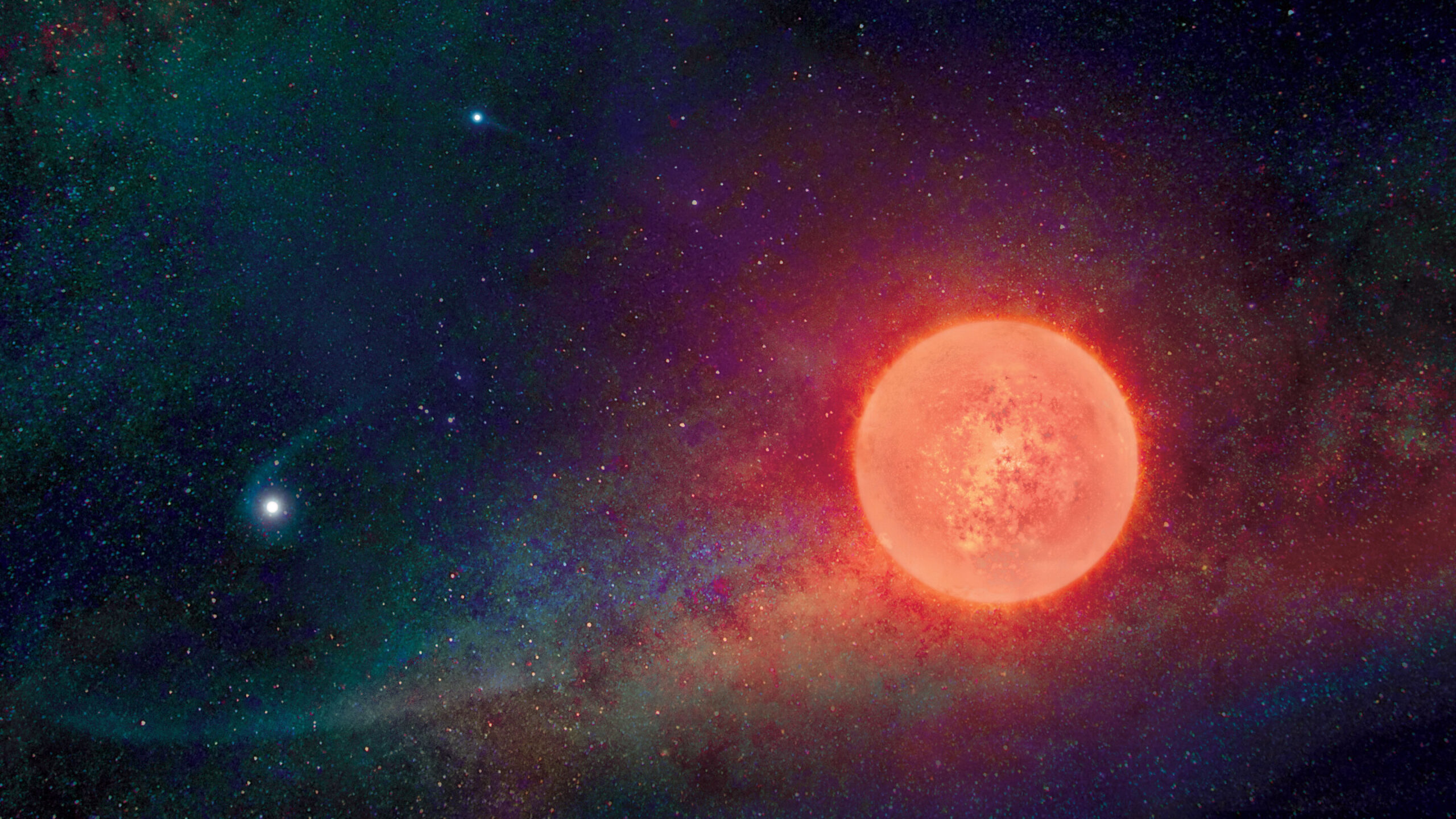
Just 28 light-years from Earth, astronomers have found an unusual family of three stars that challenges current ideas about how stars evolve. Two are white dwarfs, the dense remnants of dead stars, while the third is a red dwarf that appears to have survived an interaction that could have destroyed it. How this unlikely stellar arrangement formed remains a mystery.
The system, named Welopōʻai, is an unusual stellar family: two white dwarfs orbit a red dwarf, with one of the white dwarfs much farther away than the other. It is the closest known triple-star system containing two white dwarfs, and astronomers have found no comparable system within 100 light-years of Earth.
The discovery came unexpectedly. Researchers led by the Trottier Institute for Research on Exoplanets (IREx) at the Université de Montréal were looking for planets orbiting a nearby red dwarf when they noticed something that pointed to a much more unusual companion.
“We were actually looking for planets,” explained IREx researcher Étienne Artigau, the study’s lead author. “Instead, we found something much more surprising.”
A companion far too massive to be a planet
The search began with SPIRou, an instrument at the Canada-France-Hawaii Telescope on Maunakea, Hawaii. It detects planets by measuring subtle changes in the motion of their host stars caused by gravitational tugs from orbiting objects.
In this case, the red dwarf showed velocity variations of nearly 16 kilometers per second (10 miles per second), more than 1,000 times larger than expected. Follow-up observations over several years revealed that the unseen companion had a mass greater than half that of the sun.
That combination of substantial mass and very little light ruled out an ordinary planet and pointed toward a stellar remnant.
“The unusual combination of high mass and very low brightness left only one plausible explanation: It was the remnant of a dead star,” explained Charles-Antoine Parent, an undergraduate student at Université Laval and co-author of the study.
“The most likely explanation was a white dwarf, although a neutron star or even a black hole couldn’t be ruled out.”
White dwarfs are the compact remains of stars that have exhausted their nuclear fuel. They contain roughly stellar amounts of material packed into a much smaller volume, making them extraordinarily dense. Most stars, including the sun, are expected to end their lives this way.
Two stellar remnants, one surviving red dwarf
To confirm the identity of the companion, the astronomers turned to the Gemini North telescope on Maunakea. High-resolution images taken with its ʻAlopeke instrument revealed the faint white dwarf directly.
The observations established that the red dwarf has a close white dwarf companion, while another white dwarf orbits the pair at a much greater distance. That makes Welopōʻai a three-star system with two stars that have already reached the final stage of their evolution.
But the arrangement raises a problem about how the stars got there.
The newly identified white dwarf was once a star about 40% more massive than the sun. As it aged, it expanded into a giant, growing to several hundred times its original size. During that phase, it would have come close enough to the red dwarf for the two stars to interact dramatically.
In similar systems, an expanding giant star can engulf its companion. The interaction can lead to a merger, leaving no two separate stars behind. Yet Welopōʻai’s red dwarf appears to have survived, remaining in what researchers describe as a surprisingly wide, stable orbit.
Why the system is difficult to explain
The researchers also measured the mass of the newly discovered white dwarf with an uncertainty of less than 1%. Such precise measurements are relatively rare and can help astronomers test models of how stars evolve and how matter behaves at extremely high densities.
Still, the measurements have not resolved the system’s history. Astronomers do not yet know how the red dwarf avoided the destructive interactions that might have been expected when its companion swelled into a giant.
“This system should not exist,” said UdeM professor Patrick Dufour, who specializes in white dwarfs and co-authored the study. “We have no clean explanation for how it got here. That is the question driving our next observations.”
The team plans to investigate the gravitational interactions among the three stars to see whether their dynamics could help explain the system’s unusual evolution. Those observations may help clarify how the stars interacted in the past, although the mechanism that allowed Welopōʻai to survive remains an open question.
The name Welopōʻai was selected through A Hua He Inoa, a naming program at the ʻImiloa Astronomy Center of Hawaiʻi. It combines the Hawaiian words “welo,” meaning an inherited or family trait, and “pō’ai,” meaning an orbit or circular path, evoking a path of family traits.
The findings were published in Astronomy & Astrophysics.