The story of our universe has always been told through the lens of a great conflict between the very big and the very small. For decades, physicists have wrestled with a glitch in the cosmic code known as the black hole information paradox, a problem so profound it threatened to dismantle the foundations of quantum mechanics. Now, a team led by Richard Pinčák has published a study in the journal General Relativity and Gravitation that suggests the answer isn’t a rewrite of physics, but a hidden expansion of reality itself into seven dimensions.
The Ghostly Radiance That Broke the Universe
The trouble began in the 1970s with Stephen Hawking. He realized that black holes were not the eternal cosmic vaults everyone assumed they were. Through semi-classical calculations, Hawking showed that these giants actually leak a faint, ghostly glow now known as Hawking radiation. As they emit this energy, they lose mass, gradually shrinking over eons. This seems simple enough until you consider the finale: eventually, the black hole should evaporate entirely, vanishing from the map of existence.
This vanishing act creates a terrifying logical void. In our universe, the unitarity principle of quantum physics dictates that information can never truly be destroyed. If you burn a book, the information is technically still there in the patterns of smoke and ash. But if a black hole gobbles up a star’s worth of data and then disappears into nothingness, that information is gone forever. This violation of cosmic law suggested that either our understanding of gravity was wrong, or quantum mechanics was flawed at its core.
The Secret Twist in the Fabric of Space
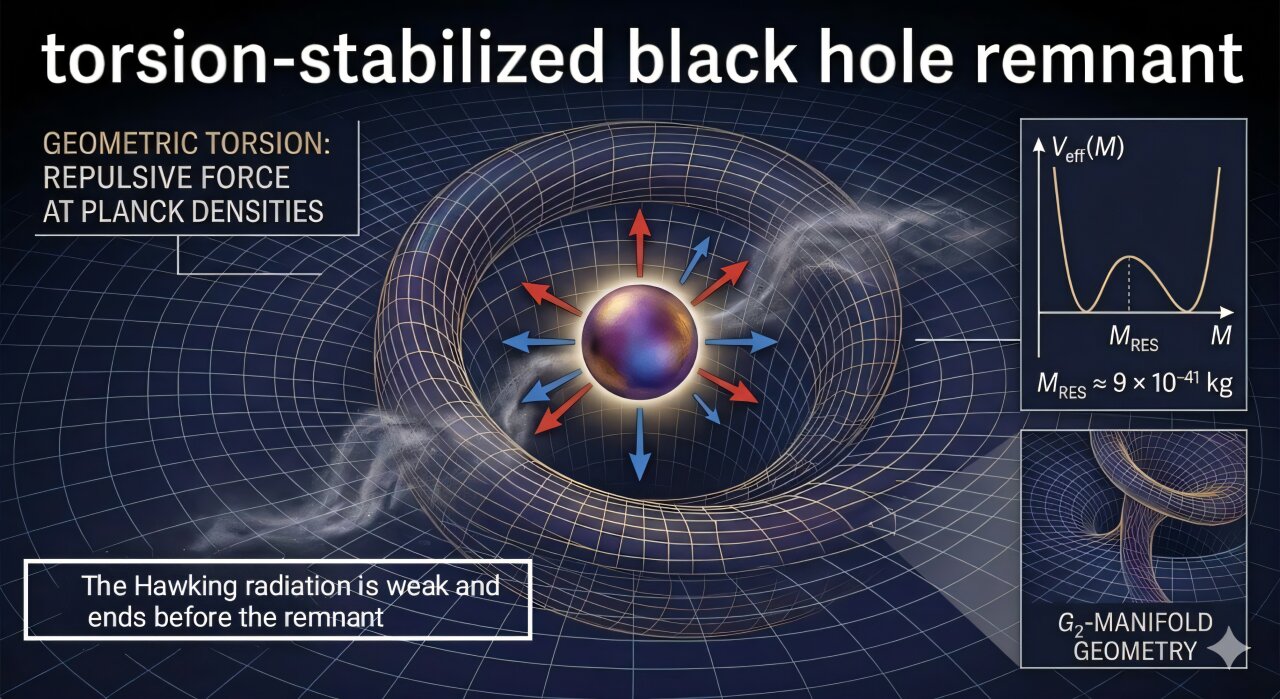
To fix this, Pinčák’s team didn’t look at the black hole as a simple three-dimensional sphere. Instead, they explored a complex geometry known as a G2-manifold with torsion. This isn’t the smooth, curved spacetime of Einstein’s standard theory. This model operates within Einstein-Cartan theory, which allows the fabric of the universe to do more than just curve under the weight of stars; it allows it to “twist.”
This “twist,” or spacetime torsion, acts as a hidden regulator of reality. The researchers discovered that when matter is crushed to the Planck scale—the absolute limit of density—this geometric torsion generates a powerful repulsive force. Think of it as a cosmic spring that refuses to be compressed any further. As a black hole shrinks toward its final moments, this force pushes back against the inward crush of gravity, dynamically halting the evaporation process before the black hole can vanish.
An Infinite Archive in a Tiny Remnant
Because the evaporation stops, the black hole never actually disappears. Instead, it leaves behind a stable remnant, a tiny “Planckian relic” with a predicted mass of approximately 9 x 10-41 kg. This speck of matter is the ultimate survivor, and it carries a heavy burden: it serves as a 7-dimensional cosmic hard drive.
The study proposes that all the information that fell into the black hole over billions of years isn’t lost; it is stored within the quasi-normal modes of the remnant. These are long-lived vibrations within the torsion field of the remnant’s geometry. To understand the sheer capacity of this storage, the team calculated that a remnant born from a black hole the size of our Sun would hold roughly 1.515 x 1077 qubits of information. This is the exact amount needed to account for every particle that entered the black hole, perfectly resolving the paradox and keeping the laws of quantum physics intact.
The Geometry That Gives Us Mass
The most startling revelation of the study, however, is that this 7-dimensional geometry doesn’t just solve the problems of black holes; it might explain why we exist at all. When the researchers performed a dimensional reduction—mathematically “folding” the extra dimensions down into the four dimensions of our perceivable world—something remarkable happened. The geometry naturally produced the electroweak scale, which is roughly 246 GeV.
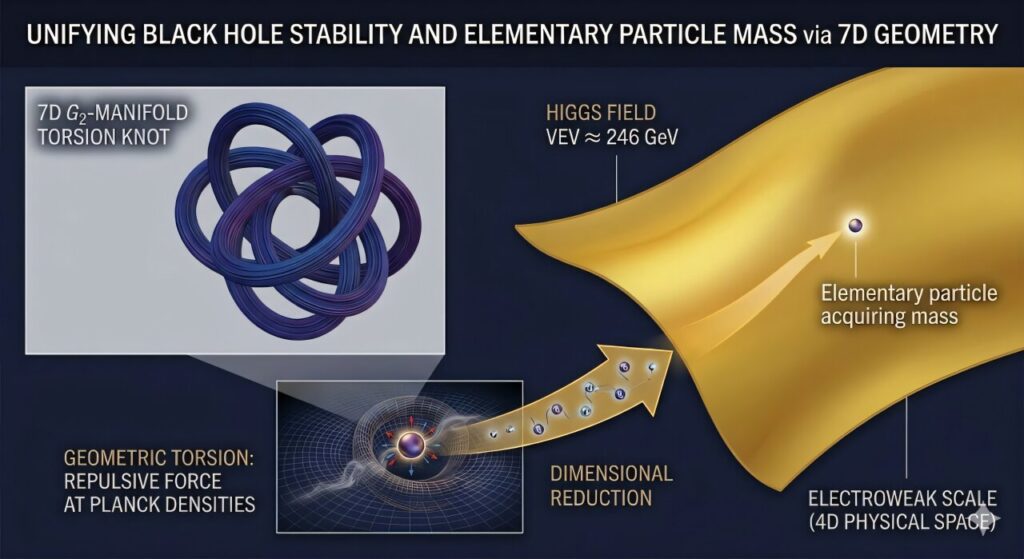
This number is the holy grail of particle physics. It is the vacuum expectation value (VEV) associated with the Higgs field, the invisible sea that gives mass to the elementary particles that make up our bodies and the stars. In this theory, the torsion field that saves information in a black hole is the same property that generates the Higgs boson’s influence. This creates a bridge between the cosmic scale of gravity and the subatomic scale of the mass hierarchy problem, suggesting that the weight of an electron and the survival of a black hole are two sides of the same geometric coin.
Hunting for the Invisible Dimensions
If these extra dimensions are real, why haven’t we seen them? The team’s calculations show that the particles associated with these dimensions, called Kaluza-Klein excitations, are unimaginably heavy. Their masses are estimated at 8.6 x 10¹⁵ GeV, which is eleven orders of magnitude higher than the energy levels reached by the Large Hadron Collider (LHC). We cannot build a machine on Earth powerful enough to “touch” these dimensions directly.
However, the theory is not just a mathematical daydream; it offers ways to be tested through the observation of the deep universe. Because these stable remnants have mass but are nearly impossible to see, the researchers suggest they could be a primary component of Dark Matter. If we can detect the gravitational signature of these tiny relics, we would have direct evidence of the 7-dimensional structure. Furthermore, the echoes of this geometry might be hidden in the Cosmic Microwave Background or in primordial gravitational waves—ripples in space left over from the dawn of time, when energies were high enough to activate these extra dimensions.
Why This Redefines Our Reality
This research matters because it suggests that the “broken” parts of physics are actually just missing pieces of a larger puzzle. By moving beyond a four-dimensional view, we find a universe that is self-preserving and deeply interconnected. The black hole information paradox was a warning that our map of reality was incomplete; by adding the “twist” of torsion and the depth of extra dimensions, we find a system where information is never lost and where the very mass of our atoms is a gift from the geometry of space. It invites us to see the universe not as a collection of separate particles and forces, but as a single, vibrating 7-dimensional fabric where nothing is ever truly forgotten.
Study Details
Richard Pinčák et al, Geometric origin of a stable black hole remnant from torsion in G2-manifold geometry, General Relativity and Gravitation (2026). DOI: 10.1007/s10714-026-03528-z