Primordial black holes, despite being no larger than an atom, could carry the mass of an asteroid and destroy a sunlike star from within, according to new theoretical research. The resulting explosion could produce a bright flash of ultraviolet light, X-rays and gamma rays, potentially giving astronomers a way to detect these elusive objects and investigate whether they contribute to dark matter.
Primordial black holes are hypothetical objects thought to have formed in the earliest moments after the Big Bang. Unlike black holes created when massive stars collapse, these objects may have emerged from exceptionally dense pockets of matter in the young universe.
Scientists have long considered the possibility that primordial black holes could account for some of dark matter, the invisible material that makes up most of the universe’s matter. But no primordial black hole has been confirmed.
Now, physicists at MIT and collaborating institutions have proposed a way to look for them: search for stars that are destroyed from within by a black hole they unknowingly captured.
Their calculations suggest that the encounter could end in a powerful stellar explosion, producing light that modern telescopes might be able to detect.
How a black hole could get inside a star
The smallest primordial black holes would have disappeared over time through a process known as Hawking radiation. This quantum effect, proposed by physicist Stephen Hawking, allows black holes to release energy and gradually lose mass.
But larger primordial black holes could have survived. The researchers focused on objects roughly the size of an atom but carrying the mass of an asteroid, or about one-millionth the mass of Earth.
The team first investigated how such an object might become trapped by a star.
A star’s gravity alone would not be enough to capture a passing primordial black hole, their calculations showed. However, the presence of another gravitational body, such as a companion star or planet, could change the situation.
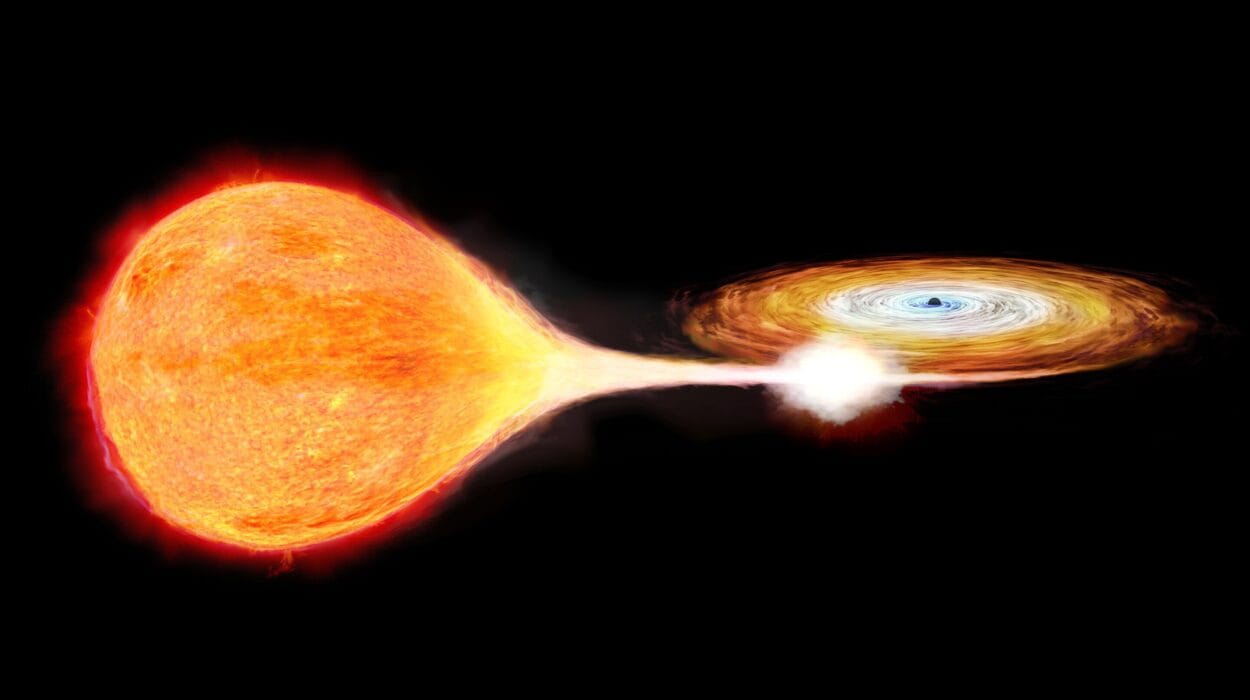
In this three-body arrangement, gravitational interactions could trap the black hole in an orbit that repeatedly takes it through the star. As it passes through the star’s material, friction would gradually drain energy from its motion, shrinking its orbit.
Over thousands to millions of years, the black hole could eventually settle into the star’s center. Although that sounds like a long wait, it is relatively brief compared with the age of the universe.
The star begins to disappear from within
Once inside, the black hole would start consuming the surrounding stellar material.
How quickly it grows depends partly on how much energy it releases into the surrounding gas. Heating that gas can slow the flow of additional material toward the black hole, limiting its growth.
But the researchers found that most of the energy would instead be carried into the black hole. This would allow it to grow more rapidly than earlier estimates suggested.
Within several million years, it could consume about 1 percent of the star’s mass.
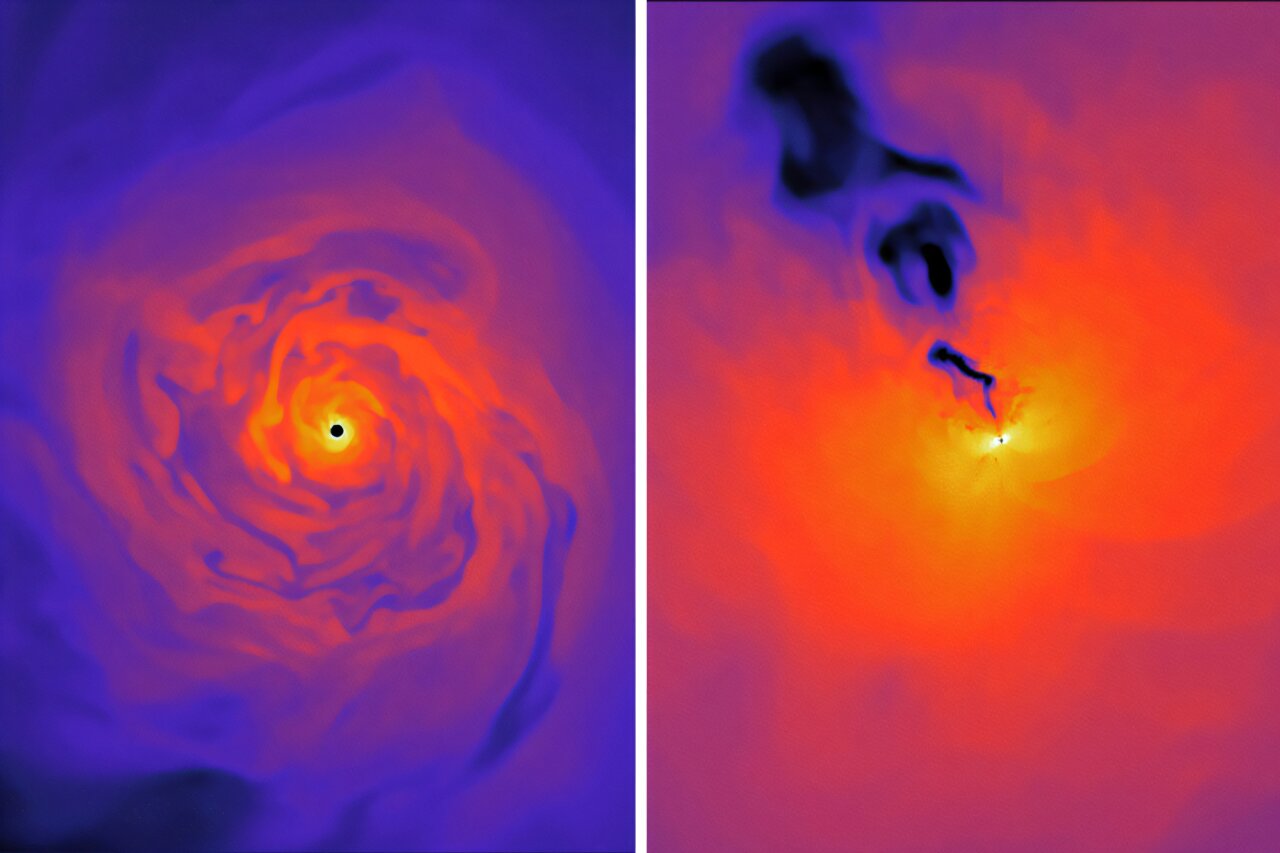
At that stage, the star’s rotation becomes especially important. If the star spins fast enough, its gas can no longer fall directly into the black hole. Instead, the material begins accumulating in a rotating disk around the black hole, which would then be only a few meters across.
This small disk could trigger the star’s destruction.
“Once the disk forms, this is essentially a death sentence for the star,” says lead author Ore Gottlieb, an assistant professor of physics at MIT.
As the black hole pulls material inward, its rotation would twist the surrounding magnetic field. The researchers’ simulations suggest that this process could power powerful jets of matter shooting outward from the black hole’s poles.
Those jets would travel through the star and ultimately tear it apart.
“This twisted magnetic field will power very strong electromagnetic jets from the poles of the black hole,” Gottlieb explains. “And these jets will just explode the star, within a few dozen seconds. It’s very fast. Once you have a disk, you are done.”
An explosion astronomers could look for
The predicted destruction would produce a burst of radiation across several parts of the electromagnetic spectrum.
The researchers calculated that the explosion should generate blue and ultraviolet light, along with X-rays and gamma rays. As the event develops, its emissions could shift toward optical and infrared light, followed later by radio waves.
“We would initially detect some X-rays and gamma rays, then over time optical and infrared emissions, and later on radio emissions,” Gottlieb says. “This is something we could potentially detect, if it’s not happening too far from us. It could be many galaxies away, not just in our backyard.”
The predicted brightness could make the event observable with existing telescopes, potentially even if it occurs in a galaxy far beyond our own.
However, spotting such an explosion would not automatically establish that a primordial black hole was responsible. Other astrophysical events can produce similar flashes, making it difficult to identify the underlying cause from light alone.
Astronomers would need to examine additional evidence about the exploding star and the characteristics of the radiation. One potentially useful clue would be finding an explosion involving a star whose mass would not normally be expected to produce such an event.
“For instance, if the star is a certain mass that is not supposed to explode, it must be something that is happening inside that is a sort of parasite that is consuming the star from the inside,” Gottlieb says. “The broader impact is that we can now place constraints on primordial black holes, and their contributions to dark matter, using observations.”
The research does not establish that primordial black holes exist or that they make up dark matter. Instead, it provides a theoretical prediction that astronomers can test against observations.
If a stellar explosion matching the predicted characteristics is identified and its origin can be established, it could offer a new way to search for these elusive objects and assess how much they might contribute to dark matter.
The research was published in The Astrophysical Journal.