At temperatures so low that motion nearly disappears, where most materials stiffen and surrender to brittleness, something quietly extraordinary happens. Inside a transparent, orange crystal, damage does not spell the end. Instead, it marks the beginning of a recovery.
Researchers at Jilin University in China have discovered that a specially designed organic crystal can heal itself even in the deep cold, a place where self-repair has long been considered impossible. These crystals, known as PBDPA, do not wait for warmth, pressure, or human intervention. When cracked, they simply begin to pull themselves back together, restoring almost everything they lost along the way.
The finding, published in Nature Materials, challenges a deeply rooted assumption in materials science: that cold stops healing. In this case, cold becomes part of the story, not the ending.
A Crystal That Refuses to Shatter
Most materials behave predictably as temperatures drop. Molecular motion slows, flexibility vanishes, and brittleness takes over. Under these conditions, cracks form easily and spread quickly, leaving behind permanent damage. This is why equipment operating in environments with extreme temperature changes suffers from fatigue and frequent failure.
The PBDPA crystals behave differently. When researchers deliberately introduced cracks at cryogenic temperatures, the crystals did not crumble. Instead, the fractures began to close. Without glue. Without heat. Without any external force. As the damage disappeared, the crystals recovered 99% of their original optical transparency, as if the break had almost never occurred.
This alone would be remarkable. But the story does not end in the cold.
Healing That Spans the Extremes
The same crystals that healed at cryogenic temperatures also repaired themselves at ambient temperature (298 K) and continued to do so even at elevated heat levels, reaching 423 K. This ability to self-heal across such a wide temperature range sets PBDPA apart from most known materials.
Traditional self-healing systems tend to rely on softness. Polymers and gels can flow, allowing molecules to migrate into cracks and seal them. But that approach collapses in the cold, where movement nearly stops. PBDPA does not rely on flow at all. Its healing is built into its structure.
This structural resilience opens the door to materials that could survive repeated stress in environments where repairs are difficult, expensive, or even impossible.
Watching Damage Reverse Itself
To understand how this healing happens, the researchers first had to create the crystals themselves. They synthesized PBDPA by combining 2,2′-(1,4-phenylene)diacetonitrile with 4-(diphenylamino)benzaldehyde, producing plate-shaped crystals with a striking orange transparency.
Once formed, the crystals were intentionally damaged. Cracks were introduced under different temperature conditions, and the healing process was observed using a microscope capable of atomic-scale resolution.
What the researchers saw was not random or chaotic. It followed a clear and repeatable pattern, revealing two distinct modes of repair.
The Moment a Crack Decides to Close
When the broken surfaces were close together, the response was almost immediate. The crystal snapped back into place, sealing the fracture in an instant. But when the gap was wider, healing unfolded more slowly, in a way that resembled the closing of a zipper.
The process always began at the points where the two surfaces were closest. These regions reconnected first, pulling neighboring areas inward. Gradually, the entire crack closed as the molecules realigned with remarkable precision.
This was not a passive process. Something inside the crystal was actively driving the repair.
Invisible Forces Doing Heavy Work
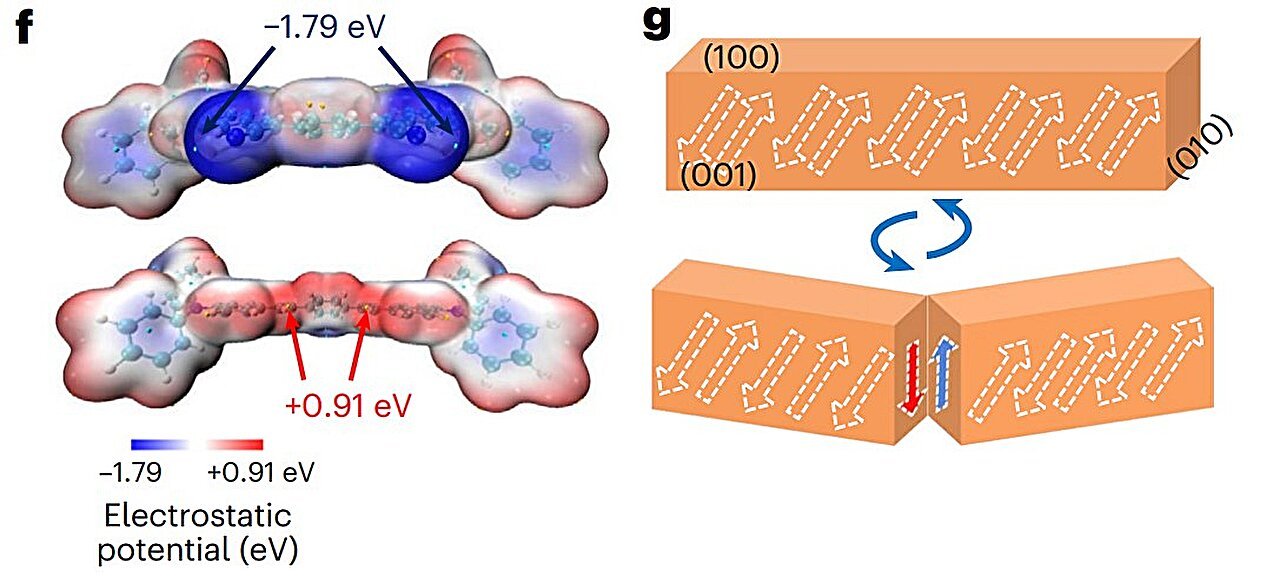
Electrical mapping revealed the source of this surprising behavior. The healing was powered by dipole–dipole interactions, strong electrical attractions that exist between molecules with uneven charge distributions.
Each molecule in a PBDPA crystal is polar, meaning it has a positive end and a negative end. This creates what scientists call a permanent dipole. Inside the crystal, these dipoles are not randomly arranged. Within each layer, all molecules point in the same direction. In the next layer, they flip, pointing the opposite way.
This alternating pattern generates a powerful attraction between layers. When a crack forms, these electrical forces do not vanish. Instead, they pull the separated surfaces back toward one another, guiding the molecules into their original positions until the crystal structure is restored.
Because this mechanism does not depend on molecular flow, it continues to work even when movement is severely limited by cold.
Why Cold Usually Wins, and Why It Didn’t This Time
At cryogenic temperatures, materials typically lose their ability to absorb stress. Molecular vibrations slow, flexibility disappears, and fractures propagate with ease. This is why extreme cold is such a formidable enemy to structural integrity.
The PBDPA crystals overcome this limitation by relying on internal order rather than motion. Their healing is not a matter of filling space but of reuniting structure. The electrical attractions embedded in their layered arrangement remain active regardless of temperature, allowing the material to resist the usual decline into brittleness.
This discovery shows that the natural barriers to self-healing in freezing environments are not absolute. They can be redesigned around.
A Glimpse of Long-Lived Materials
Materials exposed to fluctuating pressure and temperature degrade over time, and this degradation accelerates dramatically in extreme conditions. Equipment used in aerospace, deep-sea exploration, and polar research routinely faces these challenges, often far from easy repair or replacement.
A material that can repair itself across both extreme cold and high heat could dramatically extend the lifespan of such systems. By healing damage as it forms, it could reduce maintenance needs and lower long-term costs, while improving reliability in environments where failure carries high risk.
The researchers behind this study emphasize that their results make it clear that self-healing is not limited to soft, flowing materials or warm conditions. With the right molecular design, even rigid, ordered crystals can recover from damage when logic says they should not.
Why This Research Truly Matters
This work reshapes how scientists think about damage, repair, and survival at the limits of temperature. It demonstrates that self-healing materials do not have to surrender to the cold, and that structurally ordered organic crystals can overcome constraints once thought unavoidable.
By revealing how dipole–dipole interactions can drive healing without external input, the study opens a path toward materials designed to endure where repair is least practical and failure is most costly. It suggests a future where systems exposed to harsh, fluctuating environments can quietly fix themselves, preserving function and extending their working lives.
In a world that often sees cold as the end of motion, these crystals tell a different story. Even when everything seems frozen, the right structure can still find a way to heal.
Study Details
Chengde Ding et al, Cryogenically self-healing organic crystals, Nature Materials (2025). DOI: 10.1038/s41563-025-02411-7