Deep in the heart of the constellation Pisces, about 30 million light-years away from our own celestial backyard, sits a grand design spiral galaxy known to astronomers as NGC 628, or Messier 74. To the naked eye or even a standard telescope, it is a swirling masterpiece of two perfectly defined arms. But for a team of international researchers, this galaxy was not just a pretty picture; it was a cosmic nursery hidden behind a thick, stubborn veil of interstellar dust. For eons, the earliest moments of star birth within this galaxy remained a mystery, invisible to the optical tools we once relied upon.
The Secret Cradles Hidden in the Dust
The story of a star begins in darkness. Within the gas-rich environments of spiral galaxies like NGC 628, stars do not usually form in isolation. Instead, they emerge in dense, gravitationally bound families known as young star clusters, or YSCs. These clusters are the fundamental building blocks of galaxies, serving as the engines of galactic evolution and the laboratories of stellar life. Most of these clusters are considered “young” if they are less than 100 million years old, but there is a specific, fleeting window of time that has long eluded scientists: the emerging phase.
During this “emerging” stage, the infant stars are still tucked inside their natal clouds, the very cocoons of dust and gas that gave them life. Because these clouds are so thick, they swallow visible light entirely, making the emerging young star clusters (eYSCs) invisible to traditional optical surveys. To see them, one needs a telescope that can look past the dust and into the infrared heat of the womb itself. This is where the James Webb Space Telescope (JWST) enters the narrative.
Piercing the Galactic Veil
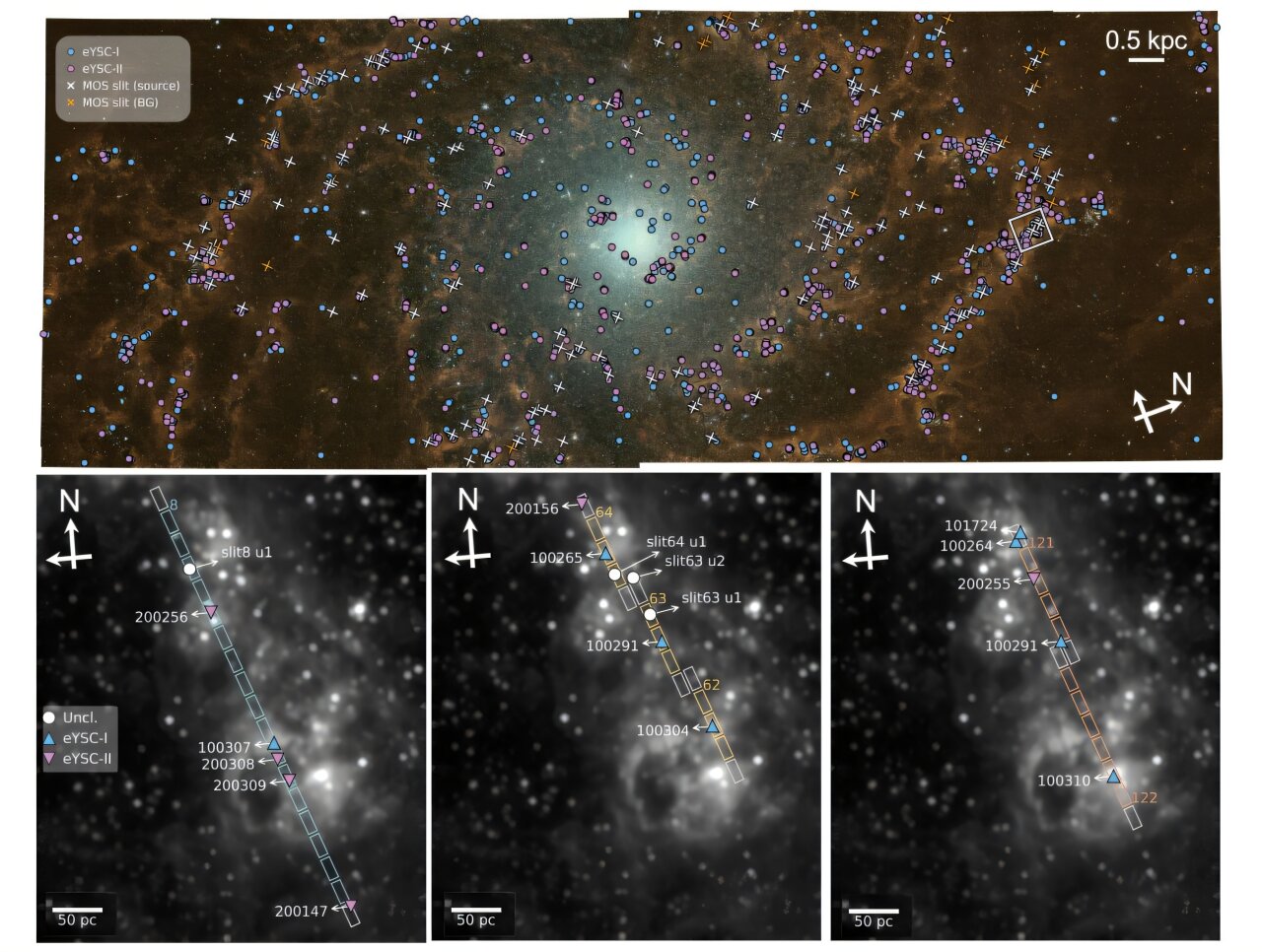
Led by Helena Faustino Vieira of Stockholm University, an international team turned the JWST’s Near Infrared Spectrograph (NIRSpec) toward the spiral arms of NGC 628. This campaign was part of a larger mission aptly named FEAST—or Feedback in Emerging extrAgalactic Star clusTers. The goal was to witness the violent, energetic transition of a star cluster as it breaks free from its gaseous origins.
While NGC 628 is an ancient structure, estimated to be between 10 and 13 billion years old, it is far from a stagnant relic. It is a factory of creation, maintaining a star-formation rate of approximately 1.7 solar masses per year. By using NIRSpec, the astronomers were able to pierce through the molecular clouds and identify an initial sample of 14 emerging young star clusters. These clusters were caught in a high-energy act of rebellion, using stellar feedback from massive stars to blast apart their surroundings and shape the interstellar medium.
The Chemical Fingerprints of Infancy
What the JWST saw within these clusters was a chaotic and energetic display of physics. The telescope detected numerous helium and hydrogen recombination lines. These lines are the “fingerprints” of H II regions—pockets of ionized atomic hydrogen that are being powered by the intense radiation of the brand-new stars.
The data revealed that these clusters are dominated by incredibly hot, massive stars, specifically those of spectral types O8.5V to O8V. These are the heavyweights of the stellar world, possessing massive ionizing photon fluxes that sculpt the environment around them. The team also identified molecular hydrogen transitions and bright emissions from polycyclic aromatic hydrocarbons (PAH) at the 3.3 µm wavelength. These emissions originate from photodissociation regions (PDRs), the turbulent border zones where the light from the young stars meets the cold, neutral gas of the natal cloud.
A Brief Window of Transformation
By analyzing the light, the researchers were able to determine just how young these “infants” really are. The median age of the observed eYSCs is a mere 3 million years—a blink of an eye in cosmic time. Some clusters showed signs of being slightly older, roughly 9 million years, evidenced by spectral signatures of more evolved stars like red supergiants.
The study uncovered a clear evolutionary path: as a cluster ages and begins to push its way out of the natal cloud, the signatures of molecular hydrogen and PAH emission begin to fade. This reveals a “tight connection” between the cluster and its local environment. The morphology of the photodissociation region actually changes as the stars emerge. It is a process of cosmic clearing, where the stars eventually blow away the very clouds that birthed them, finally making themselves visible to the rest of the universe.
Why the First Breath of a Star Matters
This research is more than just a census of a distant galaxy; it is an investigation into the mechanics of creation itself. By capturing eYSCs in their most energetic and early phases, we gain a better understanding of stellar evolution and how stellar feedback influences the growth of an entire galaxy.
Understanding the “emerging” phase is the missing link in our knowledge of how galaxies sustain themselves over billions of years. By observing how these clusters interact with the interstellar medium, astronomers can more accurately map the life cycle of stars from their first hidden moments to their final, brilliant emergence. Thanks to the JWST, the “invisible” history of NGC 628 is finally coming into the light, showing us that even in a galaxy billions of years old, the process of rebirth is constant, violent, and beautiful.
Study Details
Helena Faustino Vieira et al, FEAST: a NIRSpec/MOS survey of emerging young star clusters in NGC 628, arXiv (2026). DOI: 10.48550/arxiv.2603.09866