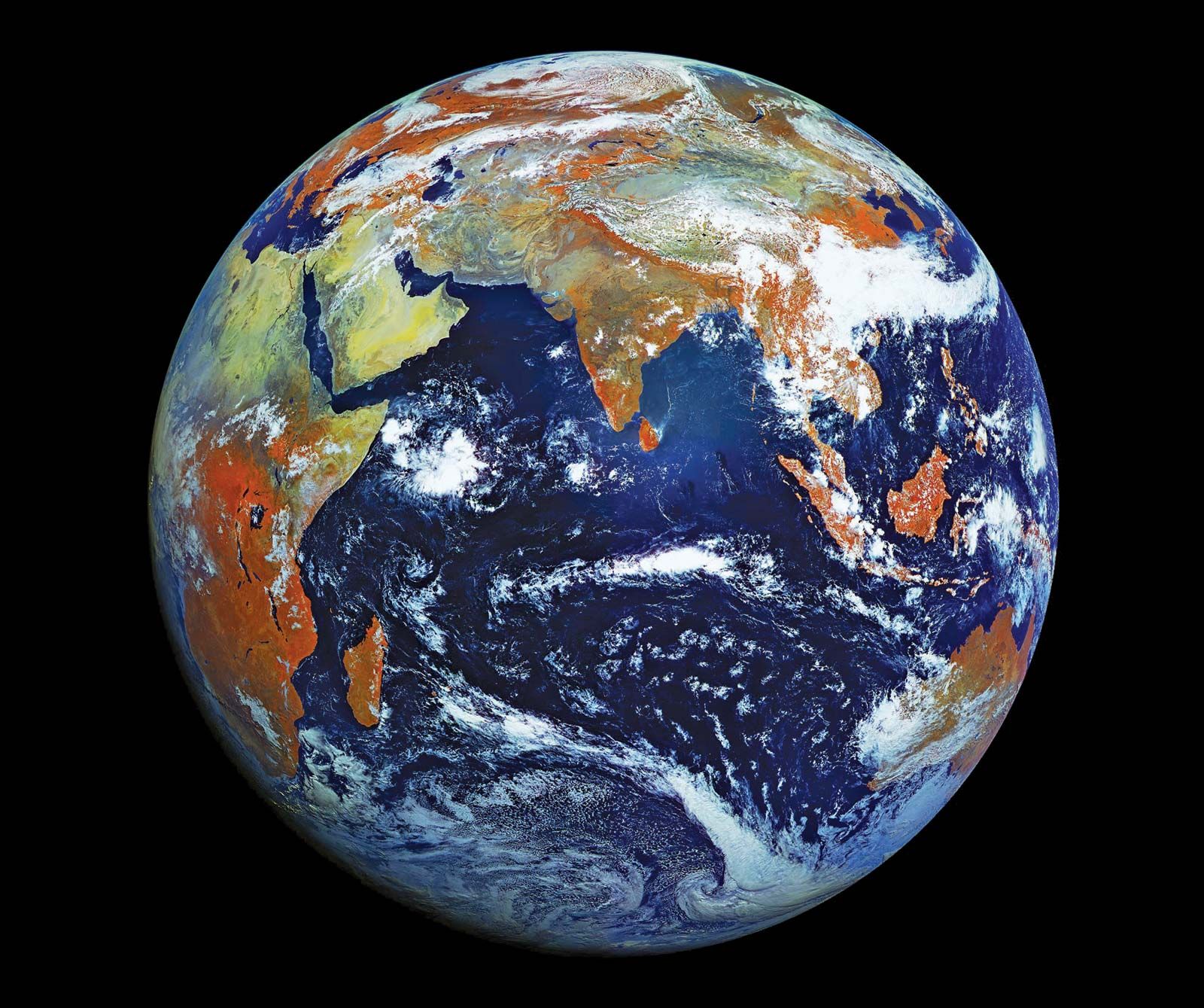
We walk on it every day, breathe its air, drink its water, and build our lives upon its surface. It feels familiar, almost ordinary—so constant that we rarely pause to consider just how extraordinary it truly is. Yet beneath our feet and above our heads lies a world far stranger, more dynamic, and more astonishing than most of us ever imagine.
Earth is not just a planet. It is a living system of immense complexity, a delicate balance of forces and processes that have unfolded over billions of years. It is shaped by fire and ice, gravity and chemistry, time and chance. It is the only known place in the universe where life exists—at least as far as we know—and even that single fact barely scratches the surface of its wonder.
Here are ten mind-blowing facts about Earth that reveal just how incredible our home truly is.
1. Earth Is Not Perfectly Round—It’s Slightly Squashed
When we picture Earth, we often imagine a perfect sphere floating in space. It’s a clean, simple image—but it’s not entirely accurate.
Earth is actually an oblate spheroid, meaning it bulges at the equator and is slightly flattened at the poles. This shape is caused by the planet’s rotation. As Earth spins, centrifugal force pushes material outward at the equator, creating a subtle swelling.
The difference isn’t enormous—the equatorial diameter is about 43 kilometers larger than the polar diameter—but it is significant enough to matter in precise scientific calculations. Satellites, GPS systems, and global measurements all account for this shape.
This slight flattening is a reminder that Earth is not static. It is constantly in motion, and even its shape reflects the forces acting upon it.
2. Earth’s Core Is as Hot as the Surface of the Sun
Deep beneath the crust, far below the continents and oceans, lies Earth’s core—a realm of extreme heat and pressure.
The inner core, composed primarily of iron and nickel, reaches temperatures of around 5,000 to 6,000 degrees Celsius. That’s comparable to the surface temperature of the Sun.
Despite this intense heat, the inner core remains solid due to the immense pressure exerted by the layers above it. Surrounding it is the outer core, a molten layer that flows and churns.
This movement generates Earth’s magnetic field through a process known as the geodynamo. Without this magnetic shield, solar radiation would strip away our atmosphere, making life as we know it impossible.
The fiery heart of Earth is not just a geological curiosity—it is a life-sustaining engine.
3. The Continents Are Constantly Moving
The ground beneath your feet feels solid and permanent. But in reality, it is part of a massive, slow-moving puzzle.
Earth’s surface is divided into tectonic plates that float atop the semi-fluid mantle. These plates move at rates of a few centimeters per year—about as fast as fingernails grow.
This movement, known as plate tectonics, drives earthquakes, volcanic activity, and the formation of mountains. Continents that are now separated by oceans were once joined together in a supercontinent called Pangaea.
Over millions of years, continents drift apart, collide, and reshape the planet’s geography. The Himalayas continue to rise as India pushes into Asia. The Atlantic Ocean widens as the Americas move away from Europe and Africa.
Earth is not frozen in time. It is a dynamic, ever-changing world.
4. Most of Earth Is Hidden Beneath the Ocean
When we think of landscapes, we imagine mountains, forests, and deserts. But these features represent only a small portion of Earth’s surface.
More than 70% of the planet is covered by oceans. Beneath these vast waters lies a world as varied and dramatic as any on land.
There are underwater mountain ranges longer than any on Earth’s surface, such as the Mid-Atlantic Ridge. There are deep ocean trenches, like the Mariana Trench, plunging nearly 11 kilometers below sea level. There are hydrothermal vents where superheated water rich in minerals supports unique ecosystems.
Despite advances in technology, much of the ocean floor remains unexplored. In fact, we have mapped more of the Moon and Mars than our own ocean depths.
Earth’s greatest frontier is not in space—it is beneath the waves.
5. Earth Has a Protective Magnetic Shield
Invisible but essential, Earth’s magnetic field surrounds the planet like a protective bubble.
Generated by the movement of molten iron in the outer core, this magnetic field extends far into space, forming the magnetosphere. It deflects charged particles from the solar wind, shielding the atmosphere from erosion and protecting life from harmful radiation.
When these charged particles interact with the magnetic field near the poles, they create stunning displays of light—the auroras.
Without this magnetic shield, Earth might resemble Mars, a planet that lost much of its atmosphere and surface water.
The magnetic field is not constant. It shifts and even reverses polarity over geological time. Yet its presence has been crucial in maintaining Earth’s habitability.
It is an invisible guardian, quietly preserving life.
6. Earth’s Atmosphere Is a Delicate Balance
The air we breathe is a carefully balanced mixture of gases—about 78% nitrogen, 21% oxygen, and small amounts of other gases like carbon dioxide and argon.
This composition did not always exist. Early Earth’s atmosphere lacked oxygen. It was through the activity of photosynthetic organisms, such as cyanobacteria, that oxygen began to accumulate in a process known as the Great Oxygenation Event.
This transformation allowed complex life to evolve.
The atmosphere also regulates temperature through the greenhouse effect. Gases like carbon dioxide trap heat, preventing the planet from becoming too cold. Without this effect, Earth would be a frozen world.
Yet too much greenhouse gas can lead to warming. The balance is delicate, and small changes can have global consequences.
Earth’s atmosphere is not just air—it is a finely tuned system that sustains life.
7. Water Exists in All Three States Naturally
Earth is unique in our solar system for having abundant water in solid, liquid, and gaseous forms.
Ice caps and glaciers store frozen water at the poles and high altitudes. Oceans, rivers, and lakes contain liquid water. Water vapor exists in the atmosphere, forming clouds and driving weather systems.
This ability to exist in all three states is crucial for the water cycle—a continuous process of evaporation, condensation, and precipitation that distributes water across the planet.
Water’s properties also make it essential for life. It is an excellent solvent, capable of dissolving a wide range of substances, facilitating chemical reactions within living organisms.
The presence of liquid water is one of the key criteria scientists use when searching for life beyond Earth.
Here, it flows freely.
8. Earth’s Rotation Is Gradually Slowing Down
Time feels constant. A day is 24 hours. A year is 365 days. But these measurements are not fixed forever.
Earth’s rotation is gradually slowing due to tidal interactions with the Moon. The gravitational pull between Earth and the Moon creates tides in the oceans. These tidal forces act like a brake, transferring rotational energy and causing the Moon to slowly drift away from Earth.
Hundreds of millions of years ago, a day on Earth was significantly shorter—perhaps only 18 hours long.
As rotation slows, days become longer, though the change is extremely gradual—on the order of milliseconds per century.
Time itself, as measured by Earth’s rotation, is not perfectly constant. It evolves with the dynamics of the Earth-Moon system.
9. Life Has Transformed the Planet
Earth is not just a place where life exists—it is a place shaped by life.
From the earliest microbes to vast forests, living organisms have altered the atmosphere, oceans, and land. Plants produce oxygen and absorb carbon dioxide. Coral reefs build massive structures from calcium carbonate. Microorganisms influence soil formation and nutrient cycles.
Life and Earth are deeply interconnected. This concept is sometimes described as the Gaia hypothesis—the idea that living organisms interact with their environment to maintain conditions suitable for life.
Mass extinctions throughout history have dramatically reshaped ecosystems. The extinction of the dinosaurs allowed mammals to rise and eventually led to humans.
Life does not merely adapt to Earth. It transforms it.
10. Earth Is the Only Known Planet with Life—So Far
Among the billions of planets in the universe, Earth remains the only one known to host life.
Scientists have discovered thousands of exoplanets orbiting distant stars. Some lie within habitable zones where liquid water could exist. Yet no definitive evidence of life beyond Earth has been found.
This uniqueness may be temporary—future discoveries could change it. But for now, Earth stands alone.
Its combination of factors—liquid water, a stable climate, a protective magnetic field, plate tectonics, and a suitable atmosphere—creates conditions that support life.
This realization carries profound implications. It highlights both the rarity and the fragility of our world.
Earth is not just our home. It may be a rare oasis in a vast cosmic desert.
The Extraordinary Ordinary
Earth feels ordinary because it is familiar. But familiarity often hides wonder.
It is a planet with a molten heart and a fragile atmosphere, shaped by shifting continents and protected by invisible forces. It hosts oceans deeper than mountains are tall, a biosphere that reshapes geology, and a climate balanced on delicate interactions.
It is a place where time stretches across billions of years, yet life thrives in the present moment.
To understand Earth is to see it not as a static backdrop, but as a dynamic system—alive with motion, energy, and transformation.
And perhaps the most astonishing fact of all is this: we are part of it.
The atoms in our bodies come from the Earth. The air we breathe is shaped by its history. Our existence is intertwined with its processes.
We do not stand apart from this planet.
We are Earth, becoming aware of itself.