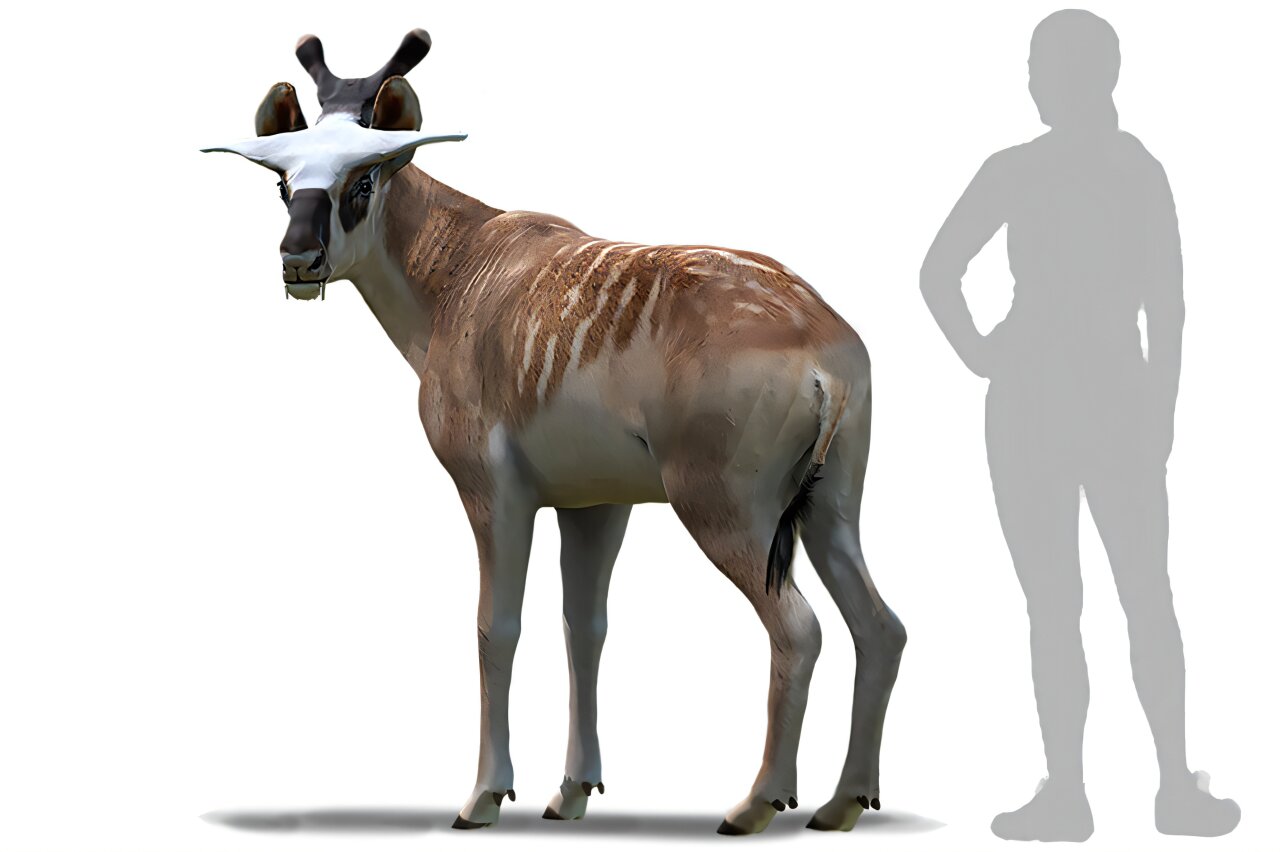
Researchers have discovered that the Miocene-era ruminant Ampelomeryx ginsburgi reached full skeletal maturity by age three but began reproducing as early as its second year of life. By analyzing microscopic “growth rings” in fossilized bones from the Els Casots site in Spain, the study reveals a life strategy more akin to modern deer than its giraffe relatives. These findings provide a rare glimpse into how this unique, flat-horned herbivore adapted to the lush, subtropical riparian forests of 16 million years ago.
Imagine a landscape where modern Spanish vineyards now stand, but instead of rows of grapes, the horizon is dominated by dense, subtropical riparian forests and swampy lakelands. In this humid environment 16 million years ago, a robust, medium-sized ruminant moved through the thick vegetation. While it looked somewhat like a sturdy deer, its skull told a different story, sporting two flat, triangular horns above its eyes and a distinctive “Y”-shaped bony structure protruding from the back of its head. This was Ampelomeryx ginsburgi, a relative of the modern giraffe that traded the open savanna for the shelter of the wetlands. For decades, its appearance was known, but its internal life—how fast it grew and when it reached adulthood—remained a mystery locked inside its fossilized remains.
Unlocking Biological Secrets Through Paleohistology
Understanding the life history of extinct creatures is a primary challenge in modern paleontology. To move beyond mere physical reconstruction, a research team from the Institut Català de Paleontologia Miquel Crusafont (ICP-CERCA) turned to paleohistology. This field involves the microscopic study of bone tissues to uncover the biological “signatures” left behind during an animal’s life. Much like the rings within a tree trunk, bone tissue preserves a chronological record of an organism’s development, providing data on growth rates and metabolic shifts.
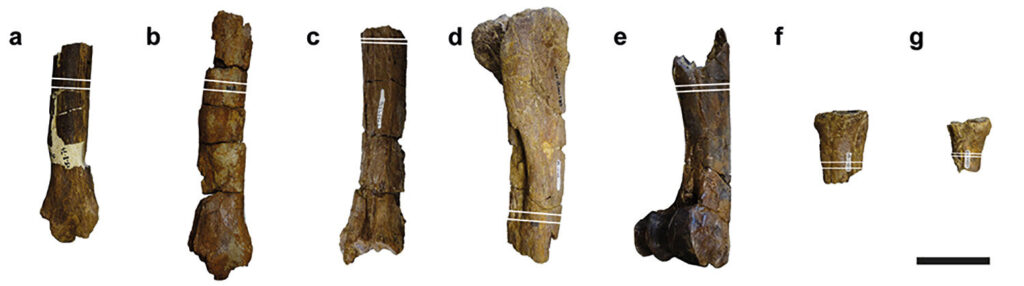
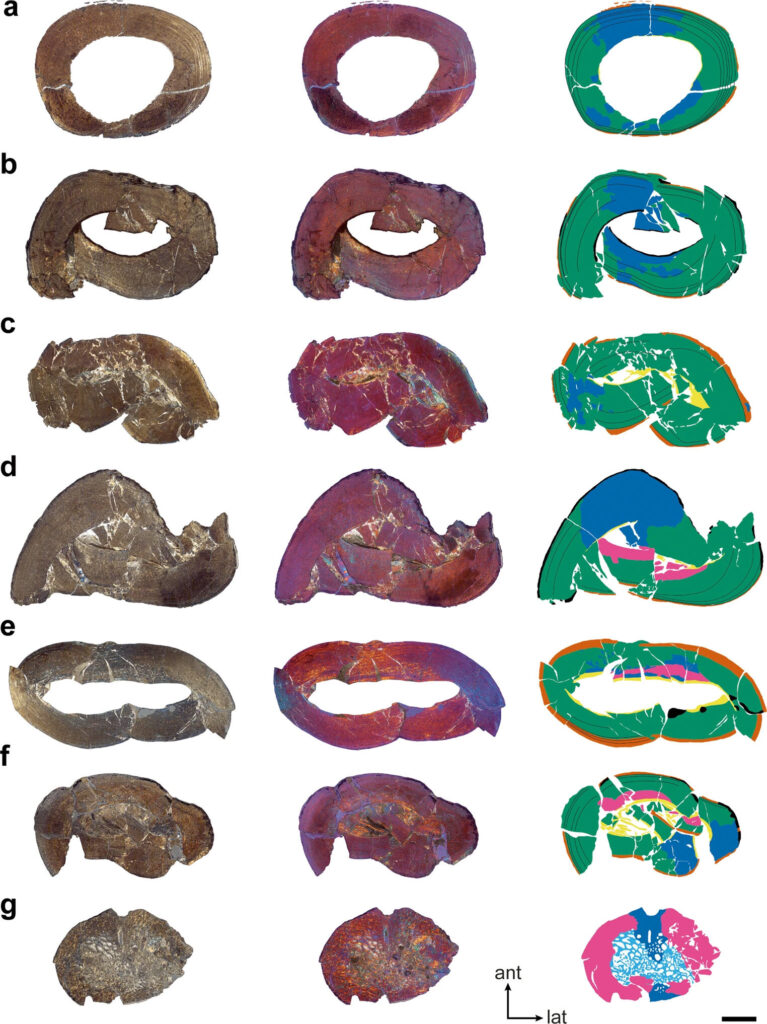
The team focused their efforts on fossils recovered from the Els Casots site in Subirats, Catalonia. This location is recognized as one of Europe’s most significant Miocene sites, offering a high density of well-preserved remains. By preparing extremely thin sections of bone, the researchers were able to observe the microscopic architecture of the animal’s skeleton under a microscope. These samples included four tibiae, one humerus, and two metapodials. The tibiae were particularly valuable, as these lower leg bones typically preserve the most complete record of an individual’s growth from birth to adulthood.
The Three-Year Path to Maturity
The core of the study, published in the Journal of Mammalian Evolution, centered on identifying a specific biological milestone known as the External Fundamental System (EFS). The appearance of this specialized bone tissue signifies that an animal has reached skeletal maturity; at this point, the rapid growth of youth ceases, and the expansion of the bone slows to a crawl.
By tracking these growth lines, the researchers determined that Ampelomeryx ginsburgi was a remarkably fast grower. The data shows that the species reached its full adult size and skeletal maturity at approximately three years of age. During the first two years of life, the animal underwent a period of intensive development, fueled by the rich resources available in its subtropical habitat.
Early Reproduction in the Riparian Forest
One of the most significant findings of the study is the timing of the animal’s reproductive life. The microscopic analysis revealed a distinct deceleration in the growth rate beginning around the second year. In ruminant biology, such a shift often indicates that the animal is diverting its metabolic energy away from skeletal growth and toward the demands of reproduction.
This suggests that Ampelomeryx began successfully reproducing after its second year, well before it had finished growing to its full physical stature. This “reproduce-first, finish-growing-later” strategy is a common trait among many modern ruminants, particularly deer. While Ampelomeryx is a member of the giraffomorph group, its life strategy appears more closely aligned with forest-dwelling deer than with modern savanna-dwelling giraffes. In the protected, resource-heavy environment of the riparian forest, early reproduction would have been an efficient way to ensure the survival of the species.
A Specialized Adaptation to Ancient Wetlands
The environment of the Middle Miocene in what is now Catalonia played a crucial role in shaping the biology of this species. Unlike the modern giraffe, which is adapted to the vast, open spaces of the African savanna, Ampelomeryx was a creature of the shadows and the water’s edge. The abundance of water and dense vegetation in these ancient Spanish wetlands provided both ample food and protection from predators.
This habitat likely influenced the evolution of its robust build and its unique cranial ornaments. The fixed, bony projections on its skull—the flat triangular horns and the occipital “Y” structure—distinguished it from other ruminants of the era. By combining these physical traits with a high growth rate and early sexual maturity, Ampelomeryx was perfectly calibrated for its specific ecological niche.
Why This Matters
This research provides more than just a biography of a single extinct species; it offers a window into the evolution of ruminant life strategies. By establishing that Ampelomeryx ginsburgi shared growth patterns with modern deer despite its relation to giraffes, scientists can better understand how different environments—such as forests versus open plains—drive the biological development of herbivores.
Furthermore, the study highlights the importance of the Els Casots site as a laboratory for understanding Miocene ecosystems. With the baseline for Ampelomeryx now established, researchers can begin to investigate whether other contemporary herbivores, such as archaic antelopes and early deer species, followed similar developmental paths. This work ultimately helps paleobiologists reconstruct the complex web of life that flourished in Europe millions of years before the arrival of modern mammals, showing how energy, environment, and reproduction intersect to define the success of a species.
Study Details
Alexandra Viladot et al, Growth and life history of a palaeomerycid: Inferences from the histological analysis of the long bones of Ampelomeryx ginsburgi (Ruminantia, Giraffomorpha) from Els Casots (Catalonia, Spain), Journal of Mammalian Evolution (2026). DOI: 10.1007/s10914-025-09789-w