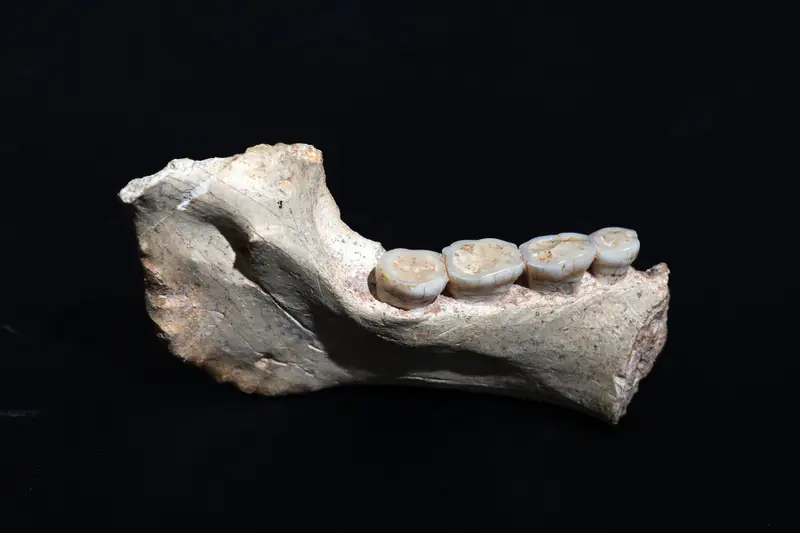
Nearly 800,000 years ago, on the wind-swept Atlantic coast of what is now Morocco, a small group of early humans lived in a world of shifting tides and changing climates. They were not yet us, but they were the pioneers of our bloodline. For decades, their story remained buried beneath layers of ancient dust and cemented sand in a place called Thomas Quarry I.
Today, an international team of researchers has peeled back those layers, revealing a collection of hominin fossils that act as a bridge between the deep past and the dawn of modern humanity. These remains—anchored in time by a rare quirk of planetary physics—provide a vivid look at the ancestors who stood at the very root of the lineage that eventually produced Homo sapiens, Neandertals, and Denisovans.
A Long Journey Into the Earth
The discovery of these ancient North Africans was not a matter of luck, but the result of more than thirty years of patient, rigorous labor. Since the late 20th century, the Moroccan-French Program “Préhistoire de Casablanca” has treated the southwest edge of Casablanca as a vast open-air archive. This region is a geological treasure house, shaped by sea-level oscillations and the rapid hardening of coastal dunes. These conditions created a perfect “preservation chamber” for the remnants of the Pleistocene epoch.
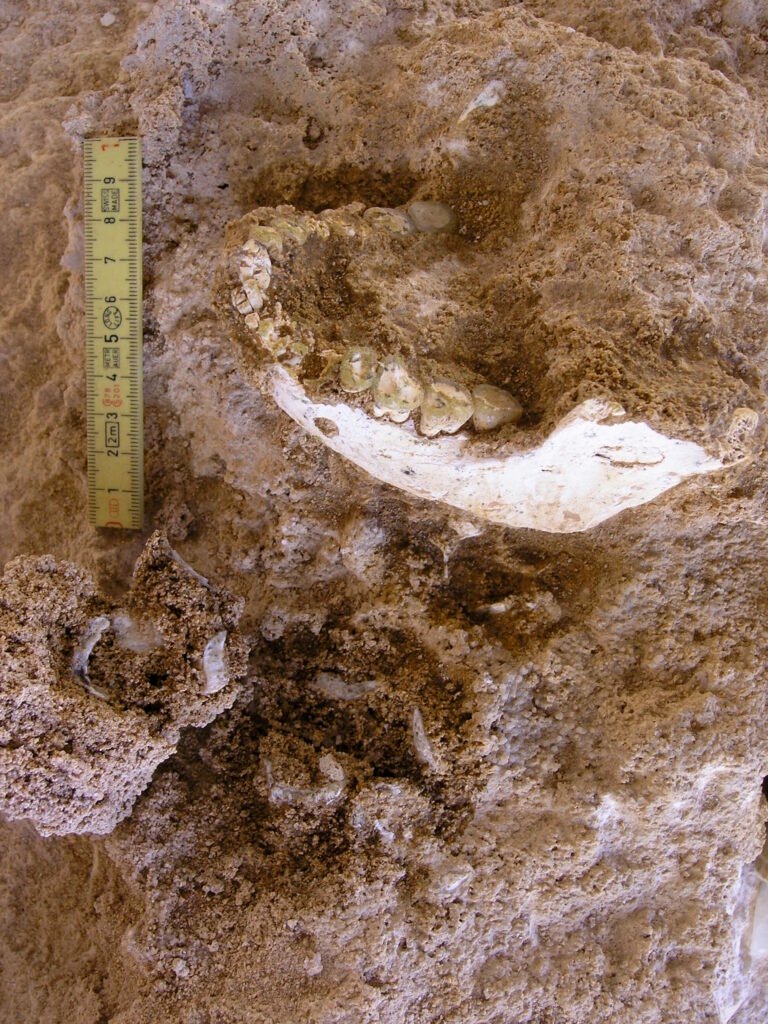
Deep within this landscape lies the Grotte à Hominidés, or the “Cave of Hominids.” Carved out by the sea during a period of high water levels and later filled with protective sediment, this cave provided a secure, undisturbed sanctuary for bones that would otherwise have vanished. The site is a neighbor to other famous locations like Sidi Abderrahmane, but the Grotte à Hominidés holds a secret that makes it unique among African archaeological sites: a perfectly preserved record of a global catastrophe.
When the Earth Turned Upside Down
Dating fossils from the Early and Middle Pleistocene is one of the most difficult tasks in science. Traditional methods often carry wide margins of error, leaving the exact age of ancient humans a matter of debate. However, the residents of the Grotte à Hominidés left behind a chronological “smoking gun.”
Our planet’s magnetic field is not static; it flips its polarity every few hundred thousand years. The last major event, known as the Matuyama-Brunhes transition (MBT), occurred when the Earth’s magnetic North and South poles swapped places. Because this reversal happens globally and almost instantly in geological terms, it leaves a synchronized magnetic signature in the soil.
At Thomas Quarry I, the sedimentation was so rapid and continuous that it captured this flip in high-definition. By analyzing 180 magnetostratigraphic samples, the researchers pinpointed the exact moment the magnetic field switched from “reverse” to “normal.” This transition is dated precisely to 773,000 years ago. The fossils were found embedded directly within this magnetic flip, giving them a rock-solid age of 773,000 years, plus or minus only 4,000 years. This makes them some of the most securely dated human ancestors ever found in Africa.
The Echoes of a Carnivore’s Meal
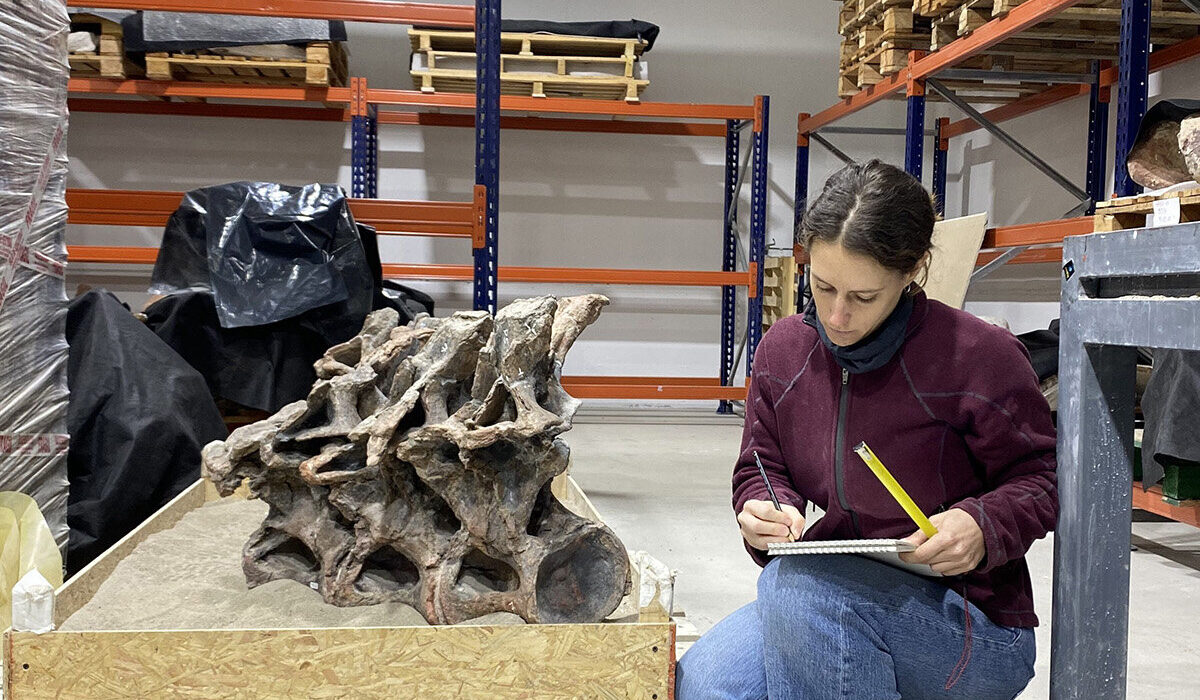
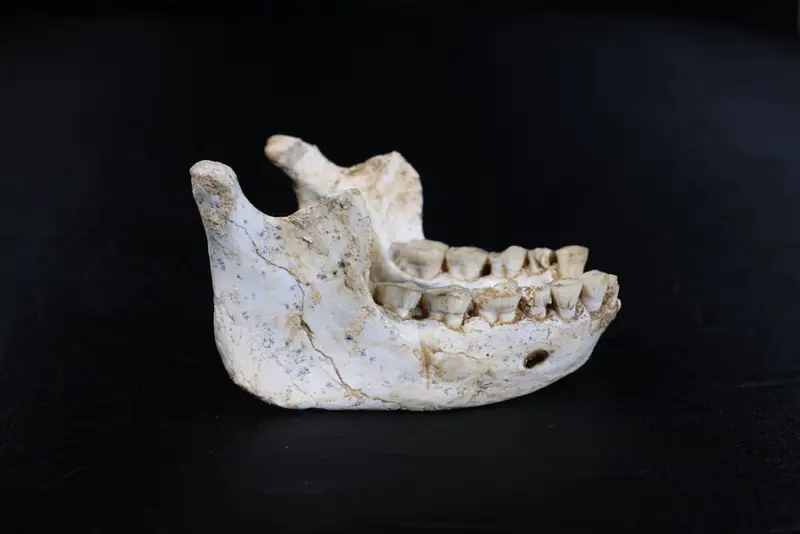
The story these bones tell is one of survival and, occasionally, tragedy. The fossil assemblage includes a nearly complete adult mandible, a second adult jawbone, a child’s mandible, several vertebrae, and a handful of teeth. Curiously, the site appears to have once been a carnivore den. One of the most haunting finds is a hominin femur that bears the unmistakable grooves and pits of gnawing and consumption by a prehistoric predator.
To understand who these people were, the team used high-resolution micro-CT imaging to look inside the fossils. They specifically focused on the enamel-dentine junction, a hidden internal structure of the teeth that remains preserved even when the outer surface is worn away by a lifetime of chewing. This internal map acts as a taxonomic fingerprint, allowing scientists to distinguish one species from another.
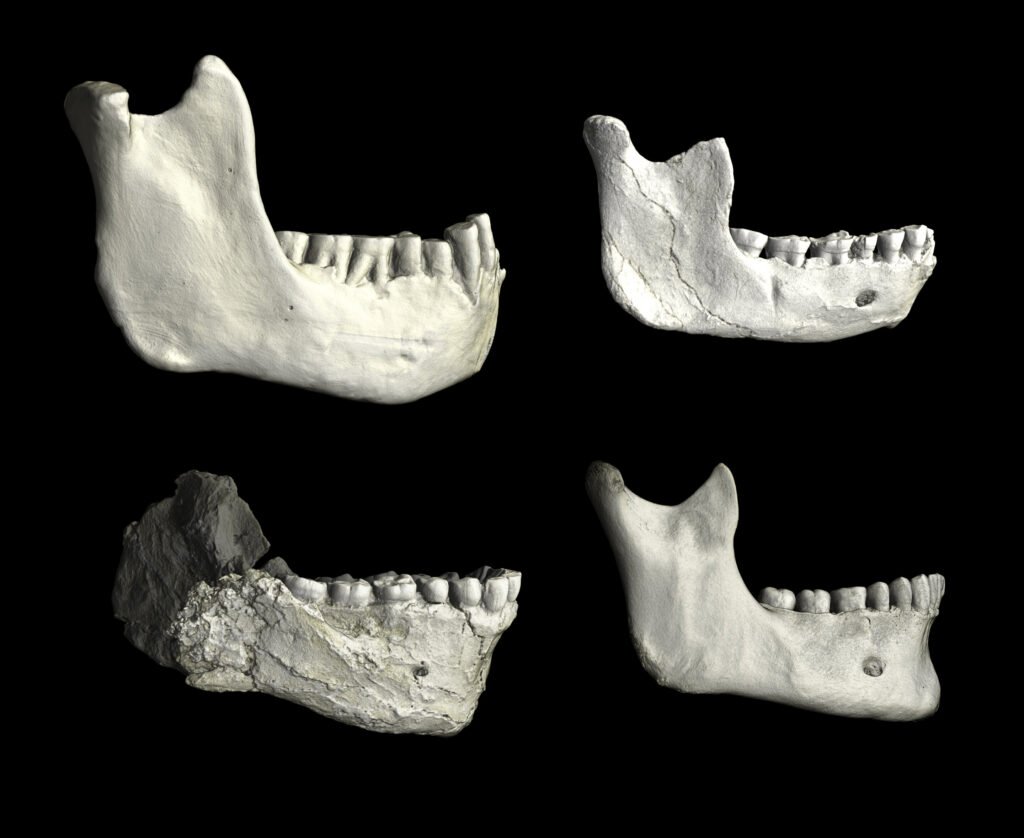
The results revealed a fascinating mosaic of traits. These individuals possessed archaic features that linked them to their African predecessors, but they also showed “derived” or more modern developments. While they shared some similarities with Homo antecessor—a species found in Spain’s Gran Dolina at Atapuerca—the Moroccan fossils were distinct. They lacked the specific specialized features that would later define Neandertals. Instead, they represented a more generalized, basal population.
The Ghost of a Shared Ancestor
For a long time, researchers wondered if the Sahara Desert acted as a wall that trapped ancient humans in different pockets of the continent. The evidence from Thomas Quarry I suggests otherwise. The presence of these hominins, along with diverse animal fossils, shows that the Sahara was not a permanent barrier. Instead, ecological corridors periodically opened, allowing life to flow between Northwest Africa and the savannas of the East and South.
By the time the magnetic poles were flipping 773,000 years ago, the populations of Africa and Europe were already beginning to drift apart. The ancestors in the Grotte à Hominidés lived roughly 500,000 years before the famous Jebel Irhoud fossils (the earliest known Homo sapiens).
Genetic studies have long suggested that the last common ancestor of humans, Neandertals, and Denisovans lived somewhere between 765,000 and 550,000 years ago. The Moroccan fossils fit perfectly into the oldest part of that window. They are the best candidates yet for the actual faces of that shared ancestry—the root of the family tree before it split into the different human groups that would eventually colonize the globe.
Why This Discovery Changes Our History
The research at Thomas Quarry I is a reminder that the story of humanity is deeper and more interconnected than we once thought. By providing a definitive date and a clear anatomical profile of these North African populations, the study proves that Northwest Africa was not a sideline in human evolution, but a central stage.
These fossils matter because they fill a “dark ages” in our history. They show that nearly 800,000 years ago, a group of hominins in Morocco already carried the biological blueprint that would eventually lead to us. They reinforce the theory of a deep African origin for our species and provide a tangible link to the mysterious ancestor we share with our extinct Neandertal cousins. In the quiet layers of a coastal quarry, we have finally found the people who stood at the beginning of the road to becoming human.
Study Details
Jean-Jacques Hublin, Early hominins from Morocco basal to the Homo sapiens lineage, Nature (2026). DOI: 10.1038/s41586-025-09914-y. www.nature.com/articles/s41586-025-09914-y
Of all the quarries: Casablanca fossils reveal African ancestors of Homo sapiens, Nature (2026). doi.org/10.1038/d41586-025-03986-6