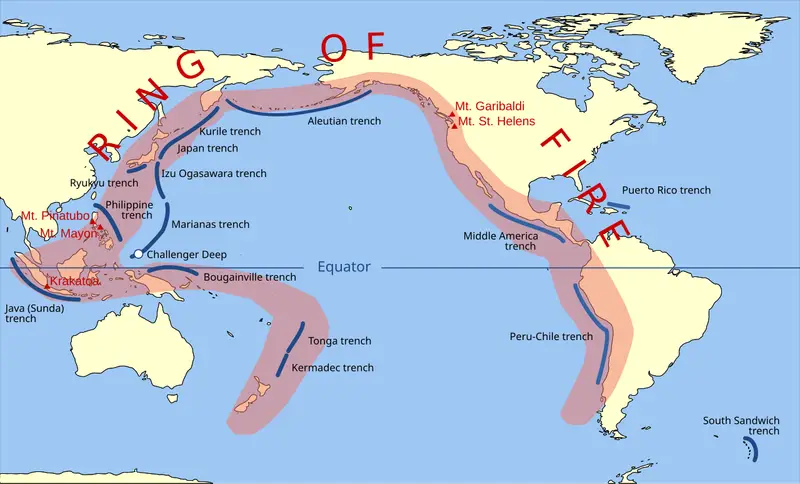
The Pacific Ring of Fire is not a single place that can be visited, photographed, or neatly outlined on a map. It is a vast, dynamic zone of instability encircling the Pacific Ocean, stretching over forty thousand kilometers and touching the shores of Asia, the Americas, and the islands scattered between them. It is here that Earth most dramatically reveals its inner violence. Earthquakes tear cities apart in seconds, volcanoes rise from the sea and explode into the sky, and entire landscapes are reshaped within a human lifetime. This region is responsible for the overwhelming majority of the world’s strongest earthquakes and most of its active volcanoes, earning its reputation as the most violent place on Earth.
Yet violence alone does not explain the Ring of Fire. Beneath the destruction lies a story of deep time, planetary physics, and relentless motion. The Ring of Fire exists because Earth is alive in a geological sense. Its interior is hot, mobile, and constantly reorganizing the surface. What appears to us as catastrophe is, on a planetary scale, the natural consequence of a dynamic world still cooling, still moving, still evolving.
A Planet Built on Motion
To understand why the Pacific Rim is so dangerous, one must first understand a fundamental truth about Earth: its surface is not fixed. The outer shell of the planet, known as the lithosphere, is broken into massive slabs called tectonic plates. These plates float atop the softer, slowly flowing mantle beneath them. Driven by heat from Earth’s interior, they move at rates comparable to the growth of human fingernails, yet their cumulative motion over millions of years reshapes continents and oceans.
The Pacific Plate is the largest of these tectonic plates, and it is also one of the fastest moving. Unlike many continents, which sit atop multiple plates, the Pacific Ocean is dominated by a single immense plate whose edges are almost entirely surrounded by zones of collision. Where the Pacific Plate meets neighboring plates, stress builds, rocks fracture, magma rises, and energy is released. The Ring of Fire traces these boundaries, marking the places where Earth’s internal engine most forcefully interacts with its surface.
Subduction Zones: Where Violence Is Born
The defining feature of the Ring of Fire is the prevalence of subduction zones. Subduction occurs when one tectonic plate is forced beneath another and sinks into the mantle. Around the Pacific, the dense oceanic crust of the Pacific Plate plunges beneath lighter continental plates or other oceanic plates. This process is slow, relentless, and extraordinarily powerful.
As the descending plate sinks, it drags water and sediments deep into the Earth. These materials lower the melting point of surrounding rock, generating magma that rises toward the surface. Over time, this magma feeds volcanoes, forming chains of explosive peaks that arc along plate boundaries. At the same time, friction between the plates locks them together. Stress accumulates until it is released suddenly as an earthquake. The world’s most powerful earthquakes, known as megathrust earthquakes, occur along these subduction zones.
This combination of volcanism and seismicity is what gives the Ring of Fire its character. It is not merely a collection of dangerous locations, but a continuous system driven by the same underlying physics. Every eruption and earthquake is a surface expression of a deeper process that has been shaping Earth for billions of years.
Earthquakes: Sudden Ruptures of a Stressed Planet
Earthquakes are the most immediate and terrifying manifestations of the Ring of Fire’s activity. Unlike storms or volcanic eruptions, earthquakes often strike without warning. The ground itself becomes unstable, transforming familiar streets into shifting waves of destruction. Buildings collapse, infrastructure fails, and lives are altered in moments.
In the Ring of Fire, earthquakes are frequent because plate boundaries dominate the region. As plates grind past, collide with, or dive beneath one another, they accumulate elastic strain. When the strength of the rocks is exceeded, they rupture along faults, releasing energy that propagates as seismic waves. These waves travel through Earth, shaking the surface with varying intensity depending on depth, distance, and local geology.
Some of the largest earthquakes ever recorded have occurred along the Pacific Rim. These events can shift the ground by meters, alter coastlines, and even change Earth’s rotation slightly. When earthquakes occur beneath the ocean, they can displace enormous volumes of water, generating tsunamis that race across entire ocean basins. The Ring of Fire is therefore not only a source of ground shaking but also of some of the most destructive waves in human history.
Volcanoes: Gateways from Earth’s Interior
Volcanoes are the fiery counterparts to earthquakes, offering a slower but equally dramatic expression of tectonic violence. The Ring of Fire hosts hundreds of active volcanoes, many of them stratovolcanoes known for their explosive behavior. These towering structures are built from layers of lava, ash, and fragmented rock, the products of repeated eruptions over thousands of years.
The magma feeding these volcanoes forms deep underground as subducting plates release water into the mantle. This process creates magma rich in dissolved gases, making eruptions particularly violent. When pressure becomes too great, magma ascends rapidly, expanding gases shatter the rock, and ash columns rise kilometers into the atmosphere. Pyroclastic flows, lahars, and ashfall can devastate areas far from the eruption site.
Volcanoes of the Ring of Fire are responsible for some of the most famous eruptions in recorded history. These events have darkened skies, cooled global climates, and reshaped civilizations. Yet volcanoes are not merely destructive. They also create new land, enrich soils, and recycle materials between Earth’s surface and interior. The same forces that make the Ring of Fire dangerous also make it fertile and geologically creative.
The Pacific Ocean: A Basin Surrounded by Danger
The Pacific Ocean itself plays a central role in shaping the Ring of Fire. It is the largest and deepest ocean basin on Earth, underlain primarily by the Pacific Plate. As this plate moves, it interacts with nearly every other major tectonic plate, including the North American, South American, Eurasian, Indo-Australian, and Philippine Sea plates.
Along the eastern Pacific, the Pacific Plate is subducted beneath the Americas, creating deep ocean trenches and towering mountain chains. Along the western Pacific, complex interactions between multiple plates generate island arcs, back-arc basins, and some of the world’s deepest trenches. The Pacific Ocean is thus encircled by zones of intense geological activity, forming a nearly continuous ring of instability.
This configuration is not permanent. Over geological time, ocean basins open and close, continents drift, and plate boundaries reorganize. The Ring of Fire exists today because of the current arrangement of plates, but it will eventually change. In this sense, the violence of the Pacific Rim is a snapshot in a much longer planetary story.
Island Arcs and Volcanic Chains
One of the most striking features of the Ring of Fire is the presence of island arcs. These curved chains of volcanic islands form where one oceanic plate subducts beneath another. As magma rises from the subduction zone, it erupts to form islands that trace the shape of the descending plate edge.
Island arcs such as those found in the western Pacific are laboratories of geological extremes. They experience frequent earthquakes, persistent volcanism, and rapid landscape evolution. Over millions of years, island arcs can collide with continents, contributing to the growth of landmasses and mountain belts. What begins as isolated volcanic peaks can become integral parts of continents.
These regions are often densely populated despite their risks. Fertile volcanic soils, abundant marine resources, and strategic locations have attracted human societies for thousands of years. As a result, the Ring of Fire is not only a zone of geological activity but also a region where human vulnerability to natural hazards is particularly acute.
Tsunamis: The Ocean’s Silent Fury
Among the most devastating consequences of Ring of Fire earthquakes are tsunamis. These massive waves are not caused by wind but by sudden displacement of the seafloor, usually during large subduction-zone earthquakes. When the ocean floor shifts, it lifts or drops enormous volumes of water, sending waves outward at jetliner speeds.
In the open ocean, tsunamis may pass unnoticed, their energy spread over long wavelengths. As they approach shallow coastal waters, however, they slow down and grow in height, transforming into walls of water capable of obliterating entire communities. The Pacific Ocean’s size allows tsunamis to travel vast distances, spreading destruction far from their point of origin.
The Ring of Fire’s geography makes it particularly prone to tsunamis. Deep trenches, steep coastal slopes, and frequent megathrust earthquakes combine to create ideal conditions for wave generation. Understanding tsunamis requires integrating seismology, oceanography, and coastal geology, highlighting how interconnected Earth systems are in this volatile region.
Fire and Water: A Delicate Balance
The phrase “Ring of Fire” evokes images of lava and flame, but water is just as central to the region’s dynamics. Water influences magma formation, earthquake behavior, and volcanic explosivity. Subducting plates carry water into the mantle, while surface water interacts with volcanic heat to produce steam-driven explosions.
This interplay between fire and water creates a delicate balance. Small changes in pressure, temperature, or composition can determine whether a volcano erupts gently or violently. Water-saturated sediments along subduction zones can weaken faults, influencing how earthquakes rupture. The Ring of Fire is therefore a place where Earth’s fundamental elements constantly interact, amplifying both creation and destruction.
The Human Experience of a Violent Earth
For the millions of people living along the Pacific Rim, the Ring of Fire is not an abstract scientific concept but a lived reality. Cities are built with earthquakes in mind, evacuation routes are planned for tsunamis, and volcano monitoring is a constant necessity. Generations grow up with an awareness that the ground beneath them is unstable.
This awareness shapes cultures and histories. In some regions, myths and traditions reflect the power of volcanoes and earthquakes, embedding geological events into collective memory. In others, scientific understanding and engineering have become essential tools for survival. The Ring of Fire thus illustrates how humanity adapts to Earth’s violence, blending respect, fear, and ingenuity.
Despite advances in science, complete safety is impossible. Earthquakes cannot yet be predicted with precision, and volcanic behavior remains complex. What science offers is not certainty but understanding, allowing societies to reduce risk and respond more effectively when disaster strikes.
Why the Ring of Fire Is Uniquely Dangerous
While earthquakes and volcanoes occur worldwide, the Pacific Rim stands out because of the concentration and intensity of its activity. The convergence of multiple fast-moving plates, the dominance of subduction zones, and the presence of the world’s largest ocean basin combine to amplify geological hazards.
This uniqueness is not a coincidence but a consequence of Earth’s tectonic architecture. The Pacific Plate is shrinking as it is consumed by subduction around its edges, a process that concentrates stress and energy release. As long as this configuration persists, the Ring of Fire will remain the planet’s most active and violent geological region.
Understanding this violence requires thinking beyond human timescales. The same processes that cause destruction also build continents, regulate Earth’s chemistry, and sustain the long-term habitability of the planet. The Ring of Fire is dangerous precisely because it is essential to Earth’s ongoing evolution.
A Planet Still Becoming
The Ring of Fire reminds us that Earth is not a finished world. It is a planet still becoming, shaped by forces that operate far beneath our feet and far beyond our lifetimes. What we experience as disaster is, from a geological perspective, part of a continuous cycle of creation and destruction.
This perspective does not diminish human suffering, but it adds context. By studying the Ring of Fire, scientists gain insight into the fundamental workings of our planet, from the flow of heat in the mantle to the mechanics of plate motion. Each earthquake and eruption provides data that deepen our understanding, even as they challenge our capacity to coexist with a restless Earth.
Conclusion: Living on the Edge of Fire
The Pacific Ring of Fire is the most violent place on Earth because it sits at the crossroads of planetary motion. It is where Earth’s internal energy most forcefully meets its surface, releasing power that can reshape landscapes and alter human history. Earthquakes, volcanoes, and tsunamis are not random events here but predictable outcomes of tectonic processes operating over immense spans of time.
Yet within this violence lies profound meaning. The Ring of Fire tells the story of a dynamic planet, one whose surface is continually renewed and reshaped. It challenges humanity to understand, adapt, and respect the forces that sustain and threaten life. To live along the Ring of Fire is to live on the edge of Earth’s creative and destructive power, a reminder that the ground beneath us is not as solid as it seems, and that our planet is very much alive.