Imagine standing on a quiet beach and looking out across the ocean. The water stretches to the horizon, calm and familiar. It may seem like one of the most explored parts of our world. After all, humans have crossed oceans for thousands of years. Satellites can map continents from space, and spacecraft have traveled to distant planets.
Yet beneath those waves lies a realm so mysterious that we know less about it than some regions of the Moon and Mars.
Far below the ocean’s surface, hidden in perpetual darkness, is the deepest place on Earth: the Mariana Trench. This immense underwater canyon is one of the most extreme environments known to science. Temperatures hover near freezing, sunlight never reaches the depths, and the pressure is so intense that it would crush an ordinary submarine instantly.
For centuries, this abyss remained completely inaccessible. Humans could only imagine what might exist there. Some speculated that nothing could survive such conditions. Others wondered whether strange and unknown creatures inhabited the darkness.
When explorers finally reached the bottom, what they discovered changed our understanding of life, geology, and the limits of survival itself.
The story of the Mariana Trench is not merely about a deep hole in the ocean. It is a story of exploration, curiosity, astonishing discoveries, and a sobering reminder that even the most remote corners of our planet bear the fingerprints of humanity.
Where Is the Mariana Trench?
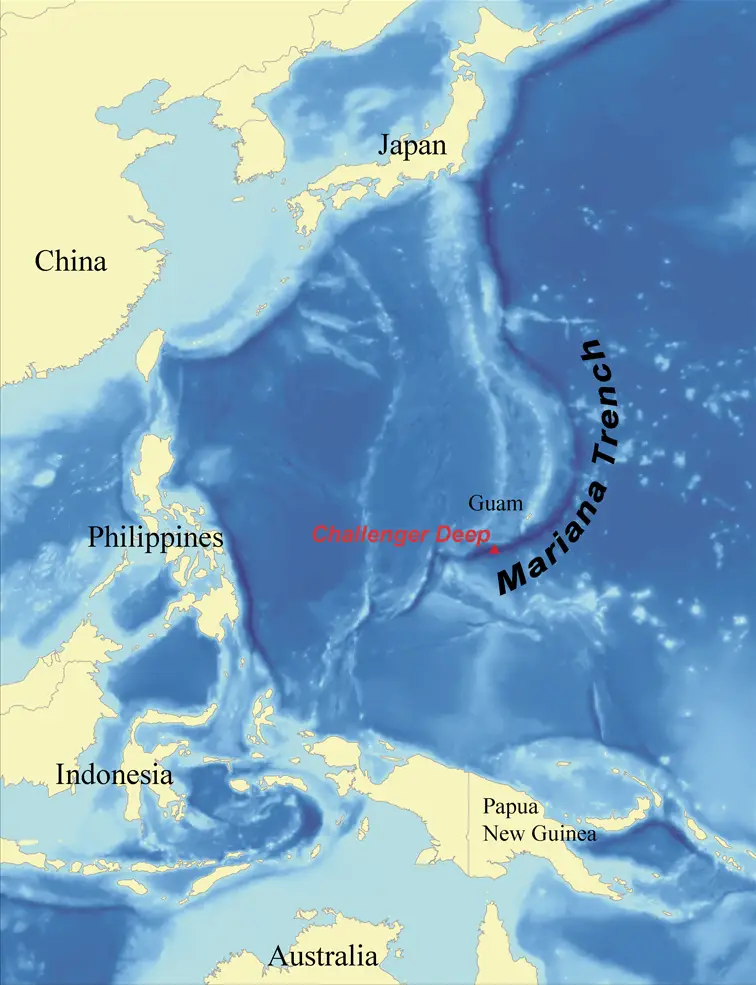
The Mariana Trench is located in the western Pacific Ocean, east of the Mariana Islands and southwest of Guam.
Stretching for approximately 2,550 kilometers (1,580 miles), the trench forms a long, narrow scar on the ocean floor. Its average width is about 69 kilometers (43 miles), but its most famous feature is its incredible depth.
At the southern end of the trench lies a region known as Challenger Deep, the deepest known point in Earth’s oceans.
Modern measurements place Challenger Deep at nearly 11 kilometers (about 6.8 miles) below sea level. Exact figures vary slightly depending on measurement methods, but it is generally accepted to be around 10,900 to 11,000 meters deep.
To appreciate this depth, imagine placing Mount Everest—the tallest mountain on Earth—inside the trench. Everest’s summit would still remain more than a kilometer beneath the ocean surface.
That staggering comparison reveals just how enormous this underwater chasm truly is.
How the Mariana Trench Formed
The Mariana Trench exists because Earth’s surface is constantly moving.
Our planet’s outer shell is divided into massive sections known as tectonic plates. These plates slowly drift across Earth’s surface over millions of years.
The Mariana Trench formed at a subduction zone, where one tectonic plate is forced beneath another.
In this region, the Pacific Plate slides underneath the smaller Mariana Plate. As the denser Pacific Plate sinks into Earth’s mantle, it creates a deep depression on the seafloor.
This process has been occurring for millions of years.
The result is one of the most dramatic geological features on the planet.
The trench is not simply a hole. It is part of a dynamic system involving earthquakes, volcanic activity, and the recycling of Earth’s crust deep within the planet.
Even today, geological forces continue shaping the region.
The Mystery of the Deep
For most of human history, the Mariana Trench was completely unknown.
Ancient sailors crossed the Pacific without any idea that such a vast abyss existed beneath them.
Even after scientists began studying the oceans, determining depth was difficult. Early measurements relied on weighted ropes lowered from ships.
This method worked reasonably well in shallow waters but became increasingly challenging in the deep ocean.
As technology improved, researchers began using sound waves to map the seafloor.
Echo sounding revealed something extraordinary.
Parts of the Pacific Ocean were far deeper than anyone had imagined.
In 1875, during the voyage of the British research vessel HMS Challenger, scientists recorded a depth of nearly 8,200 meters in the region.
Later measurements revealed even greater depths.
The deepest location was eventually named Challenger Deep in honor of that pioneering expedition.
The discovery marked the beginning of humanity’s fascination with the deepest place on Earth.
Why the Deep Ocean Is So Difficult to Explore
Exploring the Mariana Trench is extraordinarily challenging.
The greatest obstacle is pressure.
At sea level, Earth’s atmosphere exerts a pressure of about 14.7 pounds per square inch.
At Challenger Deep, the pressure exceeds 16,000 pounds per square inch.
That is more than one thousand times greater than the pressure at the surface.
A human body cannot survive such conditions without protection.
Most conventional submarines would collapse instantly.
Electronics can fail.
Materials can crack or deform.
Even collecting samples becomes difficult.
Darkness presents another challenge.
Sunlight penetrates only the upper portion of the ocean.
Beyond roughly 1,000 meters, complete darkness dominates.
At nearly 11 kilometers deep, the Mariana Trench exists in eternal night.
Temperatures near freezing further complicate exploration.
Every expedition requires engineering solutions capable of surviving one of the harshest environments on Earth.
The First Journey to Challenger Deep
For decades after its discovery, reaching the trench’s deepest point seemed impossible.
Then, in 1960, two explorers achieved what many believed could never be done.
Swiss engineer Jacques Piccard and U.S. Navy Lieutenant Don Walsh descended to Challenger Deep aboard the bathyscaphe Trieste.
The Trieste was unlike ordinary submarines.
Its crew compartment consisted of a thick steel sphere designed to withstand immense pressure.
Above the sphere floated a large chamber filled with gasoline, which provided buoyancy because gasoline is less dense than water.
The descent took nearly five hours.
As the vessel sank deeper and deeper, sunlight disappeared entirely.
Outside the small viewing window lay only darkness.
Eventually, the Trieste reached the bottom.
Human beings had arrived at the deepest known point on Earth.
The explorers spent only about twenty minutes on the seafloor before beginning their ascent.
Yet that brief visit became one of the greatest achievements in exploration history.
What the First Explorers Saw
One of the most important discoveries from the Trieste expedition was that life existed even at such extraordinary depths.
Many scientists had suspected that the extreme pressure might make complex life impossible.
Instead, the explorers reported seeing living organisms.
Although some observations remain debated today, the mission demonstrated that the deepest ocean was not a sterile wasteland.
Life had found a way.
This revelation fundamentally changed scientific thinking.
If organisms could survive under such immense pressure, perhaps life was far more adaptable than previously believed.
The implications extended beyond Earth itself.
Scientists began wondering whether life might exist in extreme environments elsewhere in the Solar System.
Decades of Silence
After the historic 1960 dive, no humans returned to Challenger Deep for more than fifty years.
The challenges and costs were simply too great.
However, scientific interest never disappeared.
Researchers continued studying the trench using unmanned instruments.
Advances in robotics allowed remotely operated vehicles and deep-sea probes to explore areas humans could not easily reach.
These missions revealed increasingly detailed images of the trench floor.
Scientists discovered unique ecosystems, geological formations, and evidence of active processes occurring in the deep ocean.
Yet the deepest regions remained among the least explored places on Earth.
James Cameron’s Historic Dive
In 2012, filmmaker and explorer James Cameron made history by becoming the first person to complete a solo descent to Challenger Deep.
Known worldwide for directing blockbuster films, Cameron also possessed a lifelong fascination with exploration.
He spent years helping design a specialized submersible called Deepsea Challenger.
The narrow green vehicle resembled something from science fiction.
Unlike the Trieste, it incorporated modern materials, advanced cameras, and sophisticated scientific instruments.
Cameron descended nearly 11 kilometers beneath the surface.
Upon reaching the seafloor, he encountered a landscape unlike anything on Earth.
The environment appeared desolate yet strangely beautiful.
Fine sediments covered much of the bottom, creating an alien terrain illuminated only by the submersible’s lights.
The dive provided valuable scientific observations and renewed public interest in deep-ocean exploration.
A World of Permanent Darkness
One of the most striking features of the Mariana Trench is its complete absence of sunlight.
The deepest parts exist in perpetual darkness.
Day and night have no meaning there.
No sunrise ever brightens the seafloor.
No sunset ever occurs.
The darkness has persisted for millions of years.
Without sunlight, photosynthesis cannot occur.
Plants cannot survive.
The familiar food chains that support most life on Earth are absent.
Yet life still flourishes.
Organisms have developed alternative strategies for survival.
Many depend on organic material drifting down from above.
Others rely on chemical processes that do not require sunlight.
This hidden ecosystem reveals the remarkable adaptability of life.
Strange Creatures of the Abyss
One of the greatest surprises of deep-sea exploration has been the diversity of life discovered at extreme depths.
Far from being empty, the trench hosts a variety of specialized organisms.
Many possess unusual adaptations.
Some creatures have soft bodies that help them withstand pressure.
Others produce light through bioluminescence.
Certain species have developed highly sensitive organs for detecting movement in darkness.
Among the most famous discoveries is the Mariana snailfish.
This ghostly fish lives deeper than any other known fish species.
Its translucent body appears delicate, yet it thrives where pressure would destroy most animals.
Researchers have also found giant single-celled organisms called xenophyophores.
Though simple in structure, they can reach impressive sizes and dominate portions of the trench floor.
Tiny crustaceans, worms, sea cucumbers, and countless microorganisms contribute to a surprisingly complex ecosystem.
The Importance of Microbial Life
While unusual animals capture public attention, microbes may be the most significant inhabitants of the Mariana Trench.
Microscopic organisms exist throughout the deep ocean.
Some survive by breaking down organic matter sinking from above.
Others obtain energy through chemical reactions involving compounds released from Earth’s crust.
These microbes play important roles in nutrient cycling and ecosystem functioning.
Studying them helps scientists understand how life adapts to extreme environments.
Some microorganisms discovered in deep trenches possess enzymes capable of functioning under pressures once thought incompatible with life.
Such adaptations may eventually inspire new technologies or medical applications.
The smallest residents of the trench may hold some of its biggest scientific secrets.
What Happens to Dead Matter in the Deep Ocean?
Everything living eventually dies.
In the open ocean, dead organisms gradually sink toward the seafloor.
Scientists often describe this process as marine snow.
Tiny particles of organic material drift downward through the water column.
At trench depths, this constant rain of biological debris becomes an important food source.
Occasionally, larger events occur.
A dead whale sinking into the abyss can create a temporary feast for deep-sea organisms.
Entire communities may gather around such nutrient-rich resources.
Because food is often scarce, trench ecosystems have evolved to exploit every available opportunity.
Nothing goes to waste for long in the deep ocean.
Discovering Plastic at the Bottom of the World
Perhaps one of the most shocking findings from recent expeditions was not a new species or geological wonder.
It was pollution.
Scientists exploring the Mariana Trench discovered plastic waste even at Challenger Deep.
Plastic bags, wrappers, synthetic fibers, and microplastics have been detected in sediments and organisms.
This revelation stunned many researchers.
The deepest point on Earth seems unimaginably remote.
Yet human influence has reached even this isolated environment.
Marine debris travels enormous distances through ocean currents.
Over time, it sinks into deeper waters.
The discovery serves as a powerful reminder that no part of the planet is truly untouched by human activity.
Chemical Pollution in the Deepest Ocean
Plastic is not the only pollutant found in the trench.
Researchers have detected industrial chemicals in deep-sea organisms.
Some contaminants were originally released decades ago and have since spread throughout global ecosystems.
These chemicals accumulate in food chains.
Even animals living at extreme depths can be exposed.
The findings challenge assumptions that remote environments are protected from human impacts.
Instead, they reveal the interconnected nature of Earth’s systems.
Actions occurring on the surface can eventually influence environments thousands of meters below.
The Geological Wonders of Challenger Deep
The trench is not merely a biological curiosity.
It is also a geological marvel.
The seafloor contains sediments, rock formations, and structures shaped by tectonic activity.
Studying these features helps scientists understand how Earth’s crust evolves.
Researchers investigate how materials are transported into subduction zones and eventually recycled into the mantle.
This process influences volcanic activity, mountain formation, and planetary evolution.
The trench provides a rare window into forces operating deep within Earth.
Each new expedition reveals additional details about these powerful geological mechanisms.
Earthquakes and the Mariana Trench
Because the trench sits at a major plate boundary, earthquakes are common in the region.
As tectonic plates interact, stress accumulates.
When that stress is suddenly released, seismic events occur.
Most happen far beneath the ocean and go unnoticed by people.
However, studying them helps scientists understand tectonic processes.
Earthquakes associated with subduction zones are among the most powerful on Earth.
Investigating these regions contributes to broader knowledge about seismic hazards and planetary dynamics.
The trench is therefore important not only for oceanography but also for geology and geophysics.
Could There Be Unknown Species?
One of the most exciting aspects of Mariana Trench exploration is the possibility of undiscovered life.
Scientists estimate that a large percentage of ocean species remain unknown.
Deep-sea environments are especially poorly explored.
Every major expedition has revealed new organisms.
Some species discovered in trenches possess characteristics unlike anything previously observed.
As technology improves, researchers gain access to areas that were once unreachable.
Many scientists believe numerous species await discovery in the deep ocean.
The trench may still hold biological surprises capable of transforming our understanding of life.
Lessons for the Search for Extraterrestrial Life
The Mariana Trench has implications extending far beyond Earth.
Many worlds in the Solar System possess environments once considered hostile to life.
Moons such as Europa and Enceladus contain subsurface oceans beneath icy crusts.
These oceans may experience extreme pressure and complete darkness.
The existence of thriving ecosystems in Earth’s deepest trenches suggests that life can survive under conditions previously thought impossible.
As a result, deep-ocean research has become increasingly relevant to astrobiology.
Studying the trench helps scientists imagine what life might look like elsewhere in the cosmos.
Earth’s deepest ocean may provide clues about alien worlds.
The Technology Making Exploration Possible
Modern exploration depends on remarkable engineering.
Advanced submersibles use titanium, specialized syntactic foams, and sophisticated electronics to survive crushing pressures.
High-definition cameras capture images never before seen.
Robotic vehicles collect samples with extraordinary precision.
Autonomous underwater vehicles can map vast regions of the seafloor.
Improved sonar systems create detailed three-dimensional models of underwater landscapes.
Each technological breakthrough expands humanity’s ability to investigate the unknown.
The trench remains challenging, but it is becoming increasingly accessible to scientific study.
Why We Continue Exploring
Some people wonder why scientists invest so much effort exploring remote places like the Mariana Trench.
The answer lies in curiosity and discovery.
Exploration has always been part of the human story.
People once crossed oceans to map unknown continents.
Today, researchers venture into deep trenches for similar reasons.
Every expedition teaches us something new about our planet.
The discoveries often have practical benefits as well.
Understanding ecosystems, geological processes, biodiversity, and environmental change contributes to science in countless ways.
The trench reminds us that even on a well-mapped planet, mysteries still exist.
The Emotional Power of the Deepest Place on Earth
There is something profoundly moving about Challenger Deep.
It exists in total darkness, nearly eleven kilometers beneath the waves.
Few human beings have ever seen it with their own eyes.
Yet despite its remoteness, it is part of our world.
The trench challenges assumptions about what life can endure.
It demonstrates the resilience of nature.
It reveals beauty in places once thought barren.
At the same time, the discovery of pollution at the bottom of the ocean reminds us of our responsibility toward the planet.
The deepest place on Earth is both a symbol of exploration and a reflection of humanity’s impact.
Conclusion
The Mariana Trench is the deepest known place on Earth, a vast underwater canyon formed by the collision of tectonic plates in the western Pacific Ocean. At its deepest point, Challenger Deep plunges nearly 11 kilometers below sea level, creating one of the most extreme environments on the planet. Crushing pressure, near-freezing temperatures, and permanent darkness make exploration extraordinarily difficult.
Yet when scientists finally reached the bottom, they discovered something remarkable: life. Strange fish, resilient crustaceans, giant microbes, and thriving ecosystems exist where many once believed survival was impossible. The trench has revealed new species, provided insights into Earth’s geology, advanced our understanding of life’s limits, and even informed the search for extraterrestrial life.
At the same time, discoveries of plastic waste and chemical pollutants in the deepest ocean serve as powerful reminders of humanity’s global influence. The Mariana Trench remains a place of wonder, mystery, and scientific importance—a hidden frontier beneath the waves that continues to challenge our imagination and expand our understanding of the world.
More than a century after its discovery, the deepest point on Earth still holds secrets. And with every expedition into the darkness, we learn that the unknown is often far more extraordinary than we ever imagined.