The sky feels permanent. It feels distant, stable, reassuring. We look up at night and see quiet stars, gentle constellations, slow-moving planets. Yet hidden in that darkness are countless fragments of rock and metal—asteroids and meteoroids—leftover debris from the formation of the solar system 4.6 billion years ago.
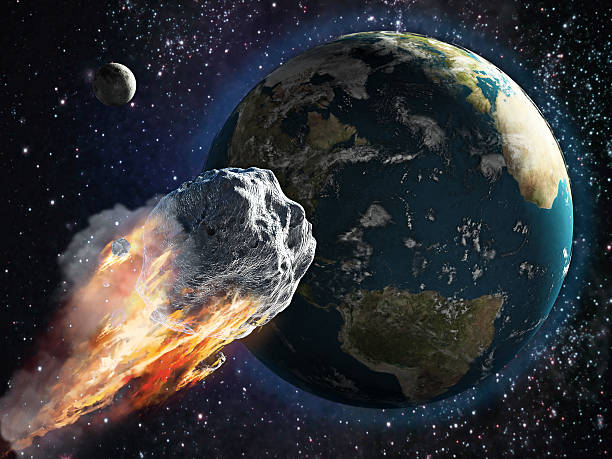
Most of the time, Earth moves safely through space. But sometimes, without warning, something slips through. A rock the size of a car. A boulder as wide as a house. Occasionally, something much larger.
Thanks to modern surveys, we track thousands of near-Earth objects. But detection systems are imperfect. Objects can approach from the direction of the Sun. Some are too small and too faint to see until it’s too late. Others are discovered only hours before they pass us.
In several documented cases, asteroids came extraordinarily close to Earth—or even entered our atmosphere—without advance warning. Some exploded in the sky. Some passed between Earth and the Moon. A few were only identified after they had already gone by.
Below are ten scientifically documented moments when asteroids nearly hit Earth without warning—reminders that space is not empty, and that vigilance matters.
1. The 2013 Chelyabinsk Meteor
On the morning of February 15, 2013, residents of Chelyabinsk, Russia, saw a brilliant fireball streak across the sky. It was brighter than the Sun. Moments later, a powerful shockwave shattered windows across the city, injuring more than 1,500 people—mostly from flying glass.
The object responsible was a previously undetected asteroid roughly 20 meters in diameter. It entered Earth’s atmosphere at about 19 kilometers per second and exploded at an altitude of around 30 kilometers in an airburst equivalent to roughly 400–500 kilotons of TNT.
No one saw it coming.
Because it approached from the direction of the Sun, ground-based telescopes could not detect it beforehand. The Chelyabinsk event became the largest atmospheric explosion since the Tunguska event of 1908.
It was a wake-up call. A rock the size of a small building had struck Earth’s atmosphere without warning in the 21st century.
2. 2008 TC3: The First Predicted Impact—But Only Hours Before
On October 6, 2008, astronomers detected a small asteroid later designated 2008 TC3. Within hours, calculations showed something extraordinary: it was going to hit Earth.
About 19 hours after its discovery, the object entered the atmosphere over Sudan. It was only about 4 meters across and disintegrated harmlessly in the upper atmosphere. Fragments were later recovered in the Nubian Desert.
This was the first time in history that scientists detected an asteroid before it struck Earth. But the warning time was less than a day.
If it had been larger, 19 hours would not have been enough to evacuate cities or mount any defense.
2008 TC3 proved that while detection is possible, many small asteroids remain invisible until they are dangerously close.
3. 2019 OK: The Surprise Visitor
In July 2019, an asteroid roughly 60 to 130 meters wide passed within about 73,000 kilometers of Earth—closer than the Moon.
It was designated 2019 OK.
The alarming part? It was discovered only days before its closest approach. Some tracking efforts identified it mere hours before it reached its minimum distance.
An object of that size could devastate a city or region if it struck. It was large enough to cause severe local destruction, possibly comparable to or exceeding the Tunguska explosion.
It slipped past our detection systems, partly because of its trajectory and speed. It approached from a direction difficult to observe and was not noticed until it was already on its way out.
The sky had delivered a close call.
4. 2020 QG: The Closest Known Near Miss
On August 16, 2020, a small asteroid designated 2020 QG passed only about 2,950 kilometers above Earth’s surface.
That is closer than many satellites.
It was approximately 3 to 6 meters across—too small to cause widespread destruction, but large enough to produce a visible fireball had it entered the atmosphere.
It was not detected until after its closest approach.
The asteroid slipped between Earth and its satellites unnoticed. If slightly larger, it might have exploded over a populated area with little to no warning.
This was one of the closest recorded near misses by a known asteroid.
5. 2014 AA: Another Impact Discovered Too Late
On January 1, 2014, astronomers detected a small asteroid named 2014 AA. Shortly after discovery, orbital calculations suggested it would impact Earth.
Less than a day later, it entered the atmosphere over the Atlantic Ocean.
The object was only a few meters in size and posed no serious threat. But once again, detection occurred mere hours before impact.
The pattern was clear: small asteroids are often discovered too late for meaningful preparation.
6. 2002 MN: A Close Brush
In June 2002, an asteroid later designated 2002 MN passed within approximately 120,000 kilometers of Earth.
It was estimated to be between 50 and 120 meters across—large enough to cause severe regional damage if it had struck.
It was not discovered until three days after it had already passed.
For three days, humanity remained unaware that a potentially city-destroying object had skimmed past our planet.
It was a sobering realization of how incomplete sky surveys still were at the time.
7. 2011 CQ1: A Gravitational Nudge
On February 4, 2011, asteroid 2011 CQ1 passed within about 5,500 kilometers of Earth’s surface.
It was discovered only hours before its closest approach.
This object was small, only a few meters across. But what made it fascinating—and unsettling—was how Earth’s gravity altered its orbit during the flyby.
The close pass changed its orbital period around the Sun significantly. It was a dramatic demonstration of how near-Earth objects can be gravitationally influenced during close encounters.
The encounter was harmless. But it underscored how small objects can approach from unexpected angles and distances.
8. 2022 EB5: A Modern Reminder
On March 11, 2022, astronomers detected asteroid 2022 EB5. Within hours, they determined it would impact Earth.
About two hours after discovery, it entered the atmosphere north of Iceland, producing a small airburst.
The object was only about 2 meters across and caused no damage.
But again, the warning time was measured in hours.
The speed at which astronomers analyzed the orbit was impressive. Yet the event reinforced a key reality: small objects frequently approach undetected until the last moment.
9. The 1972 Great Daylight Fireball
On August 10, 1972, a large meteoroid entered Earth’s atmosphere over Utah in the United States.
It skimmed the atmosphere at a shallow angle, producing a spectacular daylight fireball visible across multiple states and parts of Canada.
Instead of exploding or impacting, it skipped off the atmosphere and returned to space.
At the time, there was no prior warning. The object was likely several meters across.
Had its trajectory been slightly steeper, it might have detonated in the atmosphere or impacted the surface.
The Great Daylight Fireball was a reminder that Earth’s atmosphere sometimes acts like a cosmic shield—but only if geometry cooperates.
10. The 1908 Tunguska Event
Long before modern asteroid surveys, on June 30, 1908, something exploded over the Tunguska region of Siberia.
The blast flattened an estimated 80 million trees over an area of roughly 2,000 square kilometers.
The object, likely an asteroid or comet fragment about 50 to 60 meters in diameter, exploded in the atmosphere at an altitude of several kilometers.
There was no warning. No detection. No prediction.
Had it exploded over a major city, casualties would have been catastrophic.
The Tunguska event remains the largest impact-related explosion in recorded history.
It stands as a haunting reminder of what a moderately sized asteroid can do.
Why We Often Don’t See Them Coming
Many of these near misses share common characteristics.
Some approach from the direction of the Sun, making them nearly impossible to see with ground-based optical telescopes.
Others are simply too small and too faint to detect until they are very close.
Detection technology has improved dramatically in recent decades. Surveys now track thousands of near-Earth objects. Large, civilization-ending asteroids are unlikely to surprise us today.
But smaller, city-scale objects remain difficult to detect consistently.
And smaller does not mean harmless.
The Emotional Reality of Cosmic Risk
It is tempting to dismiss these events because most caused no damage. But each one reveals a deeper truth.
Earth is not isolated from the rest of the solar system. It moves through a dynamic environment filled with debris left over from planetary formation.
Impacts are not hypothetical. They are part of Earth’s history. The extinction of the non-avian dinosaurs 66 million years ago was triggered by a large asteroid impact.
The difference today is awareness.
We are the first species capable of detecting and potentially deflecting a dangerous asteroid. Missions like NASA’s DART spacecraft have demonstrated that altering an asteroid’s trajectory is possible.
But detection remains the first and most critical step.
You cannot deflect what you do not see.
The Fragile Shield
Earth’s atmosphere protects us from countless small meteoroids every day. Most burn up harmlessly as shooting stars.
But occasionally, something larger slips through.
The terrifying aspect of these near misses is not that they happened. It is that many happened without warning.
We live under a fragile shield of air, orbiting a star, sharing space with millions of rocks and fragments.
And yet, we continue to look up. To build better telescopes. To map the sky more thoroughly. To prepare.
Because knowledge transforms fear into strategy.
The sky is not empty. It never was.
But for the first time in history, we are watching it carefully.