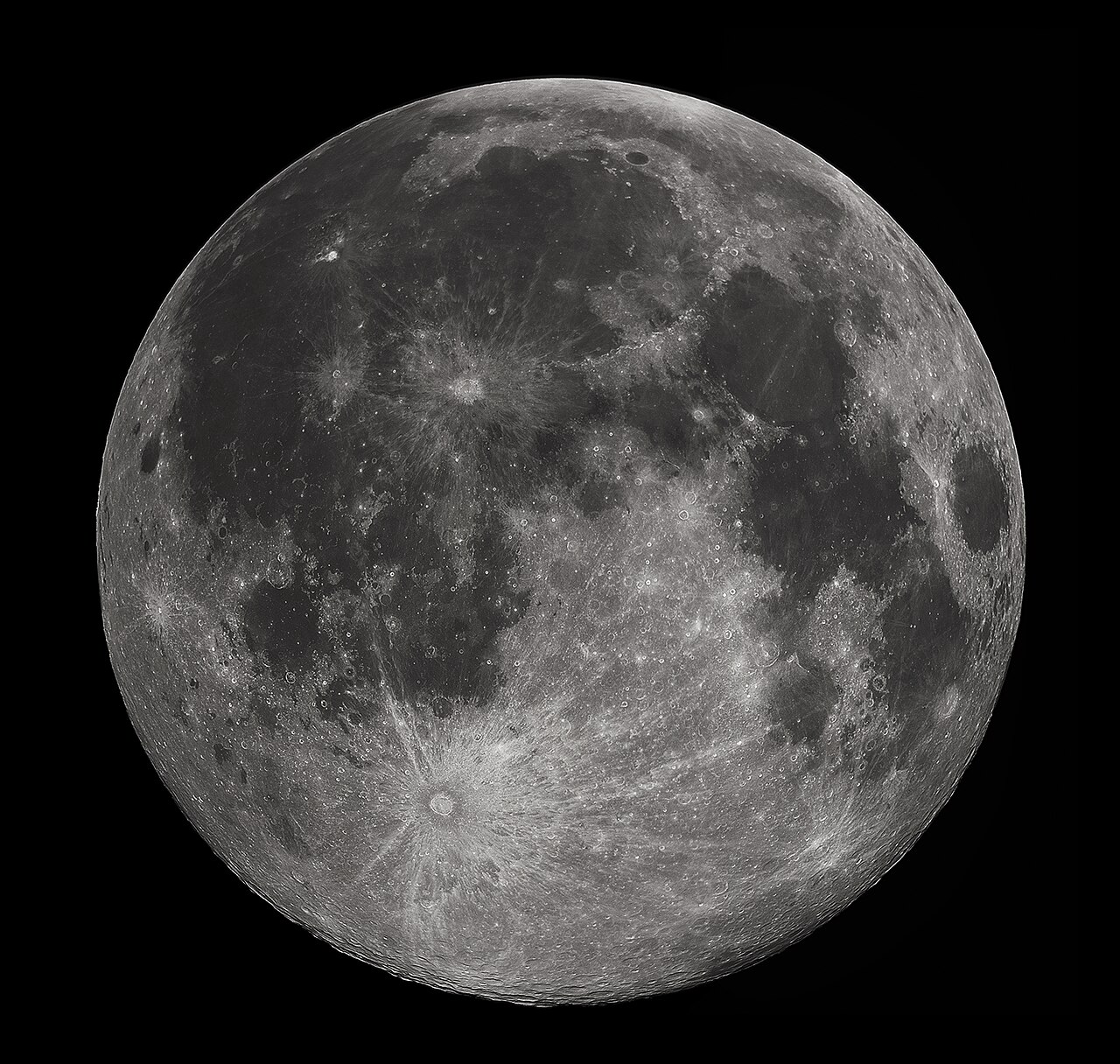
The Moon hangs in our sky with such quiet reliability that it feels permanent, comforting, almost ordinary. It governs tides, brightens night landscapes, and has inspired poetry, religion, and science for thousands of years. Yet despite its familiarity, the Moon has also been a canvas for some of the strangest ideas humanity has ever imagined.
In the age of space exploration—after telescopes, orbiters, and human footprints—most of the Moon’s major physical properties are well understood. Its composition, its craters, its origin through a giant impact with early Earth, its lack of atmosphere—these are grounded in decades of research. But belief does not always follow evidence.
Across cultures and decades, people have developed theories about the Moon that range from imaginative to deeply bizarre. Some are rooted in misunderstanding. Some arise from mistrust. Others spring from our instinct to find patterns in the unknown.
Below are ten of the weirdest Moon theories that people genuinely believe or have believed—examined carefully, and explained with scientific clarity.
1. The Moon Is Hollow
One of the most persistent Moon theories claims that the Moon is not a solid rocky body, but hollow—perhaps even an artificial structure.
This idea gained traction during the 20th century when seismic experiments conducted by Apollo astronauts produced surprising results. After stages of the Apollo spacecraft were deliberately crashed into the Moon, seismometers detected vibrations that lasted longer than expected. Some reports described the Moon as “ringing like a bell.”
To some, this sounded like evidence of a hollow interior. If the Moon rang, perhaps it was empty inside.
But the scientific explanation is far less mysterious. The Moon lacks water and tectonic activity, meaning its crust is extremely dry and rigid. On Earth, seismic waves are dampened quickly by water and fractured rock. On the Moon, vibrations can travel much farther and last longer because there is little internal energy loss.
Modern measurements show that the Moon has a crust, mantle, and core. It possesses a small, partially molten metallic core, confirmed by detailed gravitational and seismic studies.
The Moon rings not because it is hollow—but because it is geologically quiet and dry.
2. The Moon Landing Was Faked
Few conspiracy theories are as widespread as the claim that the Apollo Moon landings were staged on Earth.
Despite extensive documentation, lunar rock samples, independent tracking by multiple nations, and retroreflectors still used today for laser ranging experiments, some people believe humans never set foot on the Moon.
Arguments typically point to the lack of visible stars in photographs, the appearance of a waving flag, or shadows that seem misaligned.
Each of these claims has been thoroughly explained. The absence of stars in Apollo photos is due to camera exposure settings optimized for bright lunar surfaces. The flag appeared to ripple because it was mounted on a horizontal rod and disturbed during placement; in the vacuum of space, it does not flutter in wind. Shadow angles are influenced by uneven terrain and perspective.
Lunar rocks brought back by Apollo missions have been studied worldwide and contain isotopic signatures distinct from Earth rocks. The retroreflectors placed on the Moon still allow scientists to measure the Earth–Moon distance with centimeter precision.
The scale of coordination required to fake the landings—and maintain silence across thousands of engineers and scientists—would be staggering.
The Moon landing happened. But disbelief persists because extraordinary achievements sometimes feel too extraordinary to be real.
3. The Moon Controls Human Behavior
The idea that the Moon influences human behavior is ancient. The very word “lunatic” comes from the Latin luna, meaning Moon. Some people believe that full moons increase crime rates, trigger madness, or influence birth rates.
The Moon undeniably affects Earth’s tides through gravity. But does it affect human minds?
Scientific studies have examined correlations between lunar phases and hospital admissions, psychiatric episodes, crime statistics, and sleep patterns. The overwhelming majority find no consistent, statistically significant effect.
Human bodies are far too small for the Moon’s gravitational pull to have measurable biological consequences. The gravitational force exerted by nearby objects—like buildings—is often greater than that exerted by the Moon on an individual.
However, the Moon can influence human psychology indirectly. A bright full Moon can affect nighttime light levels, potentially altering sleep patterns in environments without artificial lighting. Cultural beliefs can also shape perception—if people expect unusual behavior during a full Moon, they may interpret events differently.
The Moon affects oceans. It does not control minds.
4. The Moon Is an Artificial Alien Megastructure
Some theorists propose that the Moon is not a natural object at all, but a constructed alien megastructure—an enormous spacecraft or observation platform placed in orbit around Earth.
This idea often stems from the Moon’s unusual characteristics. It is relatively large compared to its host planet. It is tidally locked, showing the same face to Earth. It appears almost perfectly sized to create total solar eclipses, where it covers the Sun almost exactly in our sky.
To some, these features seem too coincidental.
But astrophysics provides clear explanations. The Moon formed approximately 4.5 billion years ago from debris created when a Mars-sized body collided with early Earth. Computer simulations and isotopic analysis of lunar rocks strongly support this giant impact hypothesis.
Tidal locking is common among moons in the solar system, caused by gravitational interactions over long timescales. The near-perfect match in apparent size between the Sun and Moon is a temporary coincidence; due to gradual changes in distance, this alignment will not last forever.
While the idea of an alien construct is dramatic, every measurable property of the Moon—mass, density, composition, orbit—aligns with natural processes.
The Moon is extraordinary. It does not need to be artificial to be fascinating.
5. The Moon Produces Its Own Light
Some people believe the Moon emits its own light rather than reflecting sunlight. Variations of this claim suggest that moonlight has different properties than sunlight and may even cool objects.
In reality, the Moon shines by reflecting sunlight. Its surface is covered in regolith, a fine powder of crushed rock, which reflects about 12 percent of incoming sunlight. That reflection is enough to illuminate our night sky.
The color and intensity of moonlight differ from sunlight because it is reflected and scattered. Moonlight appears softer and cooler due to lower intensity and the way human vision adapts to darkness.
Experiments claiming temperature drops under moonlight typically fail to account for radiative cooling at night, where surfaces lose heat to the open sky.
Moonlight is sunlight—gentler, dimmer, but fundamentally the same.
6. The Moon Is Slowly Draining Earth’s Energy
A more subtle theory suggests that the Moon is somehow draining energy or life from Earth, perhaps through gravitational or electromagnetic means.
It is true that tidal interactions between Earth and the Moon transfer energy. The Moon’s gravity creates tidal bulges in Earth’s oceans. As Earth rotates, these bulges are slightly misaligned with the Earth–Moon axis, transferring angular momentum to the Moon.
As a result, the Moon slowly moves away from Earth at about 3.8 centimeters per year. Earth’s rotation also slows gradually, lengthening the day over millions of years.
But this is not “draining” in a harmful sense. It is a predictable gravitational interaction described by classical physics. The energy transfer is tiny relative to Earth’s total energy systems.
Rather than harming Earth, the Moon stabilizes Earth’s axial tilt, reducing extreme climate variations over geological timescales. Without the Moon, Earth’s climate might be far less stable.
The Moon shapes our planet—but it does not feed on it.
7. There Are Secret Bases on the Far Side
The far side of the Moon, permanently turned away from Earth due to tidal locking, has long been a source of mystery. Before spacecraft photographed it, people speculated wildly about what might be hidden there.
Even after detailed mapping by orbiters, some still claim that secret alien bases—or even human military installations—exist on the far side.
The far side is not permanently dark. It receives sunlight just like the near side; it is simply never visible from Earth’s surface.
High-resolution images from multiple missions, including orbiters from several countries, have mapped the lunar surface extensively. There is no credible evidence of artificial structures.
The far side is heavily cratered and geologically ancient. It contains mountains, basins, and lava plains—but no hidden cities.
Mystery often thrives where visibility ends. Once exploration reaches those places, the mystery usually transforms into geology.
8. The Moon Is a Projection or Illusion
A more abstract belief suggests that the Moon is not a physical object at all, but a projection, hologram, or simulated image within a larger artificial reality.
This idea often overlaps with broader simulation hypotheses about the universe. While the simulation hypothesis is a philosophical concept explored by some physicists and philosophers, there is no empirical evidence that the Moon specifically is an illusion.
We have placed spacecraft in lunar orbit, landed rovers on its surface, and brought back rock samples. Laser ranging experiments measure its distance daily. Gravitational interactions are precisely modeled and observed.
The Moon exerts measurable force, contains measurable mass, and follows orbital mechanics consistent with Newtonian and relativistic physics.
While philosophical speculation about reality’s nature continues, there is no scientific basis for the Moon being a projection.
It casts shadows. It pulls oceans. It leaves footprints in dust. Illusions do not do these things.
9. The Moon Was Captured Artificially into Orbit
Some believe the Moon did not form naturally around Earth but was captured intentionally—placed into orbit by advanced beings.
In reality, capturing an object as massive as the Moon into a stable orbit without catastrophic consequences would require an extraordinary energy mechanism. Natural capture of such a large body is extremely unlikely without atmospheric drag or a third-body interaction.
The giant impact hypothesis provides a far more consistent explanation. Lunar rocks share isotopic similarities with Earth’s mantle, suggesting common origin. Computer simulations show that debris from a massive collision could coalesce into a stable Moon.
The capture scenario fails to explain the detailed geochemical similarities observed between Earth and Moon samples.
The Moon’s orbit, composition, and angular momentum all align with a violent but natural birth.
10. The Moon Is Perfectly Engineered for Life on Earth
Some people argue that the Moon is so perfectly suited to supporting life on Earth—stabilizing axial tilt, creating tides, enabling eclipses—that it must have been intentionally designed.
It is true that the Moon plays a crucial role in Earth’s habitability. By stabilizing Earth’s tilt, it moderates climate fluctuations. Tides may have influenced early life’s transition from ocean to land. Solar eclipses, while not biologically essential, are visually extraordinary.
But “perfect” does not mean designed. Planetary formation involves chaotic processes across billions of years. Many planetary systems likely lack large moons. Others may have multiple.
We observe Earth with a Moon because we are here. If conditions were wildly different, we might not exist to comment on them. This is known as the anthropic principle: we observe a universe compatible with our existence because otherwise we would not be here to observe it.
The Moon is special. But special does not mean engineered.
The Moon as Mirror
Why do these strange beliefs endure?
Because the Moon is both familiar and unreachable. It is close enough to see with naked eyes, yet distant enough to remain mysterious. It is silent, scarred, ancient. It feels like a presence rather than an object.
When science explains the Moon in terms of impact simulations, isotope ratios, and orbital mechanics, some feel that magic is lost. Conspiracy and speculation can restore that sense of wonder—even if built on fragile foundations.
But the real Moon is not diminished by science. It is enriched by it.
It formed in violence billions of years ago. It shaped Earth’s tides and rhythms. It witnessed the rise of oceans, forests, and civilizations. It bears the footprints of astronauts and the scars of cosmic impacts.
It is not hollow. It is not artificial. It is not a projection.
It is a natural satellite born of cosmic chaos—faithfully orbiting our planet, quietly influencing our world.
And perhaps the strangest thing of all is not the bizarre theories people believe about the Moon.
It is that a species of primates on a small blue planet once looked up at that pale light, built rockets, crossed the void, and stood upon it.
No conspiracy is more astonishing than that truth.