Earth is not only a rocky planet spinning through space; it is also a living magnetic world. Invisible yet powerful, Earth’s magnetic field stretches far beyond the atmosphere, forming a protective cocoon that shields life from harmful cosmic radiation and the charged particles streaming from the Sun. This magnetic shield has guided migrating animals, oriented human navigation for millennia, and quietly preserved the conditions that allow life to flourish. Yet this shield is not fixed. Throughout Earth’s deep history, the magnetic poles have flipped many times, swapping north and south in events known as geomagnetic reversals.
The idea that Earth’s magnetic poles could reverse again has captured scientific attention and public imagination alike. News of a weakening magnetic field or a wandering magnetic north pole often sparks dramatic questions. Is Earth’s shield about to collapse? Would a magnetic pole flip spell disaster for modern civilization? Or is this simply a natural process written into the planet’s geological rhythm? To understand what a magnetic pole flip truly means, and whether one is imminent, we must journey deep into Earth’s interior, across geological time, and into the complex physics that governs our planet’s magnetic heart.
Earth’s Magnetic Field: An Invisible Shield
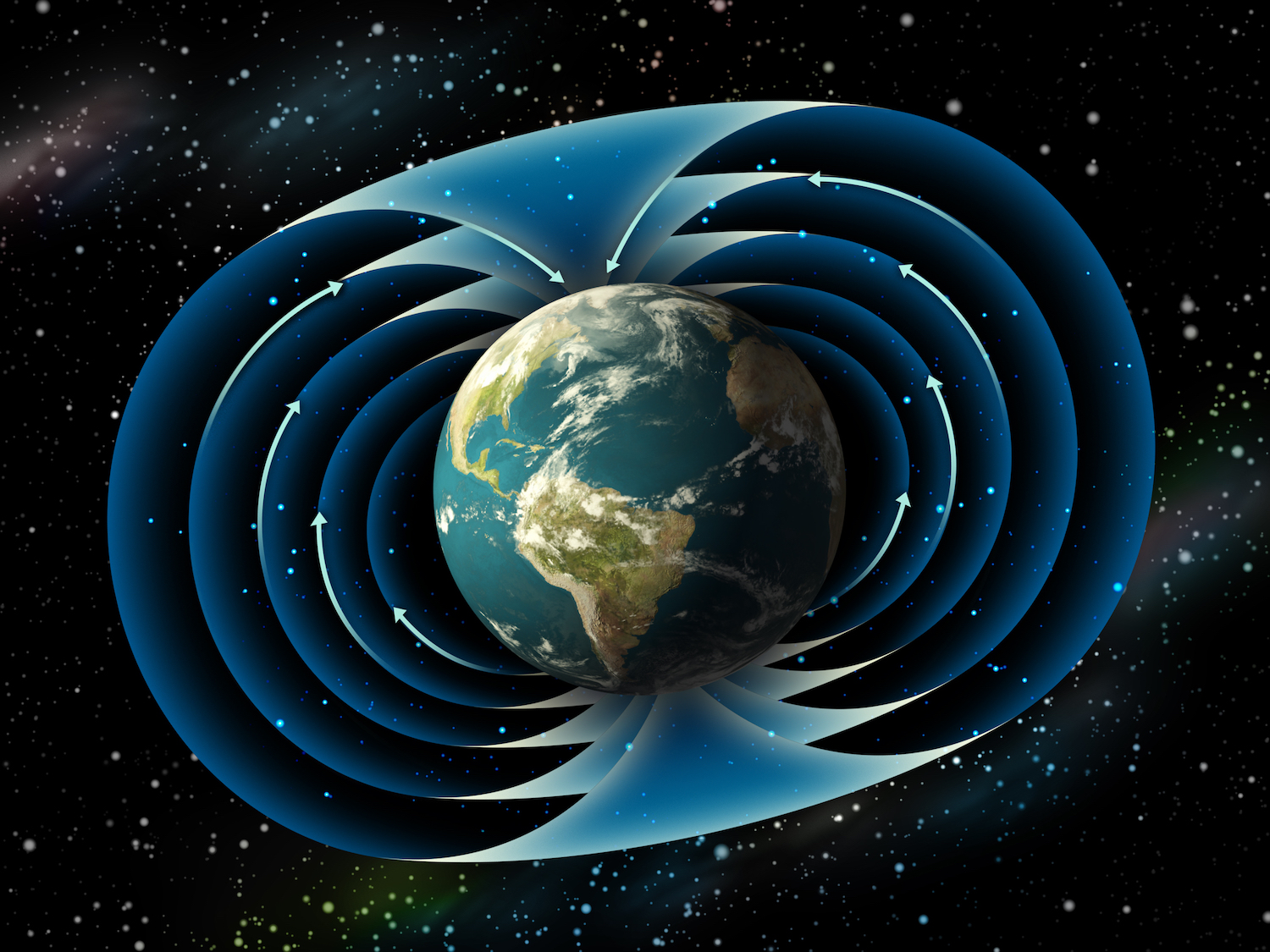
The magnetic field surrounding Earth is often compared to that of a giant bar magnet, with lines of magnetic force emerging near the south magnetic pole, looping through space, and re-entering near the north magnetic pole. While this analogy is useful, the reality is far more dynamic and complex. Earth’s magnetic field is generated not by a solid magnet, but by the motion of molten metal deep beneath our feet.
At the center of Earth lies a solid inner core composed primarily of iron and nickel, surrounded by a vast outer core of molten metal. This outer core is in constant motion, driven by heat escaping from the inner core and the slow cooling of the planet. As electrically conductive liquid iron moves and swirls, it generates electric currents. These currents, in turn, produce magnetic fields. This self-sustaining process is known as the geodynamo.
The geodynamo is remarkably efficient. It produces a magnetic field strong enough to extend tens of thousands of kilometers into space, forming the magnetosphere. This region deflects much of the solar wind, preventing it from stripping away the atmosphere and bombarding the surface with dangerous radiation. Without this magnetic shield, Earth might resemble Mars, a planet that lost much of its magnetic field early in its history and subsequently much of its atmosphere.
The Nature of Magnetic Poles
When people speak of Earth’s magnetic north and south poles, they often imagine fixed points neatly aligned with the planet’s geographic axis. In reality, magnetic poles are fluid features that drift over time. The magnetic north pole, the point where the magnetic field lines point straight down into Earth, has moved significantly over the past centuries. In recent decades, it has been racing across the Arctic toward Siberia at an unprecedented pace.
This movement is not itself a sign of an imminent pole flip. Magnetic pole drift is a normal consequence of the constantly changing flow patterns in the outer core. The magnetic field responds to these changes, shifting and reshaping itself. The geographic poles, defined by Earth’s rotation, remain fixed, but the magnetic poles wander as the geodynamo evolves.
A magnetic pole flip, however, is something more dramatic. During a reversal, the global magnetic field weakens, becomes more complex, and eventually re-establishes itself with opposite polarity. What was once magnetic north becomes magnetic south, and vice versa. Compasses would point in the opposite direction, and the magnetic field lines would reverse their orientation.
A History Written in Stone
Evidence for magnetic pole flips comes not from human records, but from rocks. When molten lava erupts and cools, iron-bearing minerals within it align with the prevailing magnetic field, locking in a record of its direction and polarity at the time of solidification. Similarly, sediments settling on the ocean floor can preserve magnetic information as tiny magnetic grains orient themselves before being buried.
By studying these magnetic signatures, geophysicists have reconstructed a timeline of Earth’s magnetic history stretching back hundreds of millions of years. This record reveals that magnetic reversals are neither rare nor regular. Sometimes millions of years pass without a flip, while at other times reversals occur relatively frequently. The last full magnetic reversal, known as the Brunhes–Matuyama reversal, occurred approximately 780,000 years ago.
The geological record also shows shorter, incomplete events called geomagnetic excursions. During these episodes, the magnetic field weakens and deviates significantly but eventually returns to its original polarity. These excursions suggest that the geodynamo is inherently unstable, capable of dramatic fluctuations without always completing a full reversal.
How a Magnetic Pole Flip Unfolds
A magnetic pole flip is not a sudden event. It does not happen overnight, nor even within a human lifetime. Based on geological evidence, reversals typically unfold over thousands of years. The process begins with a weakening of the global magnetic field, as the organized dipole structure breaks down.
As the field weakens, multiple north and south magnetic poles can appear simultaneously across the planet. The magnetic field becomes patchy and complex, with localized regions of strong magnetism and others of relative weakness. Eventually, a new dominant polarity emerges, and the field strengthens again with reversed orientation.
This gradual nature is crucial for understanding the potential impacts of a pole flip. There is no evidence that past reversals were associated with sudden mass extinctions or catastrophic environmental collapse. Life on Earth has endured countless magnetic reversals, from single-celled organisms to complex mammals, without apparent global catastrophe.
Is Earth’s Magnetic Field Weakening Now?
Modern instruments allow scientists to measure Earth’s magnetic field with remarkable precision. These measurements reveal that the field has been weakening on average over the past two centuries, losing roughly 10 percent of its strength since the early nineteenth century. This observation has fueled speculation that a magnetic reversal may be approaching.
However, a weakening field alone does not guarantee an imminent flip. The magnetic field has fluctuated in strength many times in the past without leading to a reversal. The geodynamo is a chaotic system, and short-term trends do not necessarily predict long-term outcomes.
One region that has drawn particular attention is the South Atlantic Anomaly, an area where the magnetic field is significantly weaker than average. This anomaly allows charged particles from space to penetrate closer to Earth’s surface, affecting satellites and spacecraft. While the South Atlantic Anomaly is expanding and evolving, it is best understood as a feature of the complex magnetic field rather than a definitive precursor to a reversal.
The Physics Behind a Reversal
At the heart of the magnetic pole flip lies the physics of fluid motion and electromagnetism. The outer core is a turbulent sea of molten iron, shaped by rotation, heat flow, and compositional differences. The balance between these forces determines the structure of the magnetic field.
Computer simulations of the geodynamo suggest that reversals can occur when changes in flow patterns disrupt the dominant dipole field. Small-scale magnetic features can grow and compete with the main field, eventually overturning it. These simulations reproduce many features observed in the geological record, including periods of weakened field strength and complex pole configurations.
Yet predicting exactly when a reversal will occur remains beyond current scientific capability. The system is highly nonlinear, meaning that small changes can lead to vastly different outcomes. While scientists can identify conditions that make reversals more likely, they cannot forecast them with the precision of weather predictions.
Life Under a Reversing Magnetic Field
One of the most emotionally charged questions surrounding magnetic pole flips concerns their impact on life. If Earth’s magnetic shield weakens, would radiation levels rise to dangerous levels? Would organisms that rely on magnetism for navigation become disoriented?
The geological record provides reassurance. Magnetic reversals have occurred many times without clear evidence of widespread biological harm. While increased radiation may reach the upper atmosphere during periods of weakened magnetism, Earth’s atmosphere itself remains a powerful shield against harmful radiation. Ozone depletion and increased mutation rates have been suggested as possibilities, but there is no compelling evidence that past reversals triggered mass extinctions.
Migratory animals that use Earth’s magnetic field, such as birds and sea turtles, may face challenges during periods of magnetic instability. However, these species have survived numerous reversals, suggesting that they possess adaptive mechanisms or rely on multiple navigational cues. Evolution has unfolded under a dynamic magnetic environment, not a static one.
Implications for Modern Technology
While life may be resilient, modern technology introduces new vulnerabilities. Satellites, power grids, and communication systems are sensitive to space weather and magnetic disturbances. A weakened magnetic field could allow more charged particles to reach low Earth orbit, increasing the risk of satellite malfunctions.
Geomagnetic storms, caused by solar activity interacting with Earth’s magnetic field, already pose risks to electrical infrastructure. During a prolonged period of reduced magnetic strength, such storms could have more pronounced effects. This does not mean that a pole flip would cause technological collapse, but it does highlight the importance of monitoring space weather and designing resilient systems.
Importantly, these challenges are not unique to magnetic reversals. Even under the current magnetic configuration, extreme solar events can disrupt technology. Understanding and mitigating these risks is an ongoing area of research, independent of whether a pole flip occurs in the near future.
Human Perception and Cultural Imagination
Throughout history, humans have imbued natural phenomena with symbolic meaning, and magnetic pole flips are no exception. The idea of Earth’s poles reversing evokes a sense of cosmic upheaval, a turning of the world itself. In popular culture, such scenarios are often portrayed as sudden, catastrophic events that reshape the planet overnight.
Science offers a more measured perspective. A magnetic pole flip is a slow, natural process, unfolding over thousands of years. It does not cause continents to shift or oceans to spill across land. Yet the emotional power of the idea speaks to a deeper human fascination with change and uncertainty.
Understanding the true nature of magnetic reversals can transform fear into curiosity. Rather than a sign of impending doom, a pole flip becomes a reminder that Earth is a dynamic system, constantly evolving over timescales far longer than a human life.
What the Future Holds
So, is Earth’s magnetic shield about to reverse? The honest scientific answer is that we do not know. While the magnetic field is changing and weakening in certain regions, there is no definitive evidence that a full reversal is imminent. It could occur in the next few thousand years, or it might not happen for tens of thousands of years more.
What is certain is that Earth’s magnetic field will continue to evolve. The geodynamo has been operating for billions of years, and magnetic reversals are part of its natural behavior. By studying past reversals and monitoring present changes, scientists deepen their understanding of the processes that shape our planet from within.
A Planet Alive with Change
The story of Earth’s magnetic pole flips is ultimately a story about change on a planetary scale. It reveals a world that is not static but alive with motion, from the churning of molten metal in the core to the shifting lines of magnetic force that envelop the planet.
This perspective can be emotionally grounding. In an age when change often feels threatening, Earth’s magnetic history reminds us that transformation is not inherently destructive. Life has persisted, adapted, and flourished through countless magnetic upheavals. The planet’s shield has weakened and strengthened, flipped and reformed, without extinguishing the delicate complexity of the biosphere.
Conclusion: Fear, Fascination, and Understanding
The possibility of a magnetic pole flip invites both fear and fascination. It challenges our sense of stability and raises questions about vulnerability in a technologically dependent world. Yet when viewed through the lens of science, it becomes a narrative of resilience rather than catastrophe.
Earth’s magnetic field is a dynamic shield, born from the restless heart of the planet. Its reversals are not signs of failure but expressions of an active, evolving system. By studying these processes with rigor and humility, physics and geophysics offer not only explanations, but perspective.
The magnetic pole flip, whenever it comes, will not mark the end of Earth’s protection, nor the end of life’s story. Instead, it will be another chapter in the long, unfolding history of a planet shaped by motion, energy, and change.