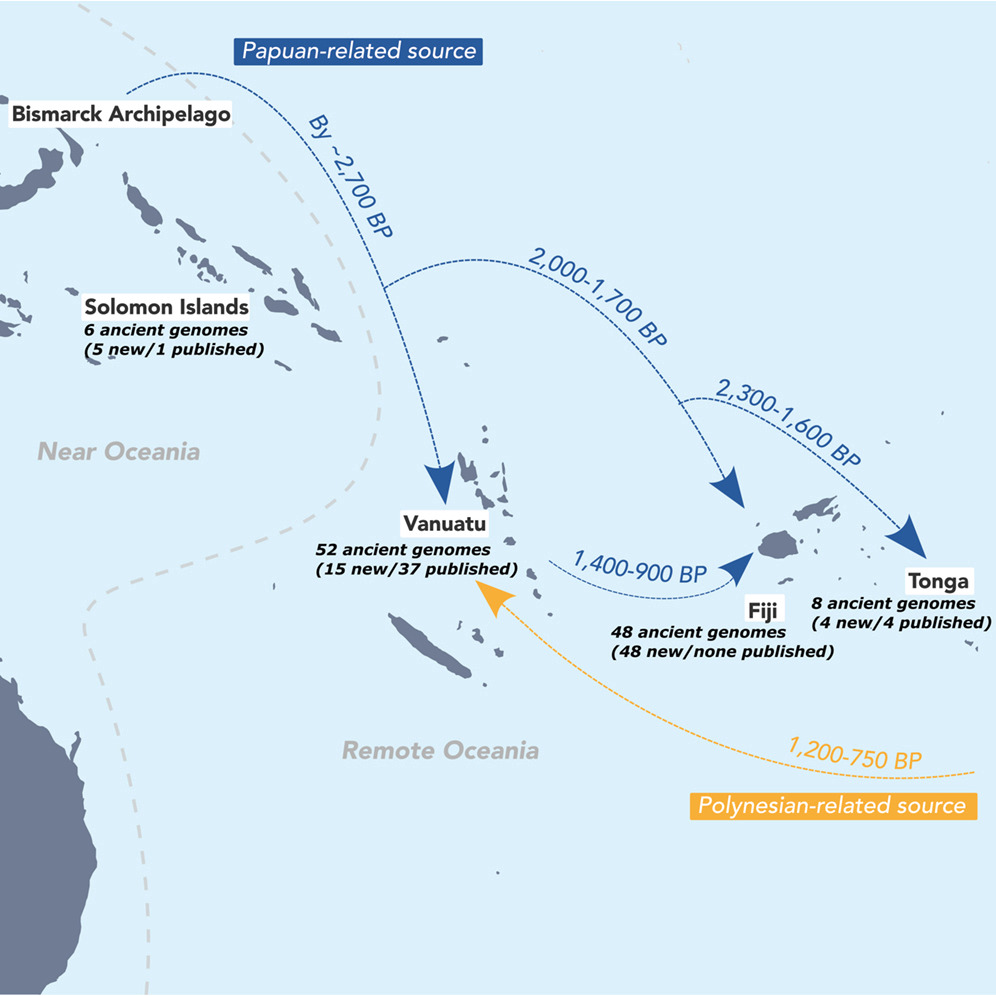
Ancient DNA from islands across the southwest Pacific shows that Papuan-related ancestry spread eastward more slowly than the first Lapita-associated settlers, reaching western Fiji in at least two separate waves between about 2,000 and 900 years ago. The finding pushes the first known Papuan-related gene flow into Fiji centuries earlier than previous estimates and helps distinguish separate movements of people across Remote Oceania.
Remote Oceania was settled in stages. The first major expansion came from Southeast Asian-related populations associated with the Lapita cultural complex. These seafaring people reached Vanuatu by about 3,000 years ago, Fiji by about 2,900 years ago, and Tonga and Samoa by about 2,850 years ago.
Later populations carrying Papuan-related ancestry moved into the region. But the timing and routes of those movements had been difficult to reconstruct because ancient genomic data were missing from Fiji, an important geographic link between Vanuatu and the Polynesian Triangle.
The new study adds genome-wide data from 72 ancient individuals from the eastern Solomon Islands, Vanuatu, Fiji, and Tonga, covering the past 3,000 years. The researchers recovered genetic data from 75 of 133 screened individuals, with 50 from western Fiji, 16 from southern Vanuatu, four from Tonga, and five from the eastern Solomon Islands. After quality control, 72 individuals were included in the analyses.
The results reveal a much more complicated sequence of population movements than a single eastward migration.
Papuan-related ancestry appeared early in Vanuatu
The earliest individual in the study carrying Papuan-related ancestry was a woman from Tanna in southern Vanuatu. She was radiocarbon dated to between 2,758 and 2,720 years ago.
Her genetic profile was modeled as having minor to no ancestry components other than Papuan-related ancestry. Another previously studied individual from Tanna, dating to around 2,500 years ago, showed a similar pattern.
The first individuals with both Papuan-related and Southeast Asian-related ancestry appeared around 2,500 years ago in Malakula, in central Vanuatu. The researchers estimated the admixture event to between about 2,840 and 2,440 years ago.
This places the earliest known Papuan-related ancestry in western Remote Oceania in Vanuatu only about 300 years after the initial Lapita-associated settlement.
But the movement did not continue eastward at the same rapid pace as the earlier Lapita expansion.
The researchers found that Papuan-related ancestry appeared in central Vanuatu by about 2,500 years ago, in western Fiji no earlier than about 2,000 years ago, and in Tonga at least several centuries later. Their results therefore indicate a slower eastward spread of Papuan-related ancestry than the initial Lapita-associated expansion.
Fiji shows evidence of two separate influxes
The most important new evidence comes from western Fiji.
Individuals from the Sigatoka site, dating to about 1,600–1,400 years ago, carried substantial amounts of both Papuan-related and Southeast Asian-related ancestry. Their genetic profiles were also highly varied. Their estimated Southeast Asian-related ancestry ranged from 35% to 85%.
That variation is consistent with a relatively recent admixture event. The researchers dated this event to about 1,970–1,740 years ago.
The finding is significant because earlier estimates based on present-day genomes had placed Papuan-related admixture in Fiji much later, at around 500 or 1,100 years ago.
The ancient genomes instead indicate that the first Papuan-related influx into western Fiji occurred around 2,000–1,700 years ago.
The researchers then found evidence for another influx.
Younger individuals from the Bourewa and Yanuca sites had higher affinities with Papuan-related groups than the Sigatoka individuals. Their estimated Papuan-related ancestry was roughly twice that of the Sigatoka group.
Admixture dating placed this second influx between about 1,364 and 927 years ago.
The study therefore identifies at least two distinct episodes of Papuan-related gene flow into western Fiji. The authors place the first around 2,000–1,700 years ago and the second around 1,300–900 years ago. Both are earlier than previous estimates based on present-day populations.
The two waves may have come from different places
The genetic evidence points to different possible sources for the two episodes.
Across Vanuatu, Fiji, and Tonga, the Papuan-related ancestry is best matched by ancestry related to populations of the Bismarck Archipelago. The researchers found stronger affinities with Bismarck Archipelago-related ancestry than with Papua New Guinea highlanders or Solomon Islands-related groups.
The first Papuan-related influx into Fiji fits this broader pattern.
The second influx appears different. When the researchers modeled the younger Bourewa individuals against possible sources, only models that included southern and central Vanuatu populations produced a good fit, accounting for about 58%–63% of the ancestry in those models.
That result points toward a geographically closer source for the second influx than for the first. But the researchers cannot identify its precise origin because ancient genomic data are still missing from several relevant regions, including New Caledonia, much of western Polynesia, and eastern Fiji.
The authors also note another possibility. Because Fiji itself had population structure, linguistic variation, and cultural diversity, the second pulse could have come from an unsampled group within Fiji that already carried elevated Papuan-related ancestry.
The source therefore remains unresolved.
The movement was slower than the first settlement
The timing across the islands gives the researchers a broader picture.
The original Lapita-associated expansion moved rapidly eastward. Archaeological evidence places the arrival of Lapita-associated populations in Vanuatu at about 3,000 years ago, followed by Fiji and then Tonga within roughly two centuries.
The Papuan-related expansion followed a different tempo.
Papuan-related ancestry was already present in Vanuatu by about 2,700 years ago, but the first evidence of admixture in central Vanuatu dates to around 2,500 years ago. In western Fiji, the first influx occurred around 2,000–1,700 years ago. In Tonga, the study establishes a latest date of about 1,600 years ago for the arrival of Papuan-related ancestry.
The researchers describe this as a slower eastward expansion, accompanied by a decline in Papuan-related ancestry from west to east.
The precise mechanisms behind these movements cannot yet be determined. In Vanuatu, for example, genetic evidence shows that admixture continued for centuries after the earliest introduction of Papuan-related ancestry. The researchers say this could represent additional long-distance movements from Near Oceania or more localized exchanges between islands, but the available data cannot distinguish between these possibilities.
Tonga received Papuan-related ancestry later
Tonga provides another part of the timeline.
The earliest Lapita-associated individuals from Tonga, dating to about 2,500 years ago, are best modeled as having entirely Southeast Asian-related ancestry. The younger Tongan individuals analyzed in the study carried about 32% Papuan-related ancestry.
The dating of this admixture was imprecise, producing a broad range of about 2,280–1,620 years ago. Even with that uncertainty, the results indicate that Papuan-related ancestry reached Tonga no later than about 350 years after its arrival in western Fiji.
There is still a major gap in the ancient genomic record from Tonga, however. The study lacks genomes covering much of the roughly 2,000-year period between the Lapita era and the beginning of the Tongan state period.
That gap prevents the researchers from determining the precise sequence by which Papuan-related ancestry entered Tonga.
A later Polynesian movement also left a genetic signal
The study also found evidence for a later movement in the opposite direction.
Polynesian-related gene flow reached western Remote Oceania around 1,200–800 years ago, contributing to the ancestry of Polynesian Outlier communities in southern Vanuatu.
One newly analyzed woman from Aniwa, a Polynesian Outlier island in southern Vanuatu, was radiocarbon dated to 1,017–799 years ago. About 66% of her ancestry was estimated to be Southeast Asian-related, similar to ancient Tongan groups.
Genetic modeling placed her close to Polynesian populations and found that a Polynesian-related model provided the best explanation for her ancestry. Her estimated admixture date, about 2,225–1,676 years ago, was earlier than those of the other Vanuatu Polynesian-associated groups examined in the study. The researchers therefore identify her as the earliest individual in Vanuatu in their dataset carrying Polynesian-related ancestry and interpret her as being of recent Polynesian descent, with no detectable admixture from local Vanuatu groups.
Two other ancient Vanuatu groups, from Futuna and the Chief Roi Mata’s Domain, also showed significant Polynesian genetic influence. Their modeled Polynesian-related ancestry was about 22% and 37%, respectively.
The estimated Polynesian-related admixture dates overlap at roughly 1,200–750 years ago. The researchers say this fits archaeological and linguistic estimates for the westward movements often called Polynesian backflows.
At the same time, the available data do not rule out earlier movements. Additional ancient genomes from islands occupied during the same period would be needed to determine whether Polynesian movement into southern Vanuatu began earlier than the study can establish.
Ancient DNA also reveals a closely connected Fijian group
The genetic record from Fiji provides another unexpected result at Sigatoka.
The researchers examined 25 individuals from the cemetery, which dates to about 1,600–1,400 years ago. About 65% had at least one first- or second-degree relative among the sampled individuals.
Genetic analysis identified a subset of 12 closely connected individuals. They had significantly more Southeast Asian-related ancestry than the rest of the cemetery, with averages of 73% and 52%, respectively. Their radiocarbon dates overlapped, indicating that the two groups were broadly contemporaneous.
The cemetery itself showed differences in burial treatment. Some people were buried beneath elaborate coral structures called cairns, while others had simpler burials. Four adult males buried under cairns at higher elevations were associated with artifacts and had previously been interpreted as higher-status individuals. Earlier isotopic work also found that greater marine resource consumption was associated with cairn burials.
Two of the higher-ranking individuals were part of the closely related genetic group.
The researchers reconstructed several possible pedigrees spanning four to five generations. These included half-sibling relationships and individuals with multiple reproductive partners. The two higher-ranking individuals could have been maternal half-siblings or a maternal grandfather and grandson.
If they were connected in this way, the pattern indicates that status or wealth may have passed through a female member of the lineage. The researchers say this could be consistent with a non-unilineal form of succession, in which inheritance or succession could involve both male and female lines.
The closely related group also showed higher levels of parental relatedness. The authors suggest that the pattern may have helped preserve wealth within the group, but they emphasize that this interpretation needs confirmation with larger samples.
The cemetery does not provide evidence that these burial clusters were family graves. Apart from one mother-daughter pair, the researchers found no close biological relationships within the clusters, and genetic relatedness was not significantly associated with burial location. The clusters instead showed an association with biological sex, with some multiple-person burials containing only males or only females.
The genetic record remains incomplete
The study cannot identify every population involved in these movements.
Ancient genomes are still lacking from important parts of Papua New Guinea, New Caledonia, Samoa, the Polynesian Triangle, and other islands. These gaps make it difficult to identify the precise geographic source of the Bismarck Archipelago-related ancestry and to determine whether some demographic changes involved additional waves of migration.
The authors also caution that the Sigatoka cemetery represents one ancient community and should not automatically be taken as evidence for social practices across other Oceanian societies. More multi-individual archaeological sites will be needed to determine how widely the patterns seen at Sigatoka occurred.
For now, the ancient genomes provide a clearer sequence: the first Lapita-associated settlement brought Southeast Asian-related ancestry rapidly across western Remote Oceania, followed by a slower eastward spread of Papuan-related ancestry. In Fiji, that later movement occurred in at least two distinct pulses, with the first arriving around 2,000–1,700 years ago and the second around 1,300–900 years ago. Later Polynesian-related movements added another layer of genetic change in parts of western Remote Oceania.
The study was published in Cell.