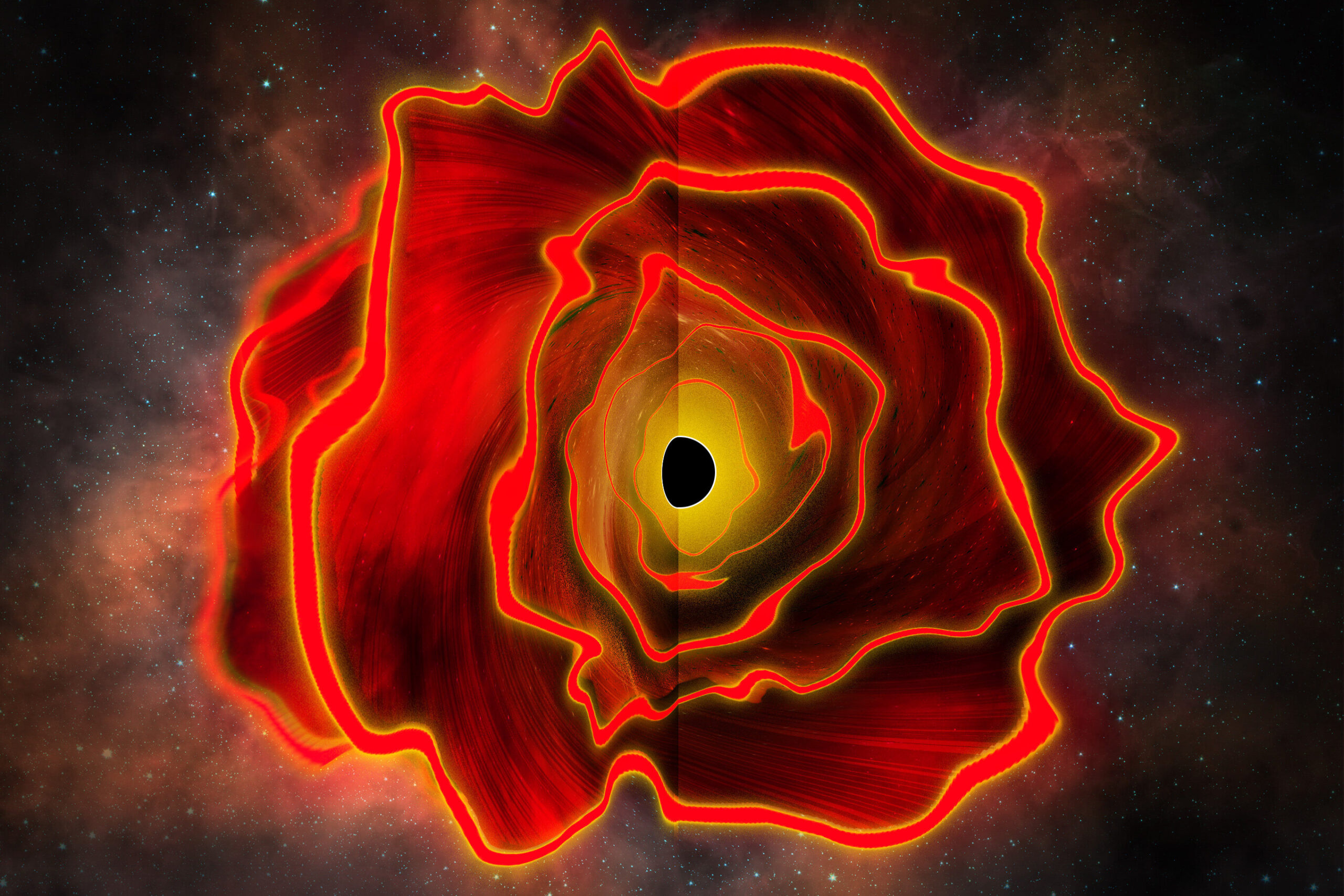
A black hole seen just 660 million years after the Big Bang appears to be buried inside an unusually dense envelope of gas, producing an extreme spectral signature that cannot be explained by a normal population of stars. The object, called MoM-BH-1, may offer evidence of the kind of gas-rich environment that theoretical models have proposed could help black holes grow rapidly in the early universe.*
MoM-BH*-1 was identified in observations of the Ultra Deep Survey field made with the James Webb Space Telescope. In images from JWST’s NIRCam instrument, it stood out as the reddest source in an area of about 250 square arcminutes. It was bright at wavelengths longer than about 3 micrometers but appeared to disappear at shorter wavelengths.
Follow-up spectroscopy revealed why.
The source lies at a redshift of 7.7569, placing it about 660 million years after the Big Bang. Its spectrum contains a broad Hβ emission line, strong absorption in Hβ and Hγ, and an exceptionally large Balmer break. Across the Balmer break, the observed flux drops by more than a factor of 20.
The size of that break is what makes the object especially difficult to explain.
A Balmer break can occur when hydrogen in stars absorbs light at particular wavelengths. For a dust-free stellar population with a typical initial mass function, the maximum expected break strength is about 3. Even an extreme population made entirely of A-type stars would be expected to have a break weaker than 5.
MoM-BH*-1 has a measured break strength of about 7.7, with uncertainties of +2.3 and −1.4. It lies well beyond the expected range for stellar populations. The source is also the only object in the comparison that clearly exceeds those limits.
That makes a normal stellar explanation highly unlikely.
Dense gas creates the unusual spectrum
The strongest clue comes from the hydrogen absorption lines.
MoM-BH*-1 shows intense absorption in Hβ and Hγ at the same time that Hβ is also seen in emission. Producing this type of Balmer absorption requires extremely dense gas, with hydrogen number densities of at least about 10⁹ particles per cubic centimeter, because enough hydrogen atoms must occupy the second energy level to absorb the light.
The source also appears extremely compact. Its effective radius is constrained to less than roughly 100 parsecs, and its Hβ emission is extremely broad. A tentative detection of the narrow [O III] doublet and a possible increase in brightness provide additional evidence that a black hole is powering the source.
The researchers therefore modeled the object as a black hole surrounded by extremely dense gas.
They used the Cloudy spectral-synthesis program to test nearly a million models containing an active galactic nucleus surrounded by gas. The models were required to reproduce several properties at once, including the strength of the Balmer break, the Hβ and Hγ lines, the weakness of the ultraviolet light, and the observed spectrum at longer wavelengths.
The model that best reproduced the observations required gas with a density of about 10¹¹ particles per cubic centimeter and a column density of about 10²⁵.⁸ square centimeters. The gas was modeled with turbulent velocities of about 500 kilometers per second.
The modeled gas envelope is also extremely thick. The authors describe the structure as a column of Compton-thick gas extending roughly 10 to 100 astronomical units around the black hole. Their schematic model places the black hole mass at roughly 10⁶ solar masses.
The redness comes from gas, not dust
One of the most important results is that the extreme redness of MoM-BH*-1 does not require a large amount of dust.
The best-fitting model uses only about 0.15 magnitudes of visual dust attenuation. Instead, the ultraviolet weakness and strong Balmer break arise from the opacity of the extremely dense hydrogen gas.
This distinction matters because dust and gas affect light in different ways.
In this model, radiation from the central black hole passes through the dense gas surrounding it. The gas absorbs, scatters and reprocesses the radiation, producing the unusual combination of a very strong Balmer break, broad emission lines and deep absorption features.
The model also reproduces the observed mid-infrared behavior without requiring substantial dust attenuation. The authors caution, however, that the modeling is highly simplified. The intrinsic spectrum of the early active black hole could differ substantially from the assumed spectrum, and the structure of the gas may be more complicated than the model represents.
The result is therefore presented as evidence that dense gas surrounding a central black hole can account for the unusual observations, rather than as a detailed determination of the envelope’s physical properties.
The Hβ line may be shaped by scattering
The hydrogen emission line contains another unusual feature.
The Hβ profile is remarkably symmetric. Its peaks and absorption troughs occur at similar velocities on both sides of the systemic velocity determined from the [O III] lines.
That symmetry makes random absorbing systems or coincident inflows and outflows an unlikely explanation for the detailed structure. A symmetric absorbing structure, such as shells of gas, is favored by the observations.
The researchers also explored a different possibility: that Hβ is being repeatedly scattered by the dense gas.
Under the extreme conditions proposed for MoM-BH*-1, Hβ photons could become trapped rather than escaping directly. A simple radiative-transfer model showed that scattering can transform a relatively narrow intrinsic Hβ emission line into a double-peaked profile. The model was able to reproduce the separation and relative intensity of the two strongest peaks observed in MoM-BH*-1.
This interpretation remains speculative. The simple model does not reproduce all of the broad wings in the observed line, and the researchers note that a more complicated geometry would need to be explored with higher-quality data.
The finding could change black hole mass estimates
The possible role of scattering has an important consequence for how black holes in these distant objects are weighed.
Astronomers commonly use the widths of broad emission lines to estimate black hole masses. But if the observed Balmer-line widths are significantly altered by scattering in dense gas, those widths may not directly represent the motion of gas in the broad-line region.
The authors find that black hole masses inferred from Balmer-line widths could therefore be overestimated by as much as two orders of magnitude in these systems.
For MoM-BH*-1 itself, different methods produce substantially different mass estimates because the unusual physical conditions make standard local scaling relations uncertain.
Applying a conventional Hβ-based relation while assuming about two magnitudes of dust attenuation would give a black hole mass of about 10⁸.³ solar masses. But the source’s spectrum indicates that such strong dust attenuation is probably unnecessary. With essentially no dust attenuation, the estimate falls to about 5 × 10⁷ solar masses.
If resonant scattering has substantially broadened the observed Hβ line, the intrinsic broad-line width could be as low as about 600 kilometers per second. That would instead imply a black hole mass of roughly 10⁶ solar masses.
The authors also use their Cloudy model to estimate the source’s bolometric luminosity at about 10⁴⁴.⁵ erg per second. The modeling and theoretical considerations favor accretion near the Eddington limit or above it. Under that assumption, they estimate a black hole mass of about 10⁶.³ solar masses.
These estimates are not presented as equally secure measurements. The authors stress that the extraordinary conditions in the source make standard black hole scaling relations unreliable and that the mass estimates should be treated as order-of-magnitude possibilities.
A possible example of rapid early growth
The timing of the observation makes the source particularly relevant to the problem of early black hole growth.
Astronomers have observed black holes with masses approaching a billion Suns at redshifts greater than about 7.5, but explaining how such massive objects could form and grow so quickly remains an open problem. Theoretical models have proposed ways for early black holes to grow extremely rapidly when surrounded by large amounts of dense gas.
In some of those models, dense gas can trap radiation from an accreting black hole or transport energy through the surrounding material. That can reduce the effectiveness of radiation pressure and potentially allow accretion above the usual Eddington limit.
MoM-BH*-1 has several properties that fit the broad physical picture predicted by such models.
The authors estimate a black hole mass in the range of roughly 10⁶ to 10⁷ solar masses. They note that the source could be undergoing an active super-Eddington growth episode, or could instead be near the end of such an episode while the gas envelope that supplied it remains in place.
The observations alone do not establish which of these possibilities is occurring.
The black hole has a small host galaxy
MoM-BH*-1 is associated with a faint, low-mass galaxy.
The researchers estimate that the host has a stellar mass below about 10⁸.⁵ solar masses. Because some of the ultraviolet light could come from the black hole itself, this is an upper limit rather than a precise measurement of the galaxy’s stellar mass.
The small galaxy is also close to a much more massive galaxy. The neighboring galaxy has a stellar mass of about 10⁹.⁵ solar masses and lies roughly 60 proper kiloparsecs away, with a redshift difference of less than 0.01. The two systems are expected to merge in about 100 million years.
The proximity is relevant to theories of direct-collapse black holes, in which black holes could form from primordial gas under conditions that suppress molecular hydrogen formation. The authors note that the nearby ionizing source could potentially be relevant to such a process, but they emphasize that the formation of these enshrouded black holes remains an open question.
The object may help explain little red dots
The researchers also examined whether MoM-BH*-1 could help explain the strange class of JWST sources known as little red dots, or LRDs.
These compact, red objects have puzzled astronomers because their spectra combine properties associated with active black holes and properties that can resemble stellar populations. MoM-BH*-1 has several of the relevant features, including a strong Balmer break, broad Balmer lines and a compact appearance.
A particularly revealing test came from combining the observations of MoM-BH*-1 with those of its brighter neighboring galaxy.
The combined spectrum and photometry produce a V-shaped spectral energy distribution similar to that seen in typical LRDs. In the resulting composite, the galaxy dominates the ultraviolet light, while the black hole dominates at longer, rest-optical wavelengths. The combined system is compact in the rest-optical but more extended in the rest-ultraviolet, another characteristic of LRDs.
This leads the researchers to propose a specific interpretation of LRDs. In their picture, an enshrouded black hole like MoM-BH*-1 could provide the active galactic nucleus component, while a star-forming galaxy provides much of the ultraviolet emission.
Under this interpretation, the black hole would dominate the rest-optical light and produce the broad Balmer lines, Balmer break and possible variability. The host galaxy would dominate the ultraviolet light and could provide narrow emission such as Lyα.
The authors present this as a proposed explanation rather than a demonstrated description of all LRDs.
The source may also be changing in brightness
There is tentative evidence that MoM-BH*-1 varies over a short period.
Three sets of observations covering wavelengths from about 3 to 5 micrometers were obtained approximately 60 days apart in the object’s rest frame. The source appeared to brighten by about 30 percent between the first and third observations.
The measurements were made with different JWST instruments and therefore contain systematic uncertainties. Even so, the authors describe the apparent change as a possible detection of variability over only about two months. MoM-BH*-1 was also the only source among 136 objects in the relevant comparison sample to show this degree of brightening.
The result provides an additional reason for future monitoring of the source, but the researchers do not treat it as definitive evidence by itself.
The broader picture remains focused on the unusual gas surrounding the black hole. The observations show a source whose radiation is largely dominated by a compact central engine, while dense, turbulent gas appears capable of producing the extraordinary absorption and spectral shape. The modeling supports that physical picture, but the authors emphasize that many details of the gas structure and the intrinsic black hole spectrum remain uncertain.
The study was published in Nature.