Archaeologists studying a medieval burial in Aberdeen have identified what may be the earliest known dental bridge in Scotland: a 20-carat gold alloy ligature wire used to stabilize or replace a missing tooth. Scientific analysis and radiocarbon dating place the individual—a middle-aged man—between 1460 and 1670 CE, showing the device had been worn for a significant time before death. The discovery offers rare physical evidence that skilled restorative dental work existed in Scotland long before dentistry became a formal profession.
A missing tooth might seem like a small detail in an archaeological skeleton—until it comes with gold.
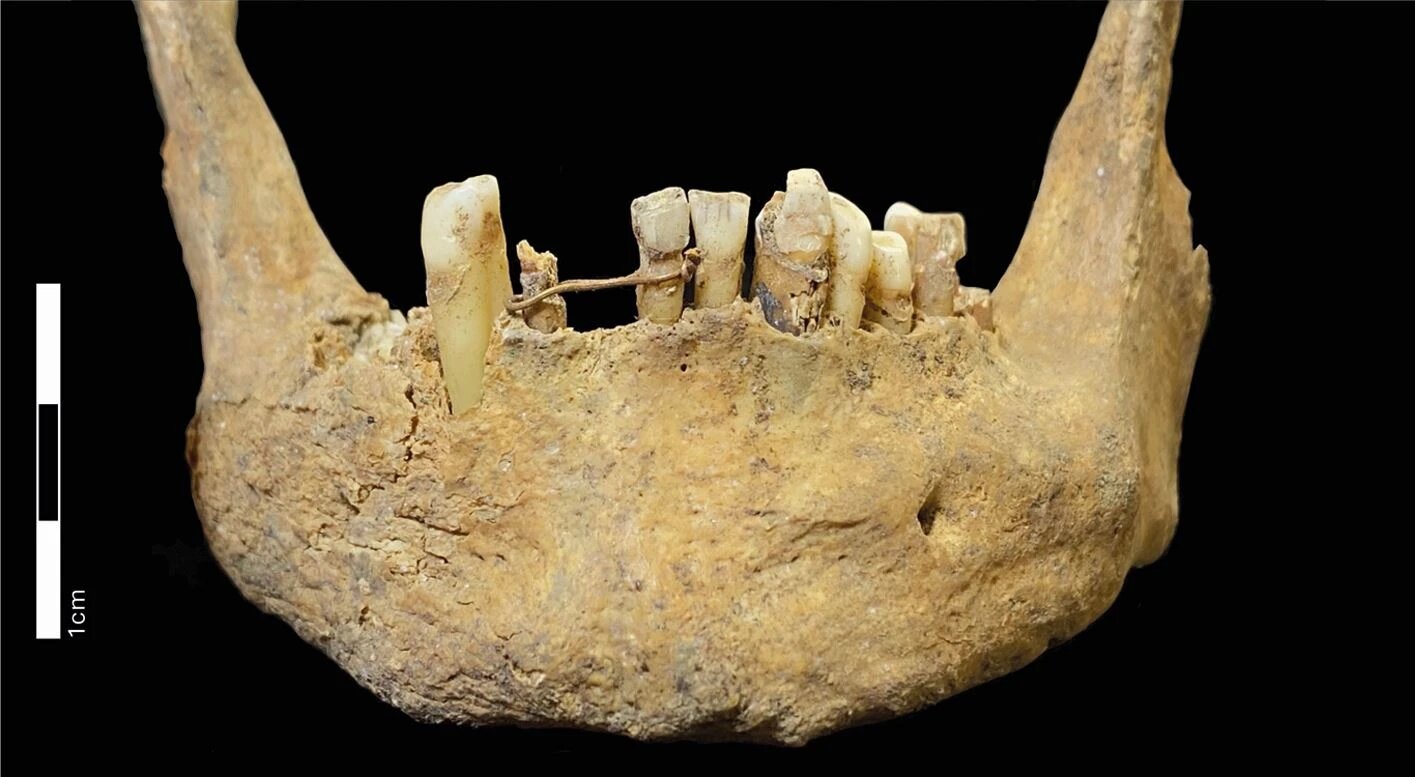
In a burial site beneath a major medieval church in Aberdeen, Scotland, researchers found a human jaw unlike the hundreds of others around it. Instead of ordinary tooth loss, this mandible carried something far more unusual: a thin gold wire carefully tied around teeth, forming what appears to be a functional dental bridge.
The finding, described in a study published in the British Dental Journal, is now considered the earliest known example of a dental bridge ever identified in Scotland.
Dental treatment existed long before modern dentistry
Dentistry, as an officially recognized profession, did not emerge until the 19th century. But long before formal dental clinics existed, people still suffered from cavities, loose teeth, and painful infections—and they still tried to fix them.
Archaeological evidence suggests that forms of dental care may date back as far as 14,000 years ago, with possible tooth modifications found from the Late Upper Paleolithic period. Another striking example comes from Slovenia around 6,500 years ago, where researchers discovered beeswax placed inside a dental cavity.
Even in ancient Egypt, dental ligatures—silver or gold wires used to stabilize teeth or replace missing ones—have been identified from as early as 2,500 BCE. However, archaeologists have long suspected that some of those Egyptian examples may have been placed after death, possibly to make the body appear “complete” before burial.
That uncertainty makes the Scottish discovery especially significant: the evidence strongly indicates the gold wire was worn during life, not added later.
Medieval Europe had dental knowledge—but not many dentists
By the Middle Ages, oral remedies and dental interventions were becoming more common in Europe. Medical, surgical, and scientific writings from the period mention dental concerns, suggesting that tooth pain and decay were widespread topics of discussion.
But the study authors point out that teeth were often not considered the responsibility of physicians. Medieval surgical texts, they note, tended to offer only brief guidance on oral health. One explanation is that teeth were seen as outside the professional scope of doctors and surgeons.
Instead, dental work was frequently carried out by barbers or specialists known as dentatores—people who focused on treating teeth.
Even so, physical evidence of dental ligatures in Europe remains rare, especially before the 17th century. And prior to this case, none had ever been documented in Scotland.
A major excavation uncovered an unexpected detail
The discovery traces back to an excavation carried out in 2006 at the East Kirk of St. Nicholas Kirk in Aberdeen. The site yielded the remains of around 900 individuals, along with an additional 3.5 metric tons of disarticulated skeletal material.
St. Nicholas Kirk was not an ordinary church. During the 14th to 16th centuries, it underwent rebuilding and expansion and was recognized as one of the largest churches in Scotland at the time. The volume of burials reflects its importance as a major religious and community center.
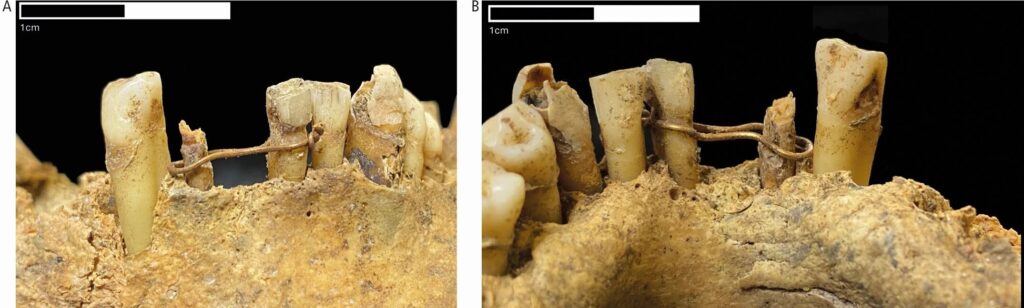
Years later, a research project focused on health trends in Scotland returned to the salvaged remains for reassessment. That’s when researchers noticed something extraordinary in one jawbone: a gold ligature connecting teeth, with one tooth missing from the center.
The wire appeared to serve as a bridge—either anchoring a prosthetic tooth or stabilizing a loose one. Out of the remains of 100 individuals examined closely, only one showed evidence of such dental work.
Scientific testing revealed the wire’s age and composition
To better understand the find, researchers applied multiple analytical techniques. They performed radiocarbon dating on the mandible to establish when the individual lived. They also used scanning electron microscopy and X-ray spectroscopy to examine the wire itself.
The results placed the burial between 1460 and 1670 CE.
The individual was identified as a middle-aged man, based on skeletal features and patterns of dental wear. Importantly, marks on the teeth showed that the ligature had not been placed shortly before death—it had been in use for a significant period.
This detail strengthens the argument that the wire served a real purpose in daily life, rather than being a symbolic burial addition.
Analysis of the metal revealed that the ligature was made of 20-carat gold alloy, a remarkably high-value material to dedicate to dental work.
Goldsmith craftsmanship may have enabled the procedure
The researchers note that during the time period in question, at least 22 goldsmiths were operating in Aberdeen. According to the study, these craftsmen would likely have been capable of producing a simple gold wire and forming the knot needed to keep it tightly secured around the teeth.
That does not prove the dental work was performed locally, but it does show that the technical ability existed in the city.
The team could not confirm whether the procedure was done in Aberdeen or elsewhere. Still, the presence of skilled goldsmiths nearby makes local production a realistic possibility.
The wire’s careful construction also suggests intention and planning, not improvisation. Someone either sought out or commissioned this dental repair, implying that restorative dentistry—at least in some form—was accessible to certain individuals.
A sign of wealth, and possibly social pressure
Gold dental work would not have been available to everyone. The researchers argue that the man likely had access to both skilled craftsmanship and the financial resources needed to pay for it.
In practical terms, the ligature may have helped preserve chewing ability and oral function, especially if it held a loose tooth in place or supported a prosthetic replacement.
But the authors suggest that function was not the only motivation.
During the Late Medieval and Early Modern periods, physical appearance carried deep social meaning. The study notes that a person’s outward health and appearance were often linked to their moral character. Visible signs of illness or physical deterioration could be interpreted as evidence of wrongdoing or sin.
In that cultural context, maintaining an intact smile may have been more than vanity—it may have been tied to reputation, respectability, and social standing.
The study authors describe the decision to undergo such a procedure as likely “multifaceted,” shaped by both personal needs and social expectations.
A rare glimpse into premodern restorative dentistry
Although dental pain and tooth loss were common in the past, physical evidence of dental restoration is difficult to find. Teeth decay, wires corrode, and small objects are easily missed or destroyed over time.
That makes this Scottish ligature especially valuable. It provides direct archaeological proof that restorative dental work existed in Scotland centuries before dentistry became a recognized profession.
It also shows that medical history is not always written in textbooks—it can be found in tiny details preserved in bone, hidden in burial sites for hundreds of years.
Why This Matters
This discovery adds rare, tangible evidence to the history of dental care in Europe, showing that people in Scotland were attempting sophisticated tooth restoration as early as 1460–1670 CE. The use of 20-carat gold alloy and the signs of long-term wear suggest the procedure was not symbolic, but part of real life—meant to preserve function and appearance.
Beyond dentistry, the find reveals something deeper about medieval society: health, craftsmanship, wealth, and social identity were closely connected. A simple gold wire in a jawbone shows that even centuries ago, people invested in medical solutions not only to survive, but to live with dignity and social acceptance.
Study Details
Jenna M. Dittmar et al, Restorative dentistry in Early Modern Scotland: archaeological evidence of the use of a gold ligature, British Dental Journal (2026). DOI: 10.1038/s41415-025-9107-3