For a long time, the bone tools of the Sierras de Córdoba sat in silence. They rested in museum drawers, emerged briefly in excavation reports, and then slipped back into obscurity. Archaeology knew they existed, but rarely asked how they were made, who shaped them, or what stories their surfaces might hold. Now, after decades of quiet neglect, those bones are finally being listened to.
A new study led by Dr. Matías Medina, alongside Sebastián Pastor and Gisela Sario, has opened a long-closed door into the lives of Late Prehispanic communities who lived in Argentina’s Sierras de Córdoba between roughly 1220 and 330 years before present. By closely examining bone arrow points, one of the most common yet least understood tools of the time, the researchers have revealed a surprisingly intimate picture of ancient craftsmanship, family life, and social identity.
Published in the International Journal of Osteoarchaeology, the research does more than describe objects. It reconstructs a process, a rhythm of work, and a way of learning that once unfolded within households and camps scattered across the Southern Punilla Valley.
A Landscape of Movement and Adaptation
The people who inhabited the Sierras de Córdoba during the Late Prehistoric Period lived flexible lives. They moved across the landscape, occupying seasonal camps, adjusting their strategies as resources shifted throughout the year. Their economy was mixed, blending hunting and gathering with farming practices, allowing them to remain mobile while still drawing stability from cultivated foods.
This adaptability left behind a subtle archaeological footprint. Instead of monumental structures or dense layers of artifacts, these communities produced scattered and low-visibility material remains. Bone tools were among the most important of these traces, yet for decades they remained understudied, overshadowed by stone artifacts that were easier to classify and date.
As Dr. Medina explains, “Publications dealing specifically with bone technology were, for decades, scarce, especially in South America.” What little was known usually came from brief mentions in site reports, where worked bone appeared as a marker of culture or chronology rather than as evidence of skilled production.
Archaeology, at the time, had other priorities. Typologies were used to answer questions about when sites were occupied, not how tools were made or what they meant to the people who used them. Bone arrow points, despite their abundance, were left largely unexplored.
Opening a Museum Drawer, Opening a Window in Time
The new study began not in the field, but in a museum. The researchers examined 117 bone artifacts housed at the Museo Arqueológico Numba Charava in Argentina. These items had been collected non-systematically throughout the twentieth century from multiple sites in the southern Punilla Valley. Many lacked precise provenance, their original contexts lost to time.
Yet even without perfect archaeological records, the bones themselves carried information. Their shapes, surfaces, and traces of manufacture offered clues about how they were made and how they fit into daily life.
The researchers identified a clear pattern in raw material choice. Most arrow points were crafted from Lama bones, likely from the guanaco. These animals were hunted for food, and their bones were later retrieved and transformed into tools. Bones from other animals, such as pampas deer, appeared far less frequently.
The choice of bone was practical and economical. Nothing was wasted. Food became tools, and tools became weapons that shaped survival and conflict.
From Limb Bone to Arrow Point
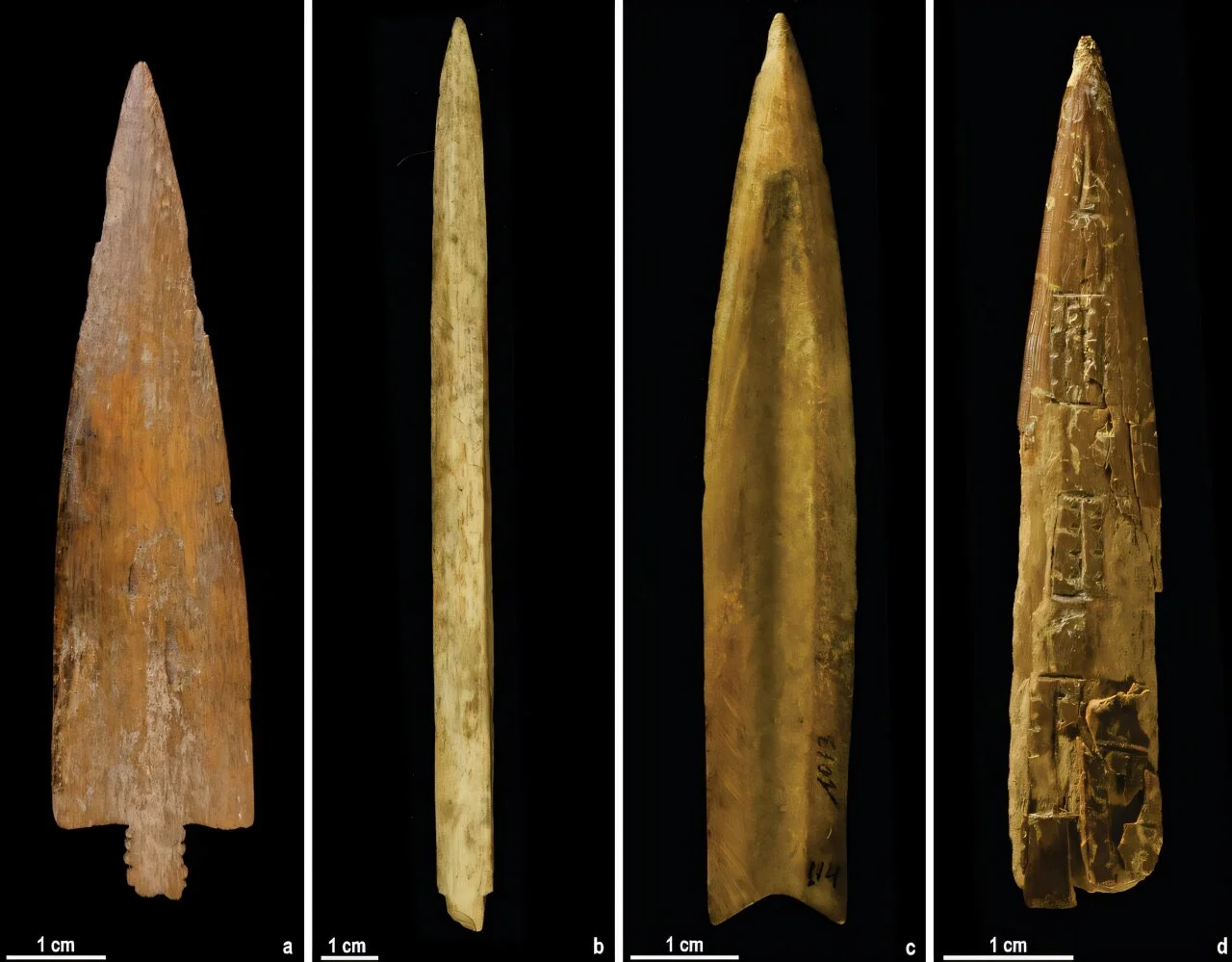
The transformation from animal bone to arrow point was neither simple nor hurried. The process began with metapodia, the long bones of the hands and feet. These were split lengthwise to create blanks suitable for shaping. From there, the blanks were flattened by grinding them against abrasive stones, a slow and controlled process that required patience and precision.
Once flattened, the bone was scraped and whittled into the recognizable form of an arrowhead. In some cases, barbs were added, along with stems that would help secure the point to a shaft. Occasionally, decorative elements were included before the final stages of smoothing and polishing.
Polishing was not just aesthetic. It created a shiny surface that reduced air resistance and helped protect the bone from weathering. Each step in the process built upon the previous one, and mistakes could not easily be undone. This was skilled labor, learned through practice and careful observation.
Despite the time-consuming nature of the work, the arrow points followed a standardized sequence of production. They were not mass-produced, and no two were exactly alike, but they clearly emerged from a shared understanding of how an arrow point should be made.
The Rare Marks of Identity
Among the many arrow points examined, decoration was strikingly rare. Only a few examples bore incised designs, making them stand out against the broader assemblage. As Dr. Medina notes, “Only three bone arrow points with incised decoration on the blade were reported in the archaeological literature … Incised decoration was composed mainly of lines and small triangles, similar to those observed on decorated pin-shaped subtype spatulas and ornaments from central Argentina.”
These marks were not random. Their similarity to other decorated objects suggests a shared visual language, one that extended beyond a single tool type. But why decorate an arrow point at all, especially when decoration was so uncommon?
The researchers offer a compelling interpretation. “We think bone arrow points were primarily used for warfare rather than hunting. Thus, incised decoration or other stylistic attributes, such as extra-barbs, express social identity and leave a potent reminder of the maker´s cultural affiliation on wounded enemies.”
In this view, decoration becomes a message carried into conflict. It marks the weapon not just as a tool, but as a statement of belonging. Even in moments of violence, identity mattered.
Learning, Making, and the Shape of Family Life
One of the most revealing conclusions of the study lies not in the bones themselves, but in what their production implies about social organization. The standardized yet individual nature of the arrow points suggests a mode of learning rooted in close relationships.
The researchers argue that arrowhead production was likely transmitted within the nuclear family, from parent to child. Each generation learned the same sequence of steps, the same techniques, the same expectations of form. Variation emerged naturally through individual hands and choices, but the underlying process remained consistent.
This finding reinforces broader evidence that the nuclear family was the primary social unit for both food procurement and tool production during the Late Prehispanic Period. Craft knowledge was not centralized or specialized; it was embedded in daily life.
Making an arrow point was not an isolated task. It was part of a cycle that began with hunting, continued through food preparation, and ended with tool manufacture. In this cycle, children would have watched, learned, and eventually participated, absorbing both technical skills and cultural values.
Looking Beyond the Valley
While the study focuses on the Southern Punilla Valley, its implications reach much further. Dr. Medina emphasizes the need for comparison with other regions, particularly those where environmental conditions and resource availability differed dramatically.
“Comparisons are needed, especially with neighboring regions near the Sierras de Córdoba, such as the Low Paraná and Uruguay River floodplains, located more than 500 km away, and with sites dated to the last 1,500 years,” he explains.
In those regions, stone raw materials were scarce, and communities developed complex bone technologies to cope. Harpoons and arrow points made from deer or bird bones reflect different choices shaped by different constraints. “Specific taxa, skeletal parts, and manufacturing methods were selected that were likely different from those in our archaeological example,” Dr. Medina notes.
A broader technological comparison, one that accounts for subsistence strategies and raw material availability, could reveal how diverse human solutions emerged from shared challenges.
Why These Ancient Bones Matter Today
This research matters because it restores depth and humanity to a past that has too often been flattened into typologies and timelines. By focusing on how bone arrow points were made, rather than simply what they look like, the study brings us closer to the people behind the artifacts.
It shows that Late Prehispanic communities in the Sierras de Córdoba were not passive users of available materials, but thoughtful craftspeople who invested time, skill, and meaning into their tools. Their arrow points were not just weapons; they were products of family learning, cultural identity, and lived experience.
The study also challenges long-standing biases in archaeology. By demonstrating the richness of bone technology, it underscores the importance of looking beyond stone artifacts to understand past societies fully. Bone tools, once dismissed as secondary or poorly preserved, emerge here as central to understanding daily life and social organization.
Most importantly, this research reminds us that even the smallest, most overlooked objects can carry powerful stories. A bone arrow point, shaped centuries ago, still holds the imprint of the hands that made it and the world in which it was used. By listening carefully, archaeology can let those forgotten voices speak again.
More information: Matías E. Medina et al, Bone Arrow Points Manufacturing in Prehispanic Sierras de Córdoba, Argentina, International Journal of Osteoarchaeology (2025). DOI: 10.1002/oa.70056