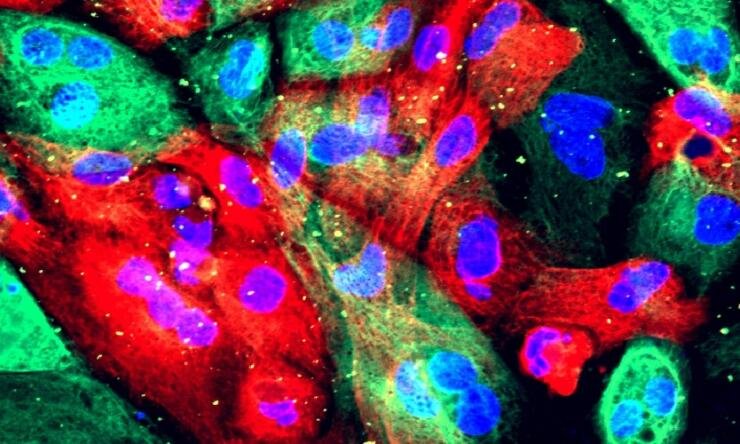
In a discovery that could change how doctors treat one of the most common cancers in men, an international team of scientists has uncovered a hidden weakness in prostate cancer cells. The finding offers fresh hope for improving therapies and tackling one of the disease’s biggest challenges—drug resistance.
The study, published in the Proceedings of the National Academy of Sciences (PNAS), was led by researchers from Flinders University in Australia and South China University of Technology. It reveals that two little-known enzymes, PDIA1 and PDIA5, play a surprisingly powerful role in helping prostate cancer cells survive and resist treatment.
Unmasking the Cancer’s Defenders
Prostate cancer depends heavily on a protein called the androgen receptor (AR). This receptor acts as the cancer’s fuel switch—when it’s active, it encourages cells to grow and multiply. That’s why many prostate cancer treatments, including widely used drugs like enzalutamide, focus on blocking the AR to starve tumors of their growth signal.
But cancer is clever. Over time, tumor cells develop ways to protect the AR and keep it functioning, even when drugs are trying to shut it down. That’s where the new discovery comes in.
The research team found that the enzymes PDIA1 and PDIA5 act like molecular bodyguards for the androgen receptor. They help the receptor fold correctly, stay stable, and resist the effects of drugs designed to disable it. When these enzymes were blocked, the AR became unstable and began to break apart. Without its protector, the cancer cells couldn’t survive.
“We’ve discovered a previously unknown mechanism that prostate cancer cells use to protect the androgen receptor, which is a key driver of the disease,” explained Professor Luke Selth, senior author of the study and Co-Director of the Cancer Impact Program at Flinders University. “By targeting these enzymes, we can destabilize the AR and make tumors more vulnerable to existing therapies like enzalutamide.”
Breaking the Cancer’s Defenses
The research team didn’t stop at identifying this vulnerability—they tested how it could be used to improve treatment. When they combined drugs that block PDIA1 and PDIA5 with enzalutamide, the results were striking. The combination not only slowed tumor growth but caused cancer cells to die more rapidly, both in lab-grown cells and in mice.
“This is an exciting step forward,” said lead author Professor Jianling Xie, who began the research at Flinders University and now leads a lab at South China University of Technology. “Our findings show that PDIA1 and PDIA5 are not just helpers of cancer growth—they’re also promising targets for new treatments that could work alongside existing drugs.”
The results were particularly encouraging because the dual treatment worked not only in laboratory settings but also in patient-derived tumor samples. That means the findings could translate well into real-world clinical trials and, ultimately, into better outcomes for patients.
Striking the Cancer Where It Hurts
What makes this discovery even more remarkable is that PDIA1 and PDIA5 don’t just protect the androgen receptor—they also help cancer cells manage stress and maintain their energy supply.
Cancer cells live under constant pressure. They grow quickly, face a chaotic environment, and often endure oxygen shortages and nutrient scarcity. To survive, they rely heavily on enzymes and pathways that help them stay stable and produce energy efficiently.
The study revealed that when PDIA1 and PDIA5 were blocked, the cancer cells’ energy factories—the mitochondria—began to fail. The result was a surge in oxidative stress and a collapse in the cell’s internal balance, leading to death.
“It’s like cutting off both the fuel and the engine at the same time,” explained Dr. Xie. “You’re not only destabilizing the main driver of prostate cancer, the AR, but also crippling the cell’s ability to generate energy and handle stress. That dual impact makes these enzymes especially attractive targets for therapy.”
Why This Discovery Matters
Prostate cancer is the second most common cancer in men worldwide, affecting millions each year. Standard treatments, including hormone therapy and AR-blocking drugs, have saved countless lives, but many patients eventually develop resistance. Once the cancer adapts, it can become aggressive and difficult to control.
By revealing a new Achilles’ heel in prostate cancer cells, the discovery of PDIA1 and PDIA5 as key survival proteins opens the door to entirely new treatment strategies. Instead of only targeting the androgen receptor directly, scientists may now focus on disabling its protectors, leaving the cancer more exposed and easier to defeat.
Professor Selth emphasized that this represents a crucial step toward overcoming drug resistance, one of the biggest challenges in prostate cancer care. “Our work suggests that targeting PDIA1 and PDIA5 could make existing therapies far more effective,” he said. “It’s an approach that strengthens the tools we already have, rather than starting from scratch.”
From Lab Bench to Patient Bedside
While the results are promising, the researchers are cautious about the road ahead. Current drugs that block PDIA1 and PDIA5 have shown effectiveness in the lab, but they can also affect healthy cells. Before these treatments can be safely used in humans, scientists must refine them to be more selective—strong enough to kill cancer cells but gentle enough to spare normal tissue.
“Some of the existing compounds are too toxic for clinical use,” noted Professor Selth. “The next stage of our research is focused on designing inhibitors that are more precise and safer for patients.”
This effort will likely involve collaborations between biochemists, pharmacologists, and cancer specialists. The goal is to translate the discovery from a promising lab result into a practical treatment that doctors can use to help men with advanced prostate cancer.
A Step Toward Smarter Cancer Treatments
The discovery of PDIA1 and PDIA5’s role in prostate cancer reflects a broader shift in how scientists are approaching cancer therapy. Instead of targeting one single pathway or molecule, researchers are now looking for multi-layered vulnerabilities—combinations of weaknesses that, when struck together, leave cancer cells no room to escape.
This approach, often called “synthetic lethality,” aims to exploit the cancer’s own dependencies. Cancer cells are often more fragile than they appear; they rely on specific mechanisms to survive their own instability. When those supports are taken away, they collapse.
In this case, the combination of blocking PDIA1 and PDIA5 with AR-targeting drugs hits cancer on two fronts: it destabilizes the receptor driving growth and disrupts the energy machinery that keeps the cells alive. It’s a one-two punch that could make future treatments more durable and less prone to resistance.
Hope for the Future
Prostate cancer has long been a challenging foe. While early-stage cases can often be treated successfully, advanced or metastatic forms of the disease remain difficult to manage. Drug resistance, relapse, and progression continue to threaten patients’ lives.
The discovery of PDIA1 and PDIA5 as key enablers of prostate cancer offers new optimism. It provides a scientific foundation for developing combination therapies that could not only extend life but also improve quality of life for patients living with the disease.
Dr. Xie expressed hope that this line of research could eventually lead to clinical trials within the coming years. “We’re just beginning to uncover how these enzymes shape cancer biology,” she said. “But the evidence so far suggests that targeting them could make a real difference for men with advanced prostate cancer.”
The Broader Meaning of Discovery
Beyond its immediate implications for prostate cancer, this study highlights the power of international collaboration and curiosity-driven science. By connecting researchers across continents and disciplines, the team was able to see what had previously been hidden: a pair of enzymes quietly orchestrating cancer’s survival.
In the grander story of biology, discoveries like this remind us that even in the face of something as complex and devastating as cancer, understanding its hidden mechanisms brings us closer to control. Each new insight is a step toward a future where treatment is smarter, more personalized, and more effective.
And perhaps most importantly, it brings renewed hope — for patients, families, and researchers alike — that the relentless search for cancer’s weaknesses will one day lead to its ultimate defeat.
More information: Protein disulfide isomerases regulate androgen receptor stability and promote prostate cancer cell growth and survival, Proceedings of the National Academy of Sciences (2025). DOI: 10.1073/pnas.2509222122