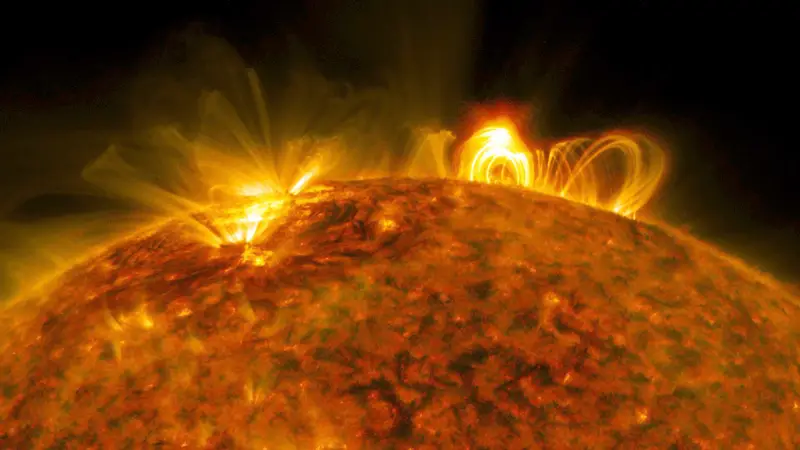
On a typical afternoon in late 2017, the sun did what it has done for billions of years: it unleashed a fury of magnetic energy that dwarfed the power of any nuclear arsenal on Earth. This particular event, an X8.2-class flare, was a gargantuan eruption that sent ripples through the solar system. For decades, scientists have known that these violent tantrums produce more than just heat and light; they also emit intense gamma rays, the most energetic form of light in the universe. Yet, for all our sophisticated telescopes, the exact source of these rays—and the mysterious “engine” driving them—remained hidden behind a veil of solar plasma.
The mystery was a persistent one for solar physicists. We could see the signal, but we couldn’t find the source. Without knowing where these rays were coming from or how they were being born, our understanding of the sun’s most violent behavior was incomplete. We were essentially listening to a symphony without being able to see the orchestra. However, a team of researchers from NJIT’s Center for Solar-Terrestrial Research (NJIT-CSTR) recently announced they have finally identified the culprit: a previously unknown class of high-energy particles lurking in the sun’s upper atmosphere.
A Convergence of Giants
To solve a puzzle this massive, researchers needed to look at the sun through two very different lenses. They turned to NASA’s Fermi Gamma-ray Space Telescope, which orbits Earth and catches the invisible high-energy flickers of the cosmos, and the Expanded Owens Valley Solar Array (EOVSA) in California. While Fermi acted as the cosmic ear, recording the intensity of the gamma-ray emissions, EOVSA acted as the eye. As a state-of-the-art radio telescope array, EOVSA provided spatially resolved microwave imaging, allowing scientists to see exactly where accelerated particles were dancing within the sun’s glowing corona.
When the team overlaid these two sets of data from the September 10, 2017 flare, a specific location began to glow with significance. While previous studies had focused on two specific areas of activity, the researchers identified a third, distinct region. They labeled it Region of Interest 3 (ROI 3). It was here, in this specific pocket of the solar atmosphere, that the microwave and gamma-ray signals converged. This was the smoking gun. It indicated that a unique population of particles was being energized to extreme levels, far beyond what is considered “typical” for a solar eruption.
The Trillion Particle Ghost
Within this localized region, the scales of energy involved are difficult to fathom. The researchers measured trillions upon trillions of particles accelerated to energies of several million electron volts (MeV). To put that in perspective, these particles were hundreds to thousands of times more energetic than the standard particles found in a typical solar flare. They were screaming through the solar atmosphere at speeds approaching the speed of light.
What makes this discovery truly unusual is the “shape” of this particle population. In a standard solar flare, you usually see a vast number of low-energy electrons and only a few high-energy ones. As the energy increases, the number of particles typically drops off. But in ROI 3, the researchers found the opposite. This was a MeV-peaked population, meaning that most of the particles were highly energetic, with relatively few lower-energy electrons present. It was as if a crowd of people consisted almost entirely of world-class sprinters with no casual joggers in sight.
The Architecture of a Collision
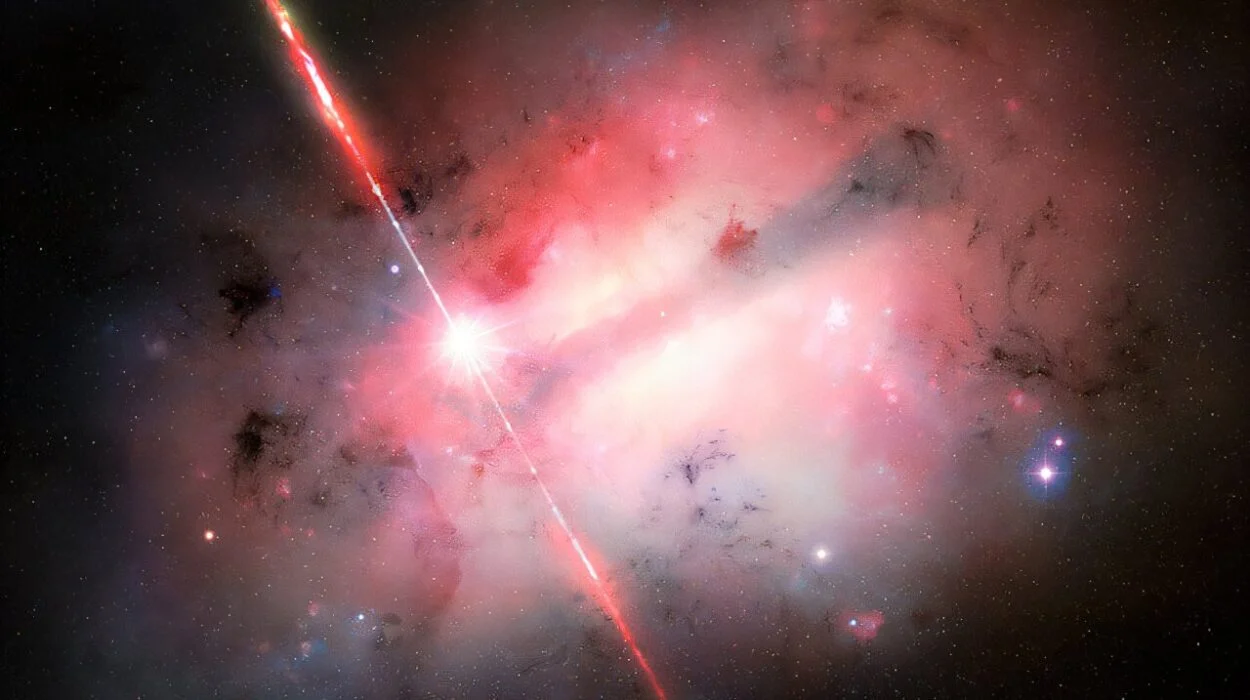
How do these hyper-fast particles actually create light? The team used advanced modeling to link the energy of these particles to the specific gamma-ray spectrum recorded by the telescopes. The answer lies in a process called bremsstrahlung. This occurs when lightweight charged particles, like electrons, are flying through space and suddenly collide with the dense material—the solar plasma—in the sun’s atmosphere. As these particles are deflected or slowed down by the collision, they release their excess energy as high-energy light.
The discovery of this process in ROI 3 provides a blueprint for how the sun transforms its internal tension into external violence. This region is located near areas of significant magnetic field decay, where the sun’s twisted magnetic lines snap and reorganize. The team believes that as the sun releases this stored magnetic energy, it acts like a cosmic slingshot, efficiently accelerating charged particles to these extreme MeV levels. These particles then evolve into the specialized population that generates the puzzling gamma-ray signals we have observed for decades.
Peering into the Heart of the Storm
Despite this breakthrough, the sun still holds onto several secrets. One of the most intriguing questions remaining is the true identity of these high-energy actors. While they are certainly charged particles, scientists aren’t yet sure if they are electrons or their antimatter counterparts, positrons. To solve this, researchers need to look at the “twist” or polarization of the microwave emissions coming from the sun. If they can measure that polarization, they can finally tell the difference between the two.
The tools to answer that question are already being built. The Expanded Owens Valley Solar Array is currently undergoing a major upgrade to become EOVSA-15. This project will add 15 new antennas and advanced ultra-wideband feeds, giving scientists a much clearer view of the sun’s magnetic machinery. By refining our ability to see these invisible particles in action, we move closer to understanding the fundamental physics of our star.
Why This Solar Secret Matters
Understanding the origin of these gamma rays is more than just an academic victory; it is a vital step in protecting our modern world. Solar flares and the high-energy particles they produce are the primary drivers of space weather. When these eruptions are directed toward Earth, they can interfere with satellite communications, disrupt power grids, and pose risks to astronauts in orbit.
By pinpointing ROI 3 and the specific bremsstrahlung mechanism, scientists can now fill critical gaps in the physics of solar eruptions. This information allows for the creation of far more accurate models of solar activity. As we move toward a future where we are more dependent on space-based technology, the ability to improve space weather forecasting becomes essential. Every piece of the puzzle we solve—like the mystery of the sun’s gamma rays—helps us better predict when the sun might next unleash its violent energy, giving us the chance to prepare before the storm arrives.
Study Details
Gregory D. Fleishman et al, Megaelectronvolt-peaked electrons in a coronal source of a solar flare, Nature Astronomy (2026). DOI: 10.1038/s41550-025-02754-w