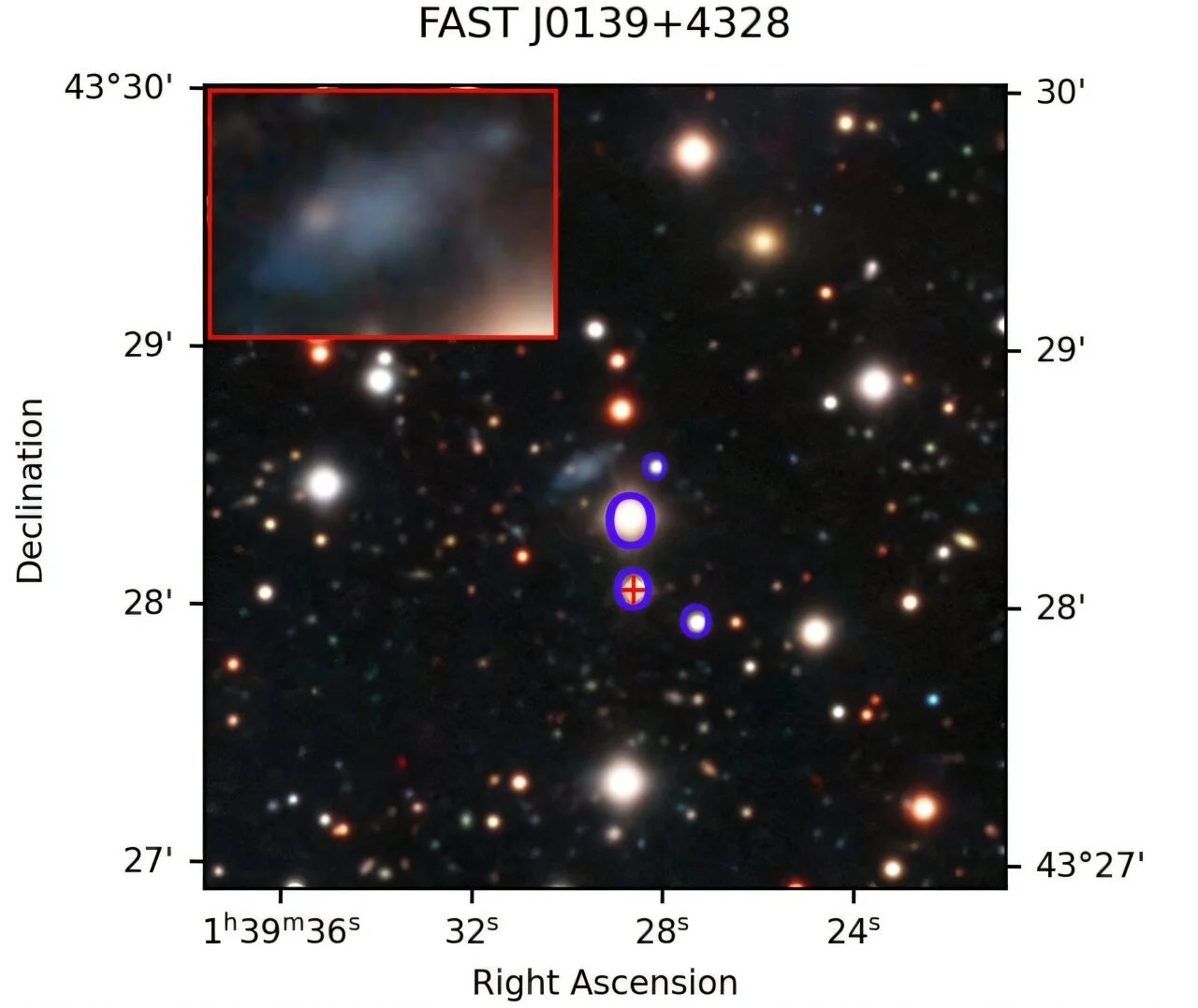
In the silent, cold expanse of the nearby universe, about 94 million light years away from our own neighborhood, there exists a ghost. For years, it appeared to be nothing more than a shadow—a massive, invisible cloud of gas drifting through the void without a single star to its name. Astronomers called it FAST J0139+4328, and for a brief window in our history of looking at the stars, it held a title of profound mystery: the first isolated dark galaxy ever found in our cosmic backyard. It was a place where gravity had pulled matter together, yet the fires of star formation had seemingly never been lit, leaving it a dark, silent enigma.
But the universe often hides its secrets behind a veil of faintness, waiting for a sharper eye to look a little longer and a little deeper. A team of astronomers from Serbia and Russia, led by Ana Mitrašinović of the Astronomical Observatory in Belgrade, decided to peel back that veil. They were not convinced that this island of hydrogen was truly empty. Their journey to uncover the truth of FAST J0139+4328 has recently rewritten the story of this distant object, transforming it from a dark ghost into a faint, shimmering reality.
The Mystery of the Invisible Island
The story of this cosmic anomaly began in 2023. At that time, the Five-hundred-meter Aperture Spherical radio Telescope, or FAST, swept across the sky and picked up a signal from a massive cloud of neutral atomic hydrogen. It was a significant find—a vast reservoir of gas floating in isolation. When researchers looked at the same patch of sky using standard optical telescopes, they saw nothing. There were no stars, no glow, and no evidence of a galaxy. Because it seemed to be a cloud of gas without an optical counterpart, FAST J0139+4328 was classified as a dark galaxy.
These dark galaxies are the holy grails of certain astronomical theories, representing “failed” galaxies that have the raw materials for stars but somehow never birthed them. For a time, FAST J0139+4328 stood as the premier example of this phenomenon. It was an isolated, starless halo of gas, a lonely giant in the dark. But the classification was based on what we couldn’t see, and in science, a lack of evidence is not always evidence of absence. The question remained: was it truly empty, or were its stars simply too shy to be seen by our current technology?
Peering Through the Darkness
To answer this, Mitrašinović and her colleagues turned to the Milanković and Nedeljković telescopes, instruments capable of deep, patient observations. They weren’t looking for bright, obvious signatures; they were hunting for the faintest whispers of light that could be buried in the noise of the night sky. The team conducted a campaign of deep optical observations and spectroscopic follow-ups, staring at the coordinates where the hydrogen cloud was known to reside.
The patience of the researchers was eventually rewarded. As the data processed, a faint, diffuse glow began to emerge from the darkness. It was not a brilliant cluster of stars, but a fragile stellar population that had been hiding in plain sight. “Using the 1.4 m Milanković and 0.6 m Nedeljković telescopes, and spectroscopic follow-up of the field, we report the unambiguous discovery of a low-surface-brightness (LSB) optical counterpart at the location of the HI cloud,” the researchers wrote in their paper. This discovery changed everything. The “dark galaxy” was no longer dark; it had an optical counterpart, a ghostly collection of stars that had finally stepped into the light.
A Ghost Revealed in the Light
The imaging revealed that these stars weren’t perfectly centered within the gas cloud. Instead, the optical counterpart was slightly offset, about 30.3 arcseconds away from the center of the hydrogen coordinates. To be certain that these stars actually belonged to the cloud and weren’t just a distant background object coincidentally lined up with it, the team looked for a specific signature: hydrogen-alpha emission. This light serves as a cosmic fingerprint, allowing scientists to measure the redshift of the object.
The results were definitive. The stellar system shared a redshift consistent with the neutral hydrogen cloud. This established a physical association, proving that the stars and the gas were part of the same structure. With this link confirmed, the researchers officially reclassified FAST J0139+4328. It was no longer a dark galaxy. Instead, it was an isolated low-surface-brightness (LSB) dwarf galaxy. These LSB galaxies are strange, diffuse systems where the light they emit is at least one magnitude lower than the ambient brightness of the night sky itself. They are the lightweights of the universe, often consisting of a few billion stars spread so thin they are nearly transparent.
The Anatomy of a Hidden Giant
Once the galaxy was found, the astronomers began to measure its true scale. Despite its faintness, FAST J0139+4328 is a significant entity. The study determined that it possesses a stellar mass equivalent to roughly 7.2 million suns. Its total luminosity is also substantial, shining with the power of 11.1 million solar luminosities. However, the most striking feature of this galaxy is its composition.
FAST J0139+4328 is an extremely gas-rich world. The researchers calculated a gas-to-stellar mass ratio of approximately 11.5. This means that for every bit of solid “star stuff” in the galaxy, there is nearly twelve times as much raw hydrogen gas waiting in the wings. It is a primitive, underdeveloped system that has barely begun the work of turning its gas into stars. From its distant perch 94 million light years away, it represents a rare look at a galaxy that exists on the very edge of visibility, a bridge between the truly dark and the brilliantly bright.
Lessons from the Faint and Far Away
The reclassification of FAST J0139+4328 is more than just a change in a database; it is a cautionary tale for how we study the universe. The astronomers concluded that the stars were always there; they were simply below the detection limit of previous surveys. If we had relied only on medium-depth observations, we would still believe this galaxy was a starless void. This discovery highlights a major gap in our current understanding of the cosmos and the limits of our technology.
“It underscores that non-detections in medium-depth surveys are insufficient to rule out the presence of stellar populations in faint HI systems. Future studies of similar candidates require deep optical imaging to distinguish between truly starless halos and the extreme LSB galaxy population,” the researchers noted. By finding the stars in FAST J0139+4328, the team has shown that many other “dark” clouds might actually be home to hidden galaxies.
This research matters because it changes the way we search for the building blocks of the universe. If we want to understand how galaxies form and why some stay small and dim while others become brilliant spirals like the Milky Way, we must be able to find them all—even the ghosts. Mitrašinović’s team is already planning further spectroscopic observations to uncover the evolutionary pathway of this gas-rich dwarf. Every time we turn a “dark” object into a “light” one, we gain a clearer picture of the cosmic architecture, proving that even in the deepest shadows of space, something is usually looking back.
More information: Ana Mitrašinović et al, Discovery of a galaxy associated with the HI cloud FAST J0139+4328, arXiv (2025). DOI: 10.48550/arxiv.2512.24924