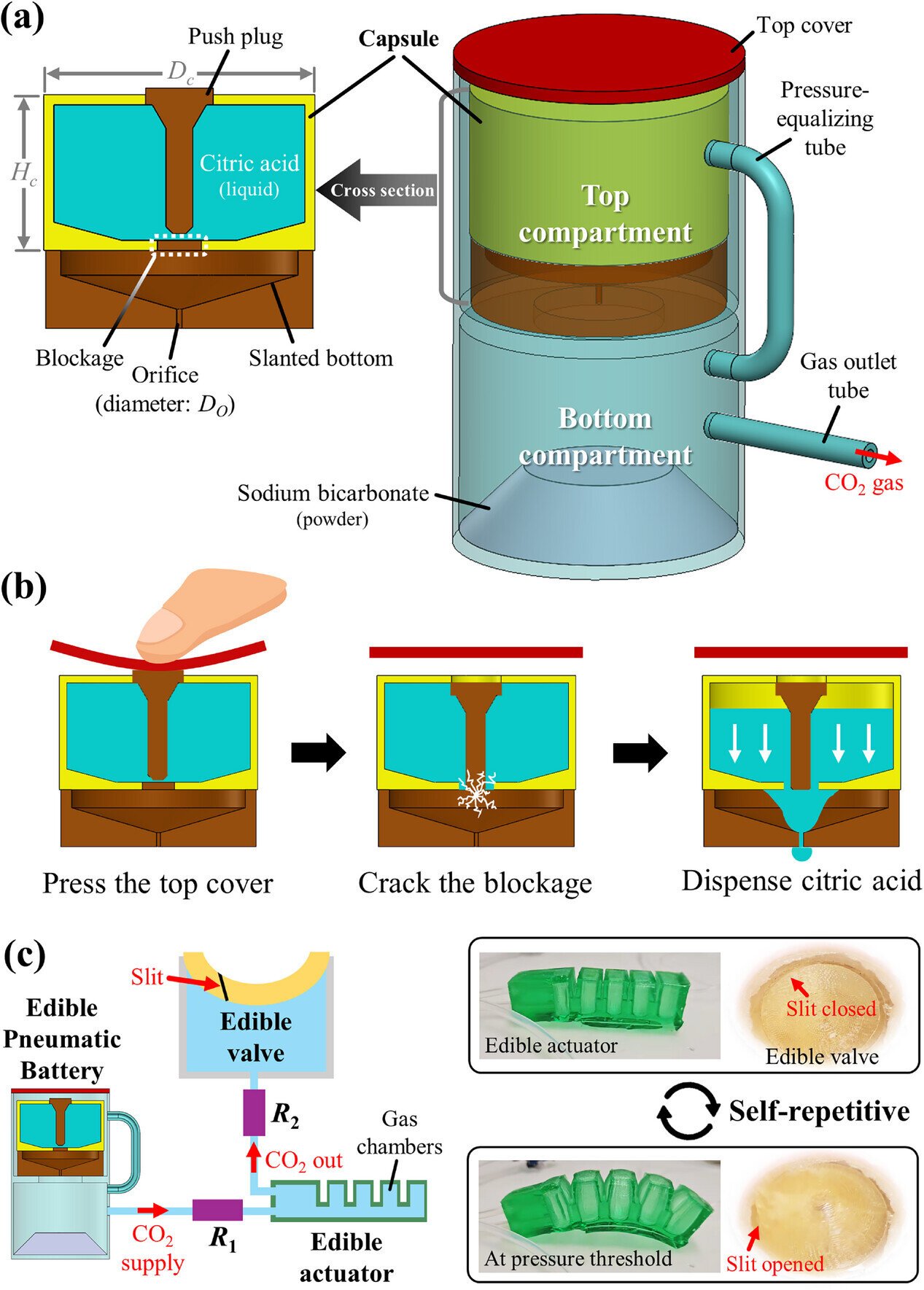
Imagine a robot that can disappear completely once it has finished its job. No lingering metal parts, no toxic battery waste—just a fully biodegradable, eco-friendly machine. It may sound like a far-off concept, but researchers at EPFL in Switzerland have taken a significant step toward making such robots a reality. In a groundbreaking study, they’ve managed to create a fully edible battery, controller, and actuator—all using common kitchen ingredients like citric acid, baking soda, and gelatin. What makes their work even more astonishing is that this edible pneumatic system can power soft robots capable of self-sustained, rhythmic movement.
The research, published in Advanced Science, introduces a new approach to the long-standing challenge of powering soft, biodegradable robots. These types of robots are often used for environmental monitoring or targeted drug delivery and are designed to completely break down and disappear after completing their tasks. But there’s a big problem: conventional batteries, like lithium, are toxic and non-biodegradable. Until now, no one had been able to create a self-sustained motion system powered entirely by edible, environmentally friendly materials. This is where the team at Dario Floreano’s Laboratory of Intelligent Systems steps in.
The Chemistry Behind the Motion
At first glance, it might sound like the stuff of science fair projects—a chemical reaction between baking soda and citric acid—but it’s this simple reaction that forms the core of the edible pneumatic battery. The researchers harnessed a classic “volcano” chemical reaction to generate the power needed for robotic movement. When citric acid, found in lemons, is combined with sodium bicarbonate (baking soda), it creates a fizzy, effervescent reaction that releases pressurized carbon dioxide gas.
This bubbling reaction may look like a harmless science experiment, but for the researchers, it was the key to building a power source that could be both safe to eat and capable of producing reliable energy. “The edible pneumatic battery described here relies on the chemical reaction of sodium bicarbonate and citric acid, yielding an energy source that is safe to eat, delivers fast actuation, is low cost, and has zero environmental impact,” the team explained in their study.
Once the gas is produced, it flows into the robot’s actuator—a flexible, gelatin-based component designed to move in response to pressure. As the carbon dioxide fills the actuator, it causes the gelatin to bend. This bending is the robot’s motion in action. But, as with any good system, it doesn’t stop there.
A Valve System That Controls the Flow
Like a well-oiled machine, the system also includes a valve that regulates pressure. Made from a thin, circular shell of gelatin with a small slit, this valve controls the flow of gas and ensures that the robot moves in a controlled, rhythmic pattern. When the gas pressure inside the actuator becomes too high, it is released through the valve. This pressure drop causes the valve to automatically close, allowing more pressure to build up in the battery and prepare for the next cycle of movement.
The beauty of this system lies in its continuous self-sustaining motion. As long as the chemical reaction between citric acid and sodium bicarbonate continues, the robot keeps moving. The researchers were able to fine-tune the process, adjusting the size of the opening where the acid drips to control the speed at which gas is generated. The result? A highly programmable, scalable system capable of powering soft robots that can be tailored to perform specific tasks or functions.
Testing the Technology in the Real World
To prove their technology could function in real-world scenarios, the researchers took their edible robot system a step further, creating an actuator that could be triggered by a footstep. In this test, they designed a foot-triggered actuator that could be buried underground, ready to be activated when a wild animal, like a boar, stepped on it. Upon activation, the actuator would begin to move, mimicking the behavior of live prey.
This clever design has enormous potential for applications like wildlife monitoring, where the robot could be used to release nutrients or vaccines into animals without harming them. Once the animal consumes the robot, the device would break down harmlessly, leaving no toxic waste behind. It’s a powerful example of how this technology could be applied in fields ranging from conservation to medicine, all while remaining environmentally friendly.
Why This Research Matters
The creation of an edible, self-powered robot that can move without leaving a toxic footprint is not just a scientific curiosity—it’s a breakthrough with real-world implications. As our world faces mounting environmental challenges, including pollution and waste from non-biodegradable materials, innovations like this offer a glimmer of hope for the future of technology. With this new system, researchers have taken an important step toward developing robots that don’t just minimize their environmental impact—they eliminate it entirely.
By using only safe, edible ingredients, these robots could operate in a variety of environments without posing a risk to ecosystems or wildlife. Imagine robots that could be deployed to monitor and clean up natural habitats, powered by materials that won’t linger in the environment once their task is completed. In healthcare, soft robots designed for drug delivery or even minimally invasive surgery could operate with the added benefit of being biodegradable, leaving behind no harmful residue once they’ve performed their job.
What’s most exciting is the system’s versatility. The researchers have demonstrated that by adjusting the components—changing the size of the openings, the resistance to gas flow, or the battery’s size—the robots can be programmed for specific tasks. This flexibility opens the door to a wide range of potential applications, from environmental monitoring to targeted delivery systems in medicine.
In the end, this research represents a major step toward a future where technology can work in harmony with nature, using sustainable materials and energy sources. As we look to the future, it’s clear that the integration of edible, biodegradable components in robotics could play a key role in reducing the environmental footprint of emerging technologies.
More information: Bokeon Kwak et al, Edible Pneumatic Battery for Sustained and Repeated Robot Actuation, Advanced Science (2025). DOI: 10.1002/advs.202509350