Few achievements of the ancient world have endured in both physical form and symbolic meaning like the roads of Rome. Winding across mountains, cutting through forests, bridging rivers, and stretching in unbroken lines across valleys, Roman roads were not mere tracks of stone—they were the veins and arteries of an empire. They carried not only legions of soldiers but also merchants, messages, ideas, and cultures. To speak of Roman roads is to speak of the very backbone of the Roman world, the infrastructure that allowed it to flourish and endure for centuries.
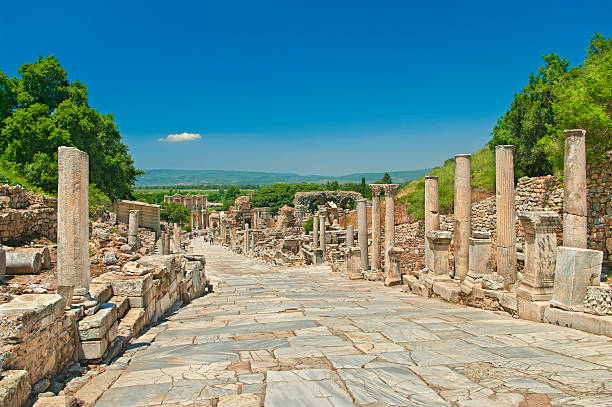
“All roads lead to Rome” is more than a proverb—it reflects a literal truth. At the empire’s height, a vast network of roads radiated from the capital, linking Rome to far-flung provinces across Europe, North Africa, and the Middle East. This interconnected web stretched over 400,000 kilometers, with around 80,000 kilometers of paved stone highways—an unparalleled achievement of engineering, organization, and vision. Roman roads were designed with remarkable durability, many surviving two millennia of wear and weather, their ancient stones still bearing witness to the footsteps of history.
Yet Roman roads were more than stone and gravel. They were instruments of conquest, tools of governance, enablers of commerce, and conduits of culture. They made possible the expansion of the Roman military machine, the administration of vast territories, and the exchange of goods and ideas that transformed the ancient Mediterranean into a cohesive world. The story of Roman roads is the story of Rome itself: ambition, innovation, power, and legacy.
The Origins of Roman Road Building
Road building was not unique to Rome. Civilizations before the Romans—such as the Persians, Egyptians, and Greeks—had built roads for trade and communication. The Persian Royal Road, for instance, stretched over 2,500 kilometers and allowed rapid movement across the empire. The Greeks also constructed stone-paved roads, though often on a more local scale.
What set the Romans apart was the sheer scale, precision, and permanence of their road system. From the early days of the Republic, Roman leaders understood that to hold power over conquered lands, they needed not only armies but also infrastructure. Roads enabled soldiers to march swiftly to rebellious regions, administrators to govern distant provinces, and merchants to supply the growing cities of the empire.
The first great Roman road was the Via Appia, or Appian Way, begun in 312 BCE under the censor Appius Claudius Caecus. Originally constructed to link Rome with Capua in southern Italy, it was later extended all the way to Brundisium (modern Brindisi), the gateway to Greece and the East. The Appian Way became the model for future Roman roads—straight, durable, and strategically vital. It earned the nickname Regina Viarum—the “Queen of Roads.”
From these beginnings, the Romans developed a systematic approach to road building, one that combined engineering genius with military precision. Roads became a defining feature of Roman rule, expanding alongside the empire’s conquests until they reached every corner of its territory.
The Engineering of Roman Roads
The durability of Roman roads was no accident—they were feats of careful planning and meticulous engineering. Unlike many earlier roads, which were little more than dirt paths, Roman roads were constructed to last centuries. Their resilience was the result of both design and materials.
Roman roads typically followed a multi-layered structure:
- Foundation Layer (statumen): Large stones were laid at the bottom to provide stability.
- Middle Layers (rudus and nucleus): Smaller stones, gravel, and sand were compacted into successive layers to absorb weight and allow drainage.
- Surface Layer (summum dorsum): Large, flat paving stones were fitted tightly together to form a smooth, durable surface.
This cross-section created a road capable of withstanding not only foot traffic and animal-drawn carts but also the heavy movement of military legions. Roads were built with a convex surface, known as camber, to allow rainwater to run off into side ditches. Drainage was essential, preventing erosion and prolonging the road’s lifespan.
Surveyors, known as gromatici, played a crucial role. Using tools such as the groma (for straight lines and right angles) and chorobates (for measuring levels), they laid out roads with extraordinary accuracy. Roman roads were famed for their straightness, often running in unwavering lines for miles, even across difficult terrain. Obstacles such as hills or rivers were overcome with cuts, embankments, tunnels, or bridges. The goal was always efficiency—shortest routes, fastest travel, enduring stability.
The result was not only practical but astonishingly effective. Many Roman roads remain visible and usable today, testifying to the extraordinary skill of their builders.
Roads as Instruments of Conquest
The Roman Empire was built on conquest, and its roads were military tools as much as civic ones. A newly conquered territory was often pacified not only by garrisons of soldiers but also by the construction of roads, which allowed reinforcements to arrive swiftly and rebellions to be crushed before they could spread.
Roman legions themselves were road builders. Soldiers were trained to dig, quarry, and lay stone, turning their hands as readily to engineering as to warfare. In some campaigns, roads were built as armies advanced, creating supply lines that stretched back to the heart of the empire. Roads made conquest possible, but more importantly, they ensured that conquest endured.
The military nature of Roman roads is evident in their placement. They often radiated outward from military camps or fortresses, linking frontier garrisons to provincial capitals and ports. In turbulent borderlands, roads became lifelines, enabling swift response to threats. The ability to march a legion hundreds of kilometers in a matter of weeks was a decisive factor in Rome’s dominance.
Roads as Networks of Administration
Once conquest gave way to governance, roads became instruments of administration. Provinces were linked to Rome not only politically but physically. Governors, tax collectors, and messengers used the roads to maintain imperial authority across vast distances.
The Romans developed an official courier system known as the cursus publicus. Established by Augustus, it relied on relay stations (mutationes) for changing horses and larger waystations (mansiones) for rest and supplies. With this system, messages could travel across the empire at astonishing speed for the ancient world—up to 80 kilometers a day. Orders from Rome could reach the distant frontiers in weeks rather than months, giving the empire a unity and responsiveness that few rivals could match.
This administrative use of roads reinforced Rome’s control. Provinces, no matter how distant, remained connected to the center, bound into a single system of governance and communication.
Roads and the Economy
The economic impact of Roman roads was immense. By reducing travel times and connecting previously isolated regions, they transformed the flow of goods and commerce. Farmers could transport grain, wine, and olive oil to markets in distant cities. Merchants carried exotic goods—spices from the East, silk from China, gold from Africa—along routes that crossed the empire.
Towns and cities often sprang up at road junctions, benefitting from trade and traffic. Inns, workshops, and markets clustered around these intersections, creating bustling hubs of activity. Roads facilitated not only long-distance commerce but also local economies, knitting together rural villages with urban centers.
This infrastructure underpinned Rome’s prosperity. The capital itself, with its population of over a million at its height, depended on roads to supply it with food from across the empire. Without its roads, Rome could not have fed its people, sustained its legions, or fueled its economy.
Cultural Highways
Beyond armies, officials, and merchants, Roman roads carried something more intangible but equally powerful: culture. Ideas, religions, and traditions traveled along the same routes as soldiers and traders.
Christianity, for example, spread across the empire in part because of the road network. Missionaries like Paul of Tarsus traveled along Roman highways, carrying their message from city to city. Roman roads enabled not only political unity but also cultural exchange, weaving together diverse peoples into a shared Mediterranean world.
Latin, the language of Rome, spread across the provinces, mingling with local dialects to give rise to the Romance languages of today. Artistic styles, architectural techniques, and philosophical ideas traveled along these same roads, ensuring that Roman influence penetrated deeply into the fabric of conquered societies.
The Symbolism of Roman Roads
To the Romans, roads were more than practical tools—they were symbols of power and civilization. To build a road was to impose order upon the landscape, to bring the wild under Roman control. Roads proclaimed the presence of the empire, even in the most remote provinces.
Milestones placed along the roads recorded distances, often measured from the golden milestone (Milliarium Aureum) in the Roman Forum, the symbolic center of the empire. Each milestone bore inscriptions that reminded travelers of Rome’s authority and the emperor’s role in maintaining the network.
The very straightness of the roads became a metaphor for Roman order, contrasting with the winding tracks of “barbarian” lands. Roads were both physical and ideological, practical structures and monuments of imperial pride.
Decline and Transformation
As the Western Roman Empire declined in the 4th and 5th centuries CE, the great road system began to deteriorate. Maintenance required organization and resources, and with the collapse of central authority, many roads fell into disrepair.
Yet they did not disappear. Medieval kingdoms inherited the Roman network, using the surviving routes for trade, travel, and warfare. Pilgrimages to holy sites often followed ancient Roman roads, and many modern highways in Europe still trace their paths. The legacy of Roman roads continued long after the empire itself had vanished, shaping the geography of Europe for centuries.
The Enduring Legacy
Roman roads remain one of the most enduring legacies of the ancient world. They were not merely infrastructure—they were instruments of empire, enablers of culture, and symbols of power. They demonstrate the Roman genius for practical engineering combined with strategic vision.
Even today, the phrase “all roads lead to Rome” reminds us of the centrality of this network, both literally and metaphorically. Roman roads remind us that empires are not sustained by military might alone but by the infrastructure that binds people, places, and power together.
In every surviving stretch of ancient paving stones, in every modern road that still follows a Roman line, we see the lasting imprint of Rome. The empire may have fallen, but its roads endure—silent, steadfast witnesses to an age when stones and sweat carved pathways that carried armies, emperors, merchants, and ideas across the known world.
The Roman road was not just a road. It was empire made tangible, a line drawn across history, a testament to humanity’s drive to connect, to build, and to endure.