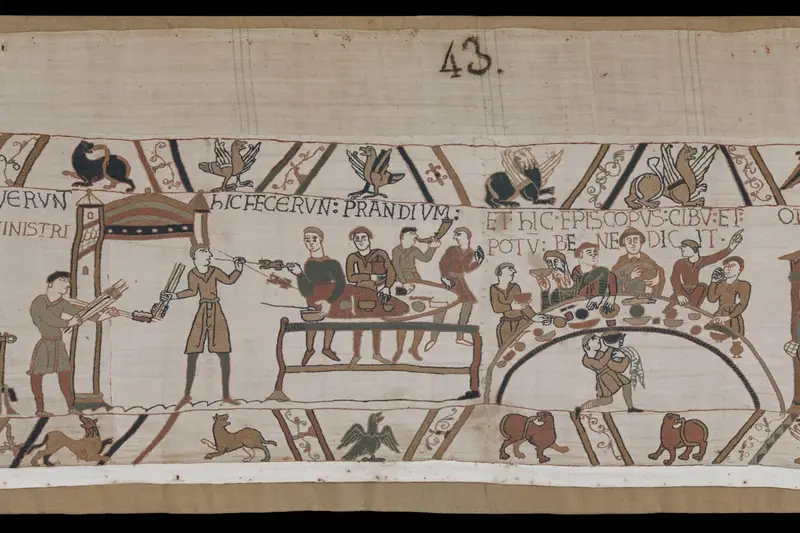
For nearly a millennium, the Bayeux Tapestry has told its story in thread and color without ever fully explaining itself. Stretching roughly 68 meters long and weighing about 350 kilograms, this extraordinary medieval embroidery has shown generations the dramatic events surrounding the Battle of Hastings in 1066, when William II of Normandy invaded England and defeated Harold II. Kings march, ships cross the sea, omens appear in the sky, and fate turns on a battlefield. Yet behind this vivid narrative lies a deeper mystery that has long resisted clear answers. Where was this tapestry meant to live, and who was meant to see it?
Now, new research by Professor Benjamin Pohl, a historian from the University of Bristol, offers a compelling and human-centered possibility. In a paper published this week in the journal Historical Research, he revisits old assumptions and invites readers to imagine the tapestry not as a silent wall hanging in a cathedral, but as a living presence in a place of daily routine, reflection, and community.
Imagining the Tapestry’s First Home
The Bayeux Tapestry is famously associated with Bayeux Cathedral, where it appears in an inventory from 1476. Before that date, however, the historical record goes quiet. There are no clear documents confirming where the tapestry was displayed, or even whether it was displayed at all. This absence has left scholars debating for decades, proposing churches, halls, and ceremonial spaces as possible early homes.
Professor Pohl approaches this problem by stepping back and asking a deceptively simple question. Instead of asking where the tapestry could fit, he asks where it would make the most sense to be seen and understood. His answer points toward the walls of the refectory at St Augustine’s Abbey in Canterbury.
The refectory was where monks gathered daily for meals. It was also a space of listening and reflection, where moral or historical texts were often read aloud while the community ate together. In this setting, the Bayeux Tapestry’s long, continuous narrative could unfold gradually, scene by scene, day after day, becoming part of the monks’ shared life.
Professor Pohl explains his thinking directly. “The truth is: we simply do not know where the Bayeux Tapestry was hung—or indeed if it was hung anywhere at all—prior to 1476. My article offers a new explanation by arguing that the most suitable place for displaying and engaging with the Bayeux Tapestry would have been in the monastic refectory of St Augustine’s during mealtimes.”
A Classroom Spark That Lit a New Idea
This reinterpretation did not emerge in isolation. It grew out of a seminar session with Professor Pohl’s students, where the Bayeux Tapestry was closely examined alongside existing theories about its origins and display. Together, they questioned assumptions that had become almost automatic in earlier scholarship.
Instead of focusing only on grand religious spaces like the abbey church, students were encouraged to consider other monastic rooms that were large enough to host such an enormous artifact. They discussed the dormitory, the chapter house, and eventually the refectory. With each possibility, they asked how the tapestry’s imagery, storytelling style, and moral complexity might interact with the people who encountered it there.
As these conversations unfolded, the refectory began to stand out. It was not just a space that could physically accommodate the tapestry, but one that could give it meaning.
Untangling Old Contradictions
One of the most intriguing aspects of Professor Pohl’s proposal is how it addresses long-standing puzzles about the Bayeux Tapestry itself. Scholars have often struggled to agree on whether the tapestry tells a religious or secular story, whether it requires literacy to be understood, and whether it presents a Norman perspective, an English one, or something more ambiguous.
Professor Pohl reflects on this directly. “The more we talked about this, the more I wondered whether a refectory setting could help explain some of the apparent and puzzling contradictions identified in existing scholarship: for example, was the Bayeux Tapestry intended for a religious or a secular audience? Did this audience have to be literate in order to engage fully with the artifact and its narrative? Does it tell an English or a Norman story, or both/neither?”
In a refectory, these questions lose some of their sharp edges. The audience would have been monks, educated but not necessarily focused on reading the tapestry in silence. Instead, the imagery could complement spoken commentary, reflection, or debate. The story could function both as history and moral lesson, encouraging contemplation rather than delivering a single, fixed message.
A Gap in Time and Memory
Professor Pohl is careful not to overstate the case. There is no direct evidence that the Bayeux Tapestry ever hung in the refectory of St Augustine’s Abbey. He acknowledges this openly, noting that the lack of records may itself be part of the explanation.
“To be clear: we have no concrete evidence of the Bayeux Tapestry’s presence at St Augustine’s, though this may well be due a combination of circumstances which meant that the abbey’s new refectory, designed in the 1080s—perhaps specifically to exhibit the Tapestry—was not completed until the 1120s.”
If the tapestry had been created with the refectory in mind, it may have spent decades in storage, waiting for the space to be finished. Over time, its purpose and origin could have been forgotten. Professor Pohl suggests that it may have remained out of sight for more than a generation before eventually making its way to Bayeux centuries later.
“Consequently, the Tapestry might have been put in storage for more than a generation and forgotten about until it eventually found its way to Bayeux three centuries later.”
This long silence would help explain why such a remarkable object left so few traces in written records before the fifteenth century.
The Social Power of Mealtimes
At the heart of this new interpretation is a reminder of how important communal meals were in the Middle Ages. The refectory was not merely a dining hall. It was a place of identity, teaching, and shared experience.
Professor Pohl draws this connection clearly. “Just as today, in the Middle Ages mealtimes were always an important occasion for social gathering, collective reflection, hospitality and entertainment, and the celebration of communal identities. In this context, the Bayeux Tapestry would have found a perfect setting.”
Seen this way, the tapestry becomes less like a static museum piece and more like a companion to daily life. Its images would have unfolded slowly, reinforcing shared memories and values within the monastic community.
Why This New Perspective Matters
The Bayeux Tapestry is set to return to the United Kingdom next year, going on display at the British Museum for the first time since it was made nearly a thousand years ago. As anticipation builds, Professor Pohl’s research offers a timely reminder that understanding an object’s meaning depends deeply on understanding how it was used.
By reimagining the tapestry in a refectory rather than a grand ceremonial space, this research shifts the focus from spectacle to experience. It invites us to see the Bayeux Tapestry not just as a historical record of conquest, but as a tool for reflection, conversation, and community-building.
“There still is no way to prove conclusively the Bayeux Tapestry’s whereabouts prior to 1476, and perhaps there never will be,” Professor Pohl admits. “But the evidence presented here makes the monastic refectory of St Augustine’s a serious contender.”
This matters because it changes how we relate to one of history’s most famous artifacts. It reminds us that great works are shaped not only by who made them, but by how they were meant to be lived with. In bringing the Bayeux Tapestry back into the rhythm of everyday medieval life, this research brings us closer to the people who first created it, viewed it, and quietly let it slip into legend.
More information: Benjamin Pohl, Chewing over the Norman Conquest: the Bayeux Tapestry as monastic mealtime reading, Historical Research (2025). DOI: 10.1093/hisres/htaf029