Few objects in the universe inspire as much fear and fascination as black holes. Even the name sounds like a cosmic trapdoor, an endless pit waiting to consume anything unlucky enough to drift too close. Popular movies, dramatic documentaries, and internet myths have helped shape an image of black holes as unstoppable monsters—celestial vacuum cleaners that roam through space devouring stars, planets, and entire galaxies.
It’s a powerful picture. A black hole as the ultimate predator, silently hunting across the cosmos.
But reality is both less terrifying and far more interesting.
Black holes are indeed extreme objects. Their gravity is so intense that once something crosses a certain boundary, it can never escape—not even light. Yet the idea that black holes “swallow everything in their path” is misleading. In fact, most black holes spend their existence doing almost nothing dramatic at all. Many are quiet. Many are invisible. And many are surrounded by vast regions of space where nothing is being consumed.
To understand whether black holes truly swallow everything, we have to understand what a black hole really is, how gravity works around it, and why space is not as dangerous as our imagination makes it seem.
What a Black Hole Actually Is
A black hole is not a hole in the usual sense, like a tunnel or an opening. It is an object—an incredibly compact region of space where a large amount of mass has been squeezed into an extraordinarily small volume.
Gravity depends on mass, but also on distance. The closer you are to a mass, the stronger its gravitational pull becomes. If an object is compressed enough, its gravitational pull near its surface becomes so strong that nothing can escape once it gets too close.
The boundary of no return is called the event horizon. It is not a physical surface like the crust of a planet. It is a mathematical boundary in spacetime. Cross it, and every possible path forward leads deeper into the black hole.
Outside the event horizon, gravity behaves like gravity everywhere else. Inside the event horizon, escape becomes impossible.
This is the key point: black holes do not magically pull things in from far away. Their gravity follows the same laws as any other object of the same mass.
The Misunderstanding: Black Holes as Cosmic Vacuum Cleaners
The most common myth about black holes is that they suck in everything nearby, like giant drains in the fabric of space. People imagine them dragging in planets from across the galaxy, swallowing solar systems like snacks.
But black holes do not work like vacuum cleaners.
A vacuum cleaner actively pulls air inward because it creates a pressure difference. A black hole creates no such suction. It simply has gravity—very strong gravity near its event horizon, but ordinary gravity at large distances.
If the Sun were replaced by a black hole with the same mass, the planets would not suddenly spiral inward and disappear. Earth would continue orbiting exactly as it does now. The gravitational pull at Earth’s distance depends on the Sun’s mass, not its size. The Sun’s mass would remain the same, so Earth’s orbit would remain stable.
The only difference would be that the solar system would go dark, because a black hole emits no visible light the way the Sun does.
This single thought experiment reveals how wrong the vacuum cleaner image is. A black hole is dangerous only if you come close enough.
Space is vast, and “close enough” is usually unimaginably close.
Gravity Around a Black Hole: Ordinary at a Distance, Extreme Up Close
To understand why black holes are not constantly swallowing everything, we must understand how gravity weakens with distance. The strength of gravity decreases with the square of the distance. That means if you double your distance from an object, its gravitational pull becomes four times weaker. Triple the distance, and it becomes nine times weaker.
This is true for Earth, the Sun, and black holes.
A black hole’s gravity is not infinitely strong everywhere. It becomes extreme only near the event horizon, because that is where you are extremely close to a huge mass concentrated into a tiny region.
Far away from the black hole, gravity behaves normally.
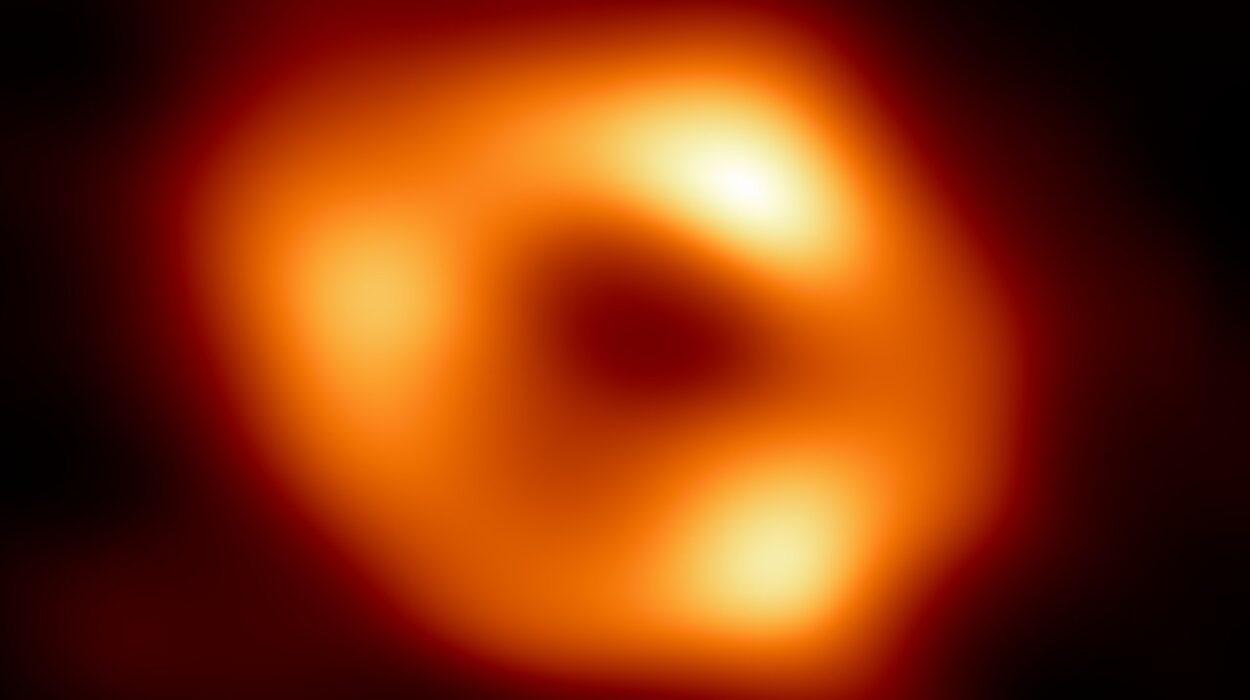
This is why black holes can exist inside galaxies without consuming them. The Milky Way has a supermassive black hole at its center, called Sagittarius A*. It has a mass about four million times that of the Sun. That sounds monstrous, yet the galaxy is not being eaten. Stars orbit the galactic center much like planets orbit the Sun.
The black hole’s gravity helps shape the galaxy, but it does not destroy it.
The truth is that black holes are usually stable gravitational centers, not cosmic predators constantly swallowing everything nearby.
The Event Horizon: The Point of No Return
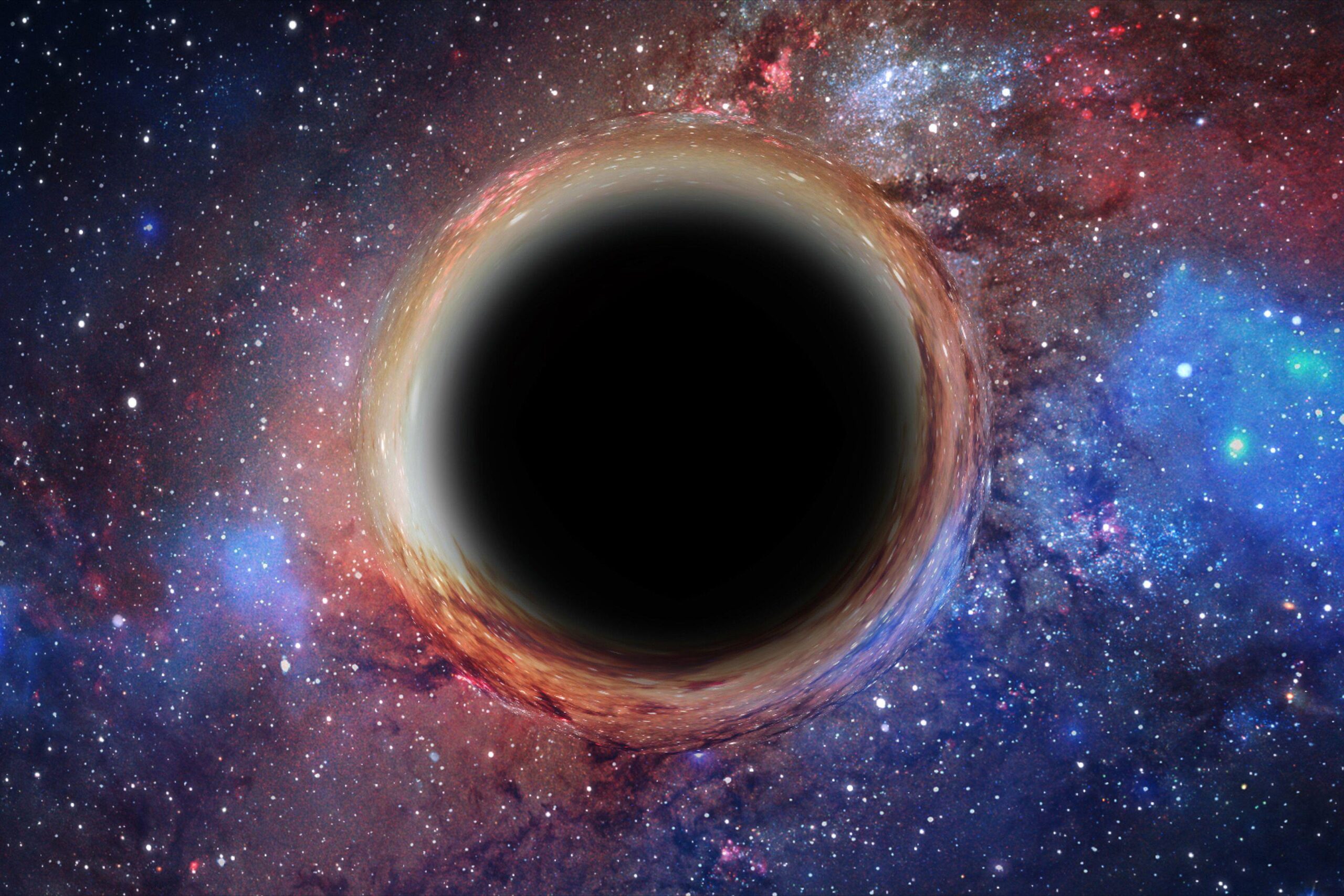
The event horizon is the most famous feature of a black hole. It is the invisible boundary where escape becomes impossible. Once something crosses the event horizon, even light cannot return. That is why black holes are black.
But the event horizon is not like a physical mouth that actively pulls things in. It is simply the region where spacetime is curved so severely that all paths lead inward.
If you could hover just outside the event horizon (which would require enormous thrust), you could still escape. But if you crossed it, no rocket, no force, and no trick could bring you back.
This boundary is defined by the Schwarzschild radius, which depends on the black hole’s mass. For a black hole with the mass of the Sun, the event horizon radius would be only about three kilometers. That is smaller than many cities.
For Earth’s mass, the Schwarzschild radius would be less than a centimeter.
This is a shocking fact: if Earth could be compressed into a marble-sized sphere, it would become a black hole. But nothing about Earth’s mass would change. Only its density would become unimaginable.
So a black hole is not automatically enormous. Some are tiny. Some are massive. Their danger is not their size alone, but how close you are to them.
Tidal Forces: The Real Danger Near a Black Hole
If black holes do not “suck” everything in, why are they so deadly?
The answer lies in tidal forces.
Tidal forces occur because gravity is stronger on the side of an object closer to the black hole than on the side farther away. This difference stretches the object. On Earth, tidal forces from the Moon create ocean tides. The effect is gentle because the Moon is far away.
Near a black hole, tidal forces can become extreme.
As you approach a stellar-mass black hole, the difference in gravitational pull between your feet and your head could become so strong that you would be stretched into a long thin strand, a process humorously called spaghettification. This stretching could tear apart atoms, shredding you before you even reach the event horizon.
However, tidal forces depend on the black hole’s size. For supermassive black holes, the event horizon is enormous. The tidal forces at the event horizon can actually be relatively weak. You might cross the event horizon without noticing anything immediate—though your fate would still be sealed.
This is one of the strangest truths in physics: falling into a supermassive black hole could feel less violent at first than falling into a small one.
The black hole does not need to “swallow” you like a monster. The geometry of spacetime and tidal gravity does the work.
Accretion Disks: When Black Holes Actually Look Like Monsters
Black holes themselves emit no light, but some of the brightest objects in the universe are powered by black holes. This seems like a contradiction, but it happens because black holes often have matter swirling around them.
When gas, dust, or stars get too close to a black hole, they may not fall in immediately. Instead, they spiral inward, forming an accretion disk. Friction and compression inside the disk heat the material to extreme temperatures, causing it to glow. In some cases, it becomes hotter than the surface of stars.
The accretion disk can emit intense X-rays and gamma rays. This is often what astronomers detect when they “see” a black hole.
Some black holes also produce jets—narrow beams of particles launched at near light speed from the region near the event horizon. These jets can extend thousands or even millions of light-years, punching through interstellar gas like cosmic spears.
When black holes have accretion disks and jets, they can appear terrifying and violent. Quasars, for example, are powered by supermassive black holes feeding on surrounding matter. They shine brighter than entire galaxies.
But even here, the black hole is not actively hunting. The violence comes from matter falling in under gravity and releasing enormous energy as it heats up.
Black holes are not destroyers by intention. They are destroyers by physics.
Do Black Holes Move Around Eating Stars?
Some black holes do move through space, but not like roaming predators. They move according to gravitational interactions, just like stars do.
Stellar-mass black holes are formed when massive stars collapse. During the supernova explosion that creates the black hole, the blast may be uneven, giving the black hole a “kick” that sends it traveling through space at high speed.
Even then, the chance of such a black hole wandering into a star system and consuming planets is extremely low. Space is mostly empty. Stars are separated by enormous distances. Even within a galaxy, the average distance between stars is several light-years. A black hole would have to pass extremely close to a star or planet to significantly affect it.
Gravity weakens with distance, so a black hole passing a light-year away would have almost no effect on a solar system. It would need to pass within a range comparable to planetary distances to disrupt or capture objects.
So while it is possible for a black hole to encounter a star and consume it, this is not a common everyday event. It is an occasional cosmic accident.
Most black holes spend most of their existence in silence.
What Happens When Something Falls Into a Black Hole?
The process of falling into a black hole depends on perspective.
From the viewpoint of the falling object, time passes normally. It crosses the event horizon in finite time. Once it crosses, it cannot escape. It continues falling inward.
From the viewpoint of a distant observer, things appear different. Due to gravitational time dilation, time slows down near the event horizon. As the object approaches the event horizon, it appears to move slower and slower. Its light becomes more redshifted, fading into darkness. To the distant observer, it never quite crosses the event horizon. It simply becomes dimmer and frozen in time.
This difference is not an illusion. It is a real feature of relativity. Space and time behave differently depending on the observer’s frame of reference.
Inside the black hole, our understanding becomes incomplete. According to general relativity, the falling object eventually reaches a singularity, a point of infinite density where spacetime curvature becomes infinite. But many physicists believe the singularity is not a real physical point, but a sign that our current theories break down and that quantum gravity is needed.
So what does a black hole do to matter?
It does not “swallow” it in the way an animal eats. It pulls it inward, and the information about that matter becomes trapped behind the event horizon. The mass contributes to the black hole’s total mass, increasing its size.
In a sense, black holes are not cosmic mouths. They are cosmic locks.
Can a Black Hole Swallow the Entire Universe?
This is a dramatic question people often ask, and it reveals how deeply black holes disturb the imagination.
The answer is no.
A black hole does not grow without limit unless it has a continuous supply of matter. Most black holes do not have enough nearby material to consume rapidly. Even supermassive black holes, despite their enormous size, grow slowly over cosmic time.
The universe is also expanding. Many galaxies are moving away from each other faster and faster due to dark energy. This expansion makes it even harder for black holes to eventually consume everything.
Additionally, black holes do not “pull” on distant galaxies in any special way. Their gravitational influence is limited by distance, just like any mass.
Black holes are powerful, but they are not infinite vacuum cleaners. They cannot consume the universe unless the entire universe collapses inward, which current evidence suggests is not happening.
The universe is not being eaten. It is expanding into the future.
Could a Black Hole Swallow Earth?
In theory, yes. In practice, it is extraordinarily unlikely.
If a black hole came close enough to Earth, its gravity would begin to disrupt Earth’s orbit. Tidal forces could deform the planet, triggering earthquakes and volcanic activity. If Earth came close enough, it could be torn apart into fragments, forming an accretion disk of molten debris before being consumed.
But for this to happen, a black hole would need to pass through our solar system at an extremely close distance. There is no evidence of any black hole on a collision course with us. Space is huge, and black holes are rare compared to stars.
Even if a rogue black hole passed through the solar system, it might not hit Earth. It could pass through the outer regions, perturbing the orbits of comets and planets, and then leave.
Earth being swallowed is possible only in the same sense that being struck by a specific grain of sand in a desert tornado is possible. Physics allows it, but probability makes it almost irrelevant.
Our real threats come from asteroids, climate change, and our own actions—not from wandering black holes.
What About the Black Hole at the Center of the Milky Way?
The Milky Way’s supermassive black hole is often described as a monster at the center of our galaxy. But it is about 26,000 light-years away. That is an enormous distance.
Its gravity does not pull on Earth directly in any significant way. The stars in our region of the galaxy orbit the center primarily due to the combined gravitational mass of billions of stars and dark matter, not just the black hole alone.
Sagittarius A* is currently relatively quiet. It is not consuming massive amounts of matter. Occasionally it may swallow gas clouds or small objects, producing flares, but it is not actively devouring the galaxy.
Even if it suddenly began feeding more aggressively, Earth would not be pulled into it. The galaxy’s structure would remain stable for a very long time.
So the black hole at the center is not a threat. It is simply part of the architecture of our galaxy.
It is less like a monster and more like a deep gravitational anchor.
Why Black Holes Don’t Constantly Consume Nearby Matter
Even near a black hole, matter does not automatically fall in. Objects can orbit black holes just like they orbit stars.
If a black hole has the mass of the Sun, it can have planets orbiting it at Earth-like distances. Those planets would remain stable unless they lost orbital energy through friction or collisions.
The reason matter often falls into black holes is because of interactions. Gas clouds collide and lose energy. Friction inside an accretion disk causes matter to spiral inward. Stars in crowded environments can have their orbits disturbed.
But without such processes, objects can orbit black holes safely.
In fact, some black holes are believed to have companion stars orbiting them. These stars can lose gas to the black hole, forming accretion disks and producing X-ray emissions. Astronomers have observed such systems, confirming that black holes can exist peacefully alongside other stars—until orbital dynamics cause material transfer.
A black hole does not need to consume everything. It only consumes what loses enough energy to fall past the event horizon.
Hawking Radiation: Black Holes Can Evaporate
One of the most mind-bending discoveries in physics is that black holes may not last forever.
In the 1970s, Stephen Hawking proposed that black holes can emit radiation due to quantum effects near the event horizon. This phenomenon is called Hawking radiation. Over extremely long timescales, this radiation would cause black holes to lose mass and eventually evaporate.
For stellar-mass black holes, this process is unbelievably slow—far longer than the current age of the universe. But in principle, it means black holes are not eternal prisons. They can leak energy.
This is important because it challenges the idea of black holes as ultimate cosmic destroyers. Even black holes are part of the universe’s cycle of change.
In the far future, long after stars have burned out, black holes may be among the last objects remaining. But even they will eventually fade away into radiation.
The universe does not keep anything forever.
Do Black Holes Destroy Information?
Another deep mystery is what happens to information that falls into a black hole. In physics, “information” does not mean facts or memories. It refers to the detailed quantum state of particles—the data that defines exactly what something is.
Quantum mechanics suggests that information cannot be destroyed. But black holes seem to trap information behind an event horizon. If the black hole later evaporates through Hawking radiation, what happens to the information?
This is known as the black hole information paradox, one of the greatest unsolved problems in theoretical physics. Many physicists believe information is not truly lost, but the mechanism of how it escapes or is preserved remains unclear.
This question has led to profound ideas involving quantum gravity, holography, and the nature of spacetime itself. In trying to understand black holes, physicists have been forced to confront the possibility that space and time may not be fundamental, but emergent from deeper quantum rules.
So black holes do not just “swallow” matter. They swallow certainty. They swallow the limits of our knowledge.
They are not merely objects in space. They are laboratories for the deepest questions about reality.
Why Black Holes Feel So Terrifying
Black holes disturb us because they challenge our sense of control. A planet can be escaped. A storm can be predicted. Even a star, no matter how large, is something we can imagine as a glowing sphere of gas.
But a black hole is different.
It is a place where the rules become extreme. It is a region where time slows, space bends, and the future becomes unavoidable. It is an object that cannot be seen directly, only inferred through its effects.
The idea that something can exist that does not allow light to escape feels like a violation of the natural order. It feels like the universe has created a trap.
Yet black holes are not supernatural. They are a natural consequence of gravity and relativity. They exist because mass can warp spacetime, and if enough mass is concentrated, spacetime becomes curved so deeply that escape becomes impossible.
Black holes are not cosmic villains. They are gravity taken to its ultimate conclusion.
So Do Black Holes Really Swallow Everything in Their Path?
The honest answer is no.
Black holes do not roam the universe devouring everything around them. They do not pull in distant objects more strongly than any other mass would. They do not act like vacuum cleaners, and they are not constantly consuming stars and planets.
Most black holes are quiet. Many are isolated. Some may not have swallowed anything significant in millions of years.
However, black holes can destroy anything that comes too close. Once an object crosses the event horizon, it is lost forever to the outside universe. And in regions where matter is dense—like the center of galaxies—black holes can become extremely active, feeding on gas and stars and releasing enormous energy through accretion disks and jets.
They do not swallow everything, but they swallow anything that falls into them.
The difference matters.
Black holes are not universal predators. They are cosmic consequences. They are the universe’s way of showing what happens when gravity becomes so strong that the very structure of spacetime collapses inward.
The Final Truth About Black Holes
Black holes are among the most extreme objects known to science, but they are not magical destroyers. They follow the laws of physics. They are dangerous only at close range. At a distance, their gravitational pull is ordinary for their mass.
They do not swallow everything in their path because space is not crowded, and gravity is not a vacuum. Objects can orbit them, avoid them, and live in stable systems near them.
Yet they remain deeply unsettling because they reveal a truth we cannot ignore: the universe contains places where escape is impossible, where time behaves strangely, and where our best theories still struggle.
In that sense, black holes are not just astronomical objects. They are reminders.
They remind us that the universe is not built for comfort. It is built for truth. It is vast, it is powerful, and it does not care about our fears.
And still, in the middle of this immense cosmic wilderness, we have minds capable of understanding black holes—of describing their gravity with equations, of imaging their shadows across galaxies, of hearing their collisions through gravitational waves.
That may be the most extraordinary fact of all.
Black holes do not swallow everything.
But they swallow the boundary between what we know and what we still dare to discover.