In the deep language of modern physics, some of the most intriguing ideas are not born from telescopes or particle detectors, but from equations written on a page. White holes belong to this rare category. They are among the most mysterious concepts in theoretical physics, objects that emerge naturally from Einstein’s equations of general relativity yet appear profoundly alien to everyday experience. If black holes are regions of space from which nothing can escape, white holes are their mathematical mirror image: regions into which nothing can enter, but from which matter, energy, and even light may emerge.
The idea of a white hole challenges intuition and stretches the imagination. It forces physicists to confront the nature of time, causality, and the limits of physical law. Are white holes real objects that exist somewhere in the universe, or are they merely mathematical curiosities—ghosts of equations with no physical counterpart? To understand what a white hole is, one must first understand black holes, the structure of spacetime, and the deep symmetry embedded in Einstein’s theory of gravity.
This is not just a story about exotic cosmic objects. It is a story about how mathematics can reveal possibilities that reality may or may not choose to realize, and about how physics often advances by exploring ideas that seem impossible until proven otherwise.
Black Holes and the Geometry of Spacetime
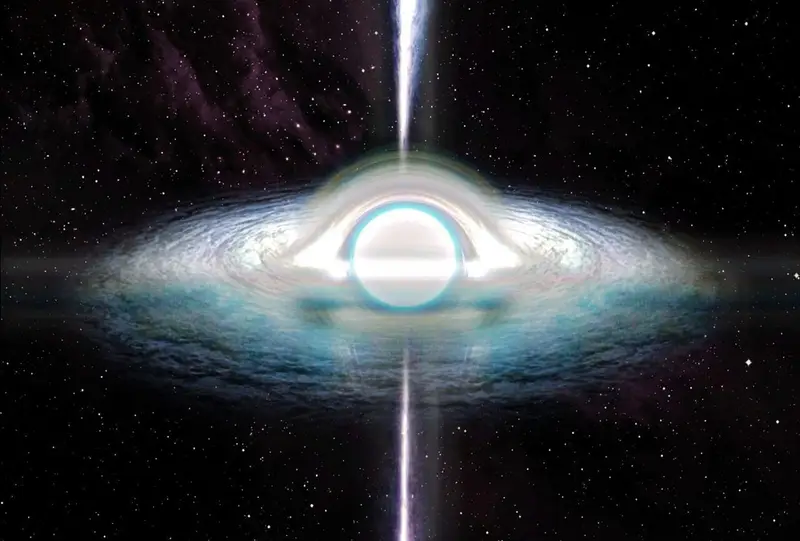
Black holes are among the most successful predictions of general relativity. They arise when matter collapses under its own gravity to such an extreme degree that spacetime itself becomes curved into a region from which escape is impossible. The defining feature of a black hole is the event horizon, a boundary beyond which light cannot return to the outside universe. Inside this horizon, all future paths lead inward, toward a singularity where classical descriptions of space and time break down.
From a physical perspective, black holes are formed by well-understood astrophysical processes. Massive stars exhaust their nuclear fuel, lose the pressure that supports them against gravity, and collapse. If the mass is sufficient, no known force can halt the collapse, and a black hole is born. Observational evidence for black holes is overwhelming, ranging from stellar-mass black holes in binary systems to supermassive black holes at the centers of galaxies.
Mathematically, however, black holes are not just objects; they are solutions to Einstein’s field equations. These equations describe how matter and energy shape spacetime, and in turn how spacetime guides the motion of matter and energy. Among the earliest and simplest solutions is the Schwarzschild solution, which describes the spacetime outside a spherically symmetric, non-rotating mass. Embedded within this solution is the seed of the white hole concept.
Time Reversal and the Birth of White Holes
The equations of general relativity possess a remarkable property: under many circumstances, they are symmetric with respect to time. If a particular arrangement of matter and spacetime satisfies the equations while evolving forward in time, then the time-reversed version of that evolution also satisfies the equations. This symmetry suggests that if black holes are valid solutions, then their time-reversed counterparts should also be valid.
A white hole is precisely this time-reversed version of a black hole. Instead of matter collapsing inward, matter emerges outward. Instead of an event horizon that traps everything inside, a white hole has a horizon that nothing can cross from the outside. From the perspective of an external observer, a white hole appears as a region of spacetime that spontaneously ejects matter and radiation, yet cannot be entered or influenced from the outside.
Importantly, the concept of a white hole does not arise from speculation alone. It is a direct mathematical consequence of extending known black hole solutions in time. When physicists examine the full, maximally extended Schwarzschild solution, they find not only a black hole region but also a white hole region, connected through a complex structure of spacetime.
This discovery reveals a profound lesson about theoretical physics: equations can contain more possibilities than nature necessarily realizes. The existence of a solution does not guarantee the existence of a physical object.
The Anatomy of a White Hole
To understand the structure of a white hole, one must imagine spacetime not as a static stage but as a dynamic geometry. In the mathematical description, a white hole possesses a horizon similar in location to a black hole’s event horizon, but with reversed causal properties. In a black hole, all future-directed paths inside the horizon lead toward the singularity. In a white hole, all past-directed paths emerge from a singularity and flow outward.
The singularity of a white hole lies in the past, rather than in the future. Matter and energy appear to originate from this singularity and move outward, eventually crossing the horizon and entering the surrounding universe. Crucially, nothing from the outside universe can cross the horizon to influence what happens inside. The white hole is causally isolated in a way that is the reverse of a black hole.
This peculiar causal structure gives white holes their defining characteristic: they violate our everyday expectations about cause and effect. Objects seem to emerge without any observable cause within the external universe. This feature makes white holes deeply unsettling from a physical standpoint, as it appears to contradict the principle that physical processes have well-defined origins in prior states.
White Holes and the Arrow of Time
One of the most profound challenges posed by white holes concerns the arrow of time. While the fundamental equations of physics are largely time-symmetric, the universe we observe is not. Processes such as the increase of entropy, the decay of unstable particles, and the expansion of the universe all define a clear direction from past to future.
White holes appear to run counter to this arrow. The emergence of matter from a singularity without a preceding cause would correspond to a dramatic decrease in entropy, something that is overwhelmingly improbable according to the laws of thermodynamics. For this reason, many physicists suspect that white holes, while mathematically allowed, are forbidden by deeper statistical principles.
The tension between time-symmetric equations and time-asymmetric phenomena is one of the central puzzles of modern physics. White holes occupy a crucial place in this puzzle, serving as a reminder that mathematical symmetry does not always translate into physical reality. Understanding why black holes form naturally while white holes do not may shed light on why time appears to flow in one direction.
The Kruskal Extension and Eternal Black Holes
The most rigorous mathematical context in which white holes appear is the Kruskal–Szekeres extension of the Schwarzschild solution. This extension reveals that what we usually call a black hole is only part of a larger spacetime structure. In this structure, there exist two asymptotically flat regions of spacetime connected by a bridge, along with both black hole and white hole regions.
In this idealized model, the black hole and white hole are eternal. They do not form from collapse or disappear through evaporation. Instead, they exist as permanent features of spacetime. Matter can fall into the black hole region, while matter can emerge from the white hole region. The two regions are causally disconnected in such a way that no signal can pass directly between them.
This mathematical construction is elegant and internally consistent, but it relies on highly idealized assumptions. Real black holes form through gravitational collapse, a process that breaks the time symmetry required for white holes to appear naturally. As a result, many physicists regard white holes as artifacts of extending solutions beyond their physically realistic domains.
Why White Holes Are Not Observed
Despite decades of theoretical exploration, there is no observational evidence for the existence of white holes. Astronomical observations reveal black holes forming, accreting matter, and merging, but nothing resembling a white hole has been detected. This absence is not merely a matter of limited technology; it reflects deep theoretical concerns.
For a white hole to exist, the universe would need to be prepared in an extraordinarily precise initial state. The singularity from which matter emerges would have to be finely tuned to produce coherent outgoing matter without collapsing or interacting with the surrounding environment in a way that destroys the white hole structure. Any small perturbation from the outside would destabilize the white hole horizon.
In addition, the thermodynamic implications of white holes are troubling. The spontaneous emergence of low-entropy matter appears to contradict the second law of thermodynamics, which governs all known physical processes. While not logically impossible, such violations would require conditions vastly different from those observed in our universe.
White Holes in Quantum Gravity and Speculative Physics
Although classical general relativity casts doubt on the physical existence of white holes, some speculative theories revive interest in the concept. In approaches to quantum gravity, where spacetime itself is subject to quantum effects, the classical picture of singularities may be replaced by more subtle structures.
Some models suggest that black hole singularities might be resolved by quantum effects, leading to a bounce rather than a breakdown of physics. In such scenarios, a collapsing black hole could, in principle, transition into a white hole over extremely long timescales. Matter that falls into the black hole would eventually emerge, not into the same universe and time, but perhaps into a distant future or a different region of spacetime.
These ideas remain highly speculative, but they illustrate how white holes continue to serve as valuable theoretical tools. By exploring their properties, physicists probe the limits of general relativity and search for clues about the true nature of spacetime at the smallest scales.
White Holes and Wormholes
White holes are often discussed alongside wormholes, another exotic feature of spacetime predicted by general relativity. A wormhole is a hypothetical tunnel connecting two separate regions of spacetime. In the maximally extended Schwarzschild solution, the black hole and white hole are connected by a structure sometimes interpreted as a non-traversable wormhole.
In this picture, the wormhole exists only instantaneously and cannot be crossed by matter or signals. The presence of a white hole on one side and a black hole on the other reflects the deep symmetry of the spacetime geometry. However, like white holes themselves, such wormholes are not believed to exist in nature under realistic conditions.
The study of these connections has nonetheless enriched theoretical physics. It has deepened understanding of spacetime topology, causal structure, and the constraints imposed by energy conditions and stability requirements.
Philosophical Implications of White Holes
White holes raise questions that go beyond physics into philosophy. If a white hole were to exist, it would challenge conventional notions of causality, suggesting that effects could appear without observable causes. This possibility forces a reconsideration of what it means for an event to be explained.
In addition, white holes highlight the distinction between mathematical existence and physical reality. Physics relies on mathematics as its primary language, yet not every mathematically consistent solution corresponds to something that can exist in the universe. White holes serve as a reminder that physical principles such as stability, causality, and thermodynamics play a crucial role in selecting which solutions are realized.
These philosophical lessons are not abstract distractions. They influence how physicists interpret theories, design experiments, and evaluate speculative ideas. White holes occupy a unique position as objects that are both rigorously defined and deeply elusive.
White Holes in Popular Imagination
Despite their uncertain physical status, white holes have captured the imagination of writers, artists, and science communicators. They appear in speculative fiction as cosmic fountains, gateways to other universes, or mechanisms for reversing time. While such portrayals often depart from scientific accuracy, they reflect a genuine fascination with the symmetry and mystery of the universe.
This cultural resonance underscores an important aspect of physics: its ideas can inspire wonder even when they remain unconfirmed. White holes exemplify how theoretical concepts can expand the boundaries of imagination while still being grounded in rigorous mathematics.
The Role of White Holes in Modern Research
In contemporary physics, white holes are not a central focus of experimental investigation, but they remain relevant in theoretical research. They appear in discussions of black hole thermodynamics, information paradoxes, and the nature of singularities. By considering white holes, physicists test the consistency of theories and explore extreme limits of known laws.
In particular, the black hole information paradox has renewed interest in time-reversed processes and exotic spacetime structures. Questions about whether information is truly lost in black holes may require new perspectives on how spacetime evolves, perspectives in which white-hole-like behavior could play a role.
What White Holes Teach Us About Physics
Even if white holes do not exist in nature, they serve an essential function in physics. They reveal the full implications of general relativity and expose tensions between different physical principles. They show how time symmetry in fundamental equations coexists with time asymmetry in observed phenomena. They challenge assumptions about causality and entropy, pushing physicists to clarify what is truly fundamental.
White holes also demonstrate the power and limits of mathematical reasoning. They remind us that equations can describe possibilities far beyond everyday experience, and that understanding which possibilities are realized requires careful attention to physical constraints.
Conclusion: The Value of an Impossible Object
A white hole is, in many ways, an impossible object. It is a region of spacetime that ejects matter but admits nothing, a cosmic structure that seems to run backward in time. There is no evidence that such objects exist, and strong theoretical reasons suggest that they do not form naturally in our universe.
Yet the importance of white holes lies not in their physical reality, but in what they reveal about the universe and about physics itself. They emerge inevitably from the mathematics of general relativity, forcing physicists to confront the meaning of time, causality, and entropy. They illustrate how theoretical exploration can uncover deep insights even when it leads to objects that nature may never realize.
In this sense, white holes occupy a unique place in science. They are mirrors held up to black holes, reflecting the hidden symmetries and unresolved questions at the heart of modern physics. By studying them, physicists gain a clearer understanding of why the universe is the way it is, and why some possibilities remain forever confined to the realm of theory.