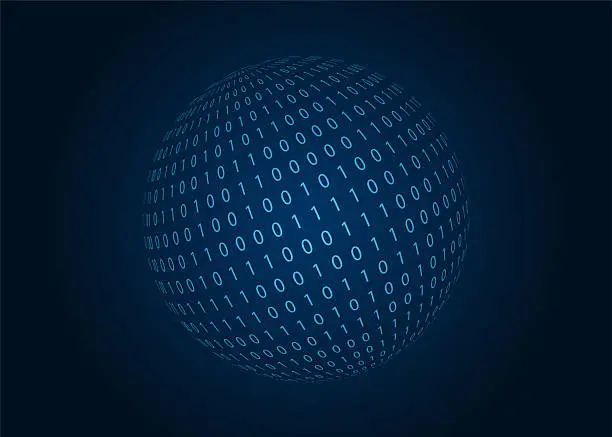
Binary code is one of the most invisible yet powerful creations in human history. It does not shout for attention. It does not dazzle the eyes with color or move the heart with melody. Instead, it whispers in an austere language of only two symbols: 1 and 0. Yet from these two modest marks arises the modern world. Every message sent across the internet, every image stored on a phone, every scientific simulation, every financial transaction, and every digital memory exists because reality has been translated into patterns of ones and zeros.
At first glance, this seems impossible. How can two symbols contain the complexity of human thought, the detail of a photograph, the nuance of music, or the structure of an entire global network? The answer is not magic. It is logic, physics, and an extraordinary idea: that all information can be reduced to choices between two states. Binary code is not merely a technical tool. It is a philosophical statement about how complexity can arise from simplicity, how the universe can be persuaded to speak in human language, and how human imagination learned to converse with machines.
To understand why the world runs on 1s and 0s, we must travel through mathematics, physics, history, and human emotion. Binary code is not only a technical achievement; it is a story of abstraction becoming power.
The Meaning of Two Symbols
Binary code is based on the binary number system, which uses only two digits: 0 and 1. In everyday life, humans use the decimal system, which is built on ten digits, from 0 to 9. The difference seems trivial, but it reflects two very different philosophies of counting. Decimal numbers likely arose because humans have ten fingers. Binary numbers arise from a deeper and more universal idea: distinction.
At its core, binary is about yes and no, on and off, true and false, something and nothing. These opposites are not human inventions. They are fundamental to logic and to the physical world. A switch can be on or off. A light can be lit or dark. An electrical signal can be present or absent. Binary code takes these physical contrasts and turns them into a language.
In binary, the number one is written as 1. The number two is written as 10. The number three becomes 11. The number four becomes 100. This system may look strange at first, but it follows the same rules as decimal counting. Each position represents a power of two instead of a power of ten. The elegance of this structure lies in its inevitability. Once you decide to count with only two symbols, this is the system that naturally emerges.
What makes binary special is not just that it works, but that it matches the behavior of physical systems. It is much easier to design a device that distinguishes between two states than one that reliably distinguishes between ten. Nature itself is noisy and unpredictable. A small fluctuation in voltage might blur the difference between seven and eight, but it is far less likely to blur the difference between zero and one. Binary code is therefore not only mathematically logical; it is physically resilient.
The Birth of an Idea
The roots of binary thinking stretch back far before modern computers. Ancient cultures explored forms of duality in philosophy and cosmology. In China, the I Ching used broken and unbroken lines to represent states of change, forming patterns that resemble binary sequences. In the West, philosophers debated the nature of being and non-being, presence and absence. These were not technical systems, but they reflected a deep intuition that reality could be described in opposites.
The mathematical foundation of binary was formalized in the seventeenth century by Gottfried Wilhelm Leibniz. He saw binary numbers as more than a curiosity. To him, they symbolized the creation of everything from nothing, echoing theological ideas about existence arising from divine simplicity. Leibniz even connected binary to ancient Chinese philosophy, believing he had discovered a universal language underlying thought itself.
For centuries, binary remained mostly theoretical. It was elegant, but it had no obvious application. Decimal numbers were easier for humans to use, and mechanical devices were too crude to benefit from binary logic. The idea waited patiently for a world that needed it.
That world arrived in the twentieth century.
Electricity Learns to Speak
The true power of binary code emerged when it met electricity. Electrical circuits naturally lend themselves to two states: current flowing or not flowing. A wire can carry a signal or remain silent. A transistor can be conducting or not conducting. These physical facts made binary not just convenient but inevitable.
Early computers were massive machines built from vacuum tubes and later transistors. Each component could represent a 1 or a 0 depending on whether electricity passed through it. By arranging these components in precise patterns, engineers could create circuits that performed logical operations. They could add numbers, compare values, and make decisions based on conditions.
At this moment, binary ceased to be an abstract idea and became a living language. Machines could now store and manipulate information in a form that mirrored their own physical behavior. The computer did not need to understand what a number meant in human terms. It only needed to respond to patterns of voltage. A 1 was simply a certain range of electrical potential. A 0 was another.
This marriage between binary and electronics transformed information into something physical. Data was no longer just ink on paper or sound in the air. It became a pattern of electrons moving through silicon. Knowledge itself gained a material form.
Information Becomes Universal
One of the most astonishing discoveries of modern science is that information, in all its forms, can be encoded in binary. Text, images, sound, and even video can be translated into sequences of ones and zeros.
A letter becomes a number. That number becomes a binary sequence. An image becomes a grid of color values. Each color value becomes a number. Each number becomes binary. A song becomes a series of measurements of air pressure over time. Each measurement becomes a number. Each number becomes binary.
Binary code does not care what the information represents. To a computer, a photograph of a human face and a financial spreadsheet are just long strings of bits. Meaning exists only when a system interprets those bits according to agreed rules. These rules are called encoding schemes and file formats. They act like dictionaries, telling machines how to turn raw binary into symbols, sounds, and images.
This universality is what allows the digital world to exist. Everything becomes compatible because everything becomes binary. The same physical medium can store a novel, a medical scan, or a movie simply by changing the pattern of ones and zeros. In this sense, binary code is the great unifier of information. It erases the differences between media and replaces them with a common language.
The Bit and the Birth of Digital Reality
The smallest unit of binary information is the bit, short for binary digit. A bit can be either 0 or 1. By itself, a bit is almost meaningless. But when bits are combined into larger structures, they become expressive. Eight bits form a byte, which can represent 256 different values. With enough bytes, you can describe entire worlds.
This scaling is one of the quiet miracles of binary. Two states do not seem powerful, but their combinations grow exponentially. With ten bits, you can represent over a thousand values. With twenty bits, over a million. With thirty bits, over a billion. Complexity does not require complex building blocks. It requires repetition and structure.
Digital reality is therefore built not from intricate symbols but from massive numbers of simple decisions. At every moment, billions of transistors in a processor are switching between on and off. Together, these tiny acts create software, images, simulations, and communication.
There is something emotionally profound about this. Human creativity, memory, and culture are being preserved and transmitted through systems that ultimately know only yes and no. Love letters become binary. Medical diagnoses become binary. Entire libraries become binary. Binary code does not diminish their meaning, but it abstracts them, turning human experience into a universal pattern.
Logic in Motion
Binary code is not just about storing information. It is also about processing it. Computers operate through logic gates, which are physical circuits that perform basic logical operations. These operations follow rules discovered in mathematical logic long before computers existed.
A logic gate might take two binary inputs and produce one output. For example, an AND gate outputs 1 only if both inputs are 1. An OR gate outputs 1 if at least one input is 1. A NOT gate flips a 1 to a 0 and a 0 to a 1. These simple rules can be combined to form complex decision-making systems.
From these gates arise adders, multipliers, memory units, and control systems. The entire architecture of a modern processor is a vast hierarchy of logical relationships. Binary code is the language spoken between these layers. It is how instructions are represented, how conditions are checked, and how results are delivered.
Seen from this perspective, a computer is not a machine that thinks. It is a machine that obeys logical rules with extraordinary speed. It does not understand the meaning of a program. It executes sequences of binary instructions that tell it how to manipulate binary data. Intelligence emerges not from awareness, but from structure.
The Emotional Paradox of Binary
There is an emotional paradox at the heart of binary code. On one hand, it feels cold and mechanical. It reduces the world to digits. It strips away color, texture, and emotion and replaces them with abstract symbols. On the other hand, it enables some of the most intimate and human experiences of the modern age.
A video call between loved ones across continents exists because faces and voices can be translated into binary. A digital photograph of a lost family member survives because memory can be encoded in bits. Music streams through headphones because sound waves can be sampled and stored as ones and zeros.
Binary code does not care about beauty or sadness. Yet it carries them faithfully. It is indifferent and devoted at the same time. It does not feel, but it preserves feeling. This is why binary code is not merely a technical curiosity. It is a medium of human connection.
Why Not More Than Two?
A natural question arises: if information can be encoded in binary, why not use three symbols or ten symbols? Why limit ourselves to two?
The answer lies in physics and reliability. Any physical system used to store information must distinguish between states. The more states you demand, the more precise the system must be. Noise, temperature, and material imperfections introduce uncertainty. It is much easier to design a system that reliably distinguishes between two states than one that must distinguish between many.
Binary also simplifies error detection and correction. If a signal meant to be 1 drifts slightly, it is still likely to be recognized as 1. If a system used ten states, small errors could cause frequent misinterpretation. Binary therefore offers robustness in an imperfect physical world.
There have been experiments with systems using more than two states, known as ternary or multi-valued logic. They can be efficient in theory, but in practice, binary remains dominant because it aligns so well with electronic behavior and because its infrastructure is already vast and refined.
Binary is not superior because it is simple. It is superior because it is stable.
Binary and the Internet
The internet is often described as a network of networks, but at its deepest level, it is a river of binary code flowing through cables, fibers, and wireless signals. Every webpage, every email, every streamed video is broken into packets of data, and each packet is a sequence of bits.
These bits are transmitted as electrical pulses or light flashes. A pulse represents a 1. No pulse represents a 0. Or vice versa. Protocols define how these sequences are structured, how errors are corrected, and how information is reassembled at the destination.
From a human perspective, the internet feels like a vast social and cultural space. From a physical perspective, it is a choreography of binary signals dancing across the planet at near the speed of light. Entire economies, friendships, and political movements now depend on the faithful transmission of ones and zeros.
This dependence gives binary code a moral and social dimension. Errors in code can cause financial disasters, medical failures, or privacy violations. The simplicity of binary does not guarantee the simplicity of its consequences. When the world runs on 1s and 0s, responsibility becomes encoded alongside data.
Binary and the Human Brain
It is tempting to compare binary code with the human brain. Neurons fire or do not fire. Synapses strengthen or weaken. These similarities have inspired models of artificial intelligence built from networks of simple units.
Yet the brain is not truly binary. Its signals are graded, chemical, and deeply contextual. Still, the metaphor is powerful. It suggests that complex thought might arise from simple units following basic rules. Binary code demonstrates that this is at least possible in principle.
When machines recognize faces, translate languages, or compose music, they do so through vast manipulations of binary data. The emotional impact of this is profound. Tasks once considered uniquely human are now performed by systems that know only 1 and 0. This challenges our sense of identity and forces us to ask what intelligence truly means.
Binary code does not think, but it enables thinking machines. It does not feel, but it carries feelings. It is the skeleton on which artificial minds are built.
The Fragility Beneath the Power
Despite its dominance, binary code is not invincible. It depends on physical media that can fail. Hard drives decay. Memory bits flip due to cosmic radiation. Signals degrade over distance. The digital world feels eternal, but it rests on fragile foundations.
This fragility reveals another emotional truth: that modern civilization is tied to the stability of tiny physical states. A corrupted file is not just a technical glitch; it can mean lost memories, broken systems, or vanished history. Binary code preserves, but it also risks erasure.
Scientists and engineers therefore invest enormous effort in error correction, redundancy, and data preservation. They create systems that can detect when a bit has flipped and restore it. In doing so, they fight entropy with logic, preserving order in a universe that tends toward disorder.
Binary code thus becomes part of a larger struggle: the struggle to maintain meaning against noise, memory against decay.
The Future of Ones and Zeros
As technology advances, new forms of computation emerge. Quantum computers promise to use quantum states instead of classical bits. A quantum bit can exist in a combination of 0 and 1 simultaneously. This challenges the dominance of binary, but it does not eliminate it. Quantum information is still measured and interpreted in binary terms at the interface with classical systems.
Even in a future with quantum machines, binary code will remain the bridge between human intention and physical execution. It is too deeply embedded in infrastructure, standards, and thought to disappear.
The future may also bring new ways of storing bits, such as in biological molecules or exotic materials. But regardless of medium, the idea remains the same: information is represented by distinguishable states. Whether those states are electrical, optical, or molecular, they still echo the ancient idea of yes and no.
Binary code is therefore not a temporary tool. It is a conceptual foundation.
A World Written in Two Symbols
The entire digital universe rests on a simple idea: that any complexity can be expressed through a pattern of two alternatives. This idea has reshaped communication, science, art, and identity. It has compressed libraries into chips and connected minds across oceans.
Binary code is not poetic in itself, yet it enables poetry to travel the world in seconds. It is not emotional in itself, yet it carries the emotional weight of billions of human lives. It does not understand meaning, yet it has become the vessel of meaning.
When we say the world is built on 1s and 0s, we do not mean that reality itself is binary. We mean that humans have discovered a way to converse with matter using the simplest possible alphabet. In doing so, they have turned logic into light, electricity into language, and silence into information.
Binary code is the quiet architecture beneath modern existence. It is the pulse behind screens, the grammar of machines, and the unseen script of the digital age. From two symbols, an entire civilization has learned to speak.